Haplogroup A1b1b2
– 5 min read


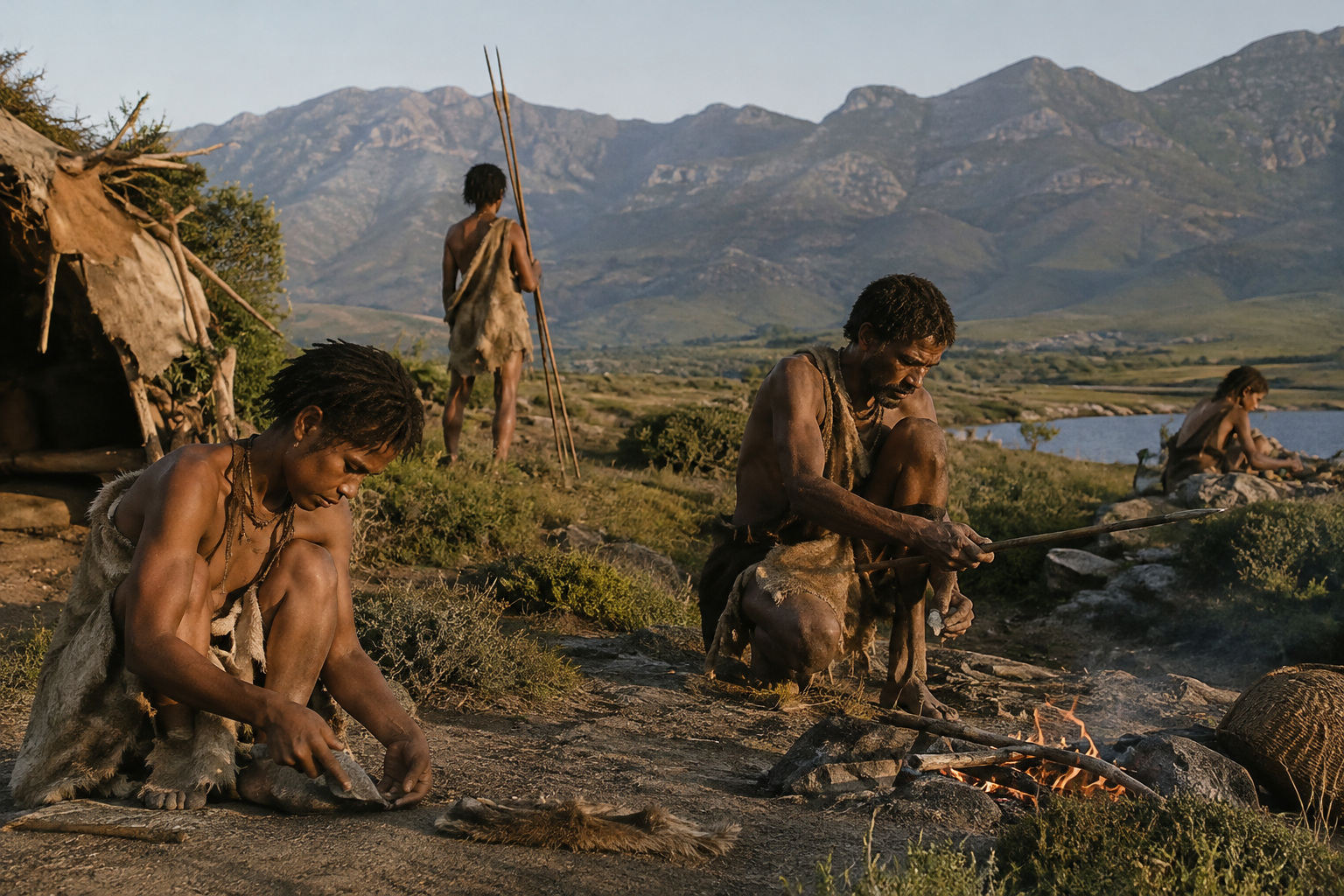
At Oakhurst in South Africa's Western Cape, one ancient male known as OAK003_C0103 offers a strikingly deep glimpse into paternal history. Dated here to around 4200 BC, he comes from a region famous in southern African archaeology for Later Stone Age burials and for preserving evidence of hunter-gatherer lives long before farming and herding reshaped much of the subcontinent. In this case, the genetic interest is especially sharp: the sample is associated with the Y-DNA haplogroup A1b1b2.
That matters because A1b1b2 belongs to one of the oldest surviving branches in the human Y-chromosome tree. Y-DNA traces a single direct paternal line, not the whole ancestry of a person or a population, but precisely for that reason it can preserve very ancient patterns. A lineage like A1b1b2 is not a badge of ethnicity or culture. It is, rather, a reminder that some paternal branches in Africa reach extraordinarily far back into human prehistory, and that archaeology and ancient DNA together can still catch them in specific people, at specific places, in specific times.
The Oakhurst area has long been important to archaeologists studying the Later Stone Age of southern Africa. The Western Cape preserves a rich record of foraging communities who lived in varied coastal and inland environments, adapting to changing climates, shorelines, and food sources over thousands of years. An ancient individual from this setting is therefore never just a genetic data point. He belongs to a landscape with a very long human history.
For OAK003_C0103, the supplied evidence is spare but significant: a male individual from ancient Oakhurst, around 4200 BC, associated with haplogroup A1b1b2. Even with limited burial detail, that is enough to place this lineage in a well-known hunter-gatherer setting in the southwestern corner of Africa during the mid-Holocene. That is a period before the later large-scale social changes linked to pastoralism and, much later, colonial expansion.
A recent ancient DNA study on southern African populations has helped frame this wider picture, showing how valuable such early individuals are for reconstructing regional population history without collapsing everything into a single story of replacement or migration. The broader research context can be found in this ancient DNA study, which is relevant to understanding how older southern African lineages are being documented and interpreted.
With very old African Y-chromosome branches, there is a temptation to make the story too grand too quickly. Better to be precise. A1b1b2 is the haplogroup identifier provided for this article, and it should be treated as such: a direct paternal classification attached to this ancient male line. It does not mean that everyone around Oakhurst carried the same Y-DNA, and it certainly does not turn one man into the representative of all ancient southern Africans.
Still, the branch matters. Haplogroup A lineages occupy a very deep position in the Y-chromosome phylogeny, and they are especially important for reconstructing early African population structure. When such a lineage appears in an ancient individual from the Western Cape, it strengthens the case that some paternal diversity now rare or regionally restricted was once part of a broader prehistoric landscape.
That is one of the most useful contributions of ancient DNA. Modern distributions can mislead us if we imagine that present-day frequency maps are timeless. Ancient individuals like OAK003_C0103 remind us that lineages move, shrink, persist, and sometimes survive only in scattered descendants.
There is no need here for castles, courts, or legendary founders. The importance of OAK003_C0103 lies in a different kind of history: one grounded in the archaeology of foraging communities in southern Africa. Mid-Holocene people in the Cape were living in societies whose histories are often harder to narrate than those of literate states, but no less complex. Their traces survive in burials, campsites, tools, food remains, and now increasingly in genomes.
That shift matters for public history. Much of popular genetic storytelling still leans too heavily on medieval surnames, royal pedigrees, or famous battles. A lineage such as A1b1b2 pushes the focus back much further, into a world where identity has to be reconstructed from archaeological context rather than from chronicles. In that sense, this is the opposite of a genealogical fantasy. It is a scientifically grounded glimpse of a paternal line in a prehistoric community.
African DNA population history
Readers sometimes assume that a single ancient Y-DNA result is too small to say anything useful. But archaeology often advances through exactly such pieces of evidence, provided they are handled carefully. One securely identified male lineage in a known time and place can anchor discussion of local continuity, diversity, and survival, especially when the lineage belongs to a very old branch.
That does not make OAK003_C0103 a founding ancestor, nor does it prove an unbroken local story from 4200 BC to the present. What it does do is demonstrate that A1b1b2 was part of the paternal landscape of ancient southwestern South Africa. In a region whose human history stretches back far beyond the date of this burial, that is an important fixed point.
It also helps correct a familiar distortion in public imagination. Deep human history is often told through Eurasian expansions, Bronze Age turnovers, or named historical peoples. Southern Africa, by contrast, is too often treated as background. Yet for the study of ancient human diversity, it is central ground. Old African lineages are not peripheral to the human story; they are at its heart.
Another reason this sample stands out is simply preservation. Recovering ancient DNA in Africa is often difficult because heat, moisture, and soil conditions can damage genetic material. Every successfully studied individual therefore carries extra value, especially when the result illuminates an early branch of the Y-chromosome tree.
That wider challenge has shaped archaeogenetics across the continent. As methods improve, more ancient African genomes are beginning to appear, and they are already changing older models that relied too heavily on modern DNA alone. For readers interested in how ancient DNA reshapes historical interpretation more generally, the methodological background is worth keeping in mind as much as the haplogroup label itself.
If your paternal line falls within A1b1b2, this ancient Oakhurst individual offers something rare: not a glamorous dynasty, but a documented prehistoric connection to one of the deepest branches of human paternal ancestry. The strongest responsible takeaway is not that you descend from this one man in any simple recent sense, but that your direct male line belongs to an ancient African heritage with roots that reach far into prehistory and that was present in the Western Cape thousands of years ago.
For MyTrueAncestry users, that is the real fascination of this haplogroup. A1b1b2 is a reminder that the oldest chapters of human paternal history are not abstract diagrams on a phylogenetic tree. Sometimes they appear in the grave of a real person, at a real archaeological site, with a sample ID we can name: OAK003_C0103.






Comments