Griffin Warrior
– 5 min read


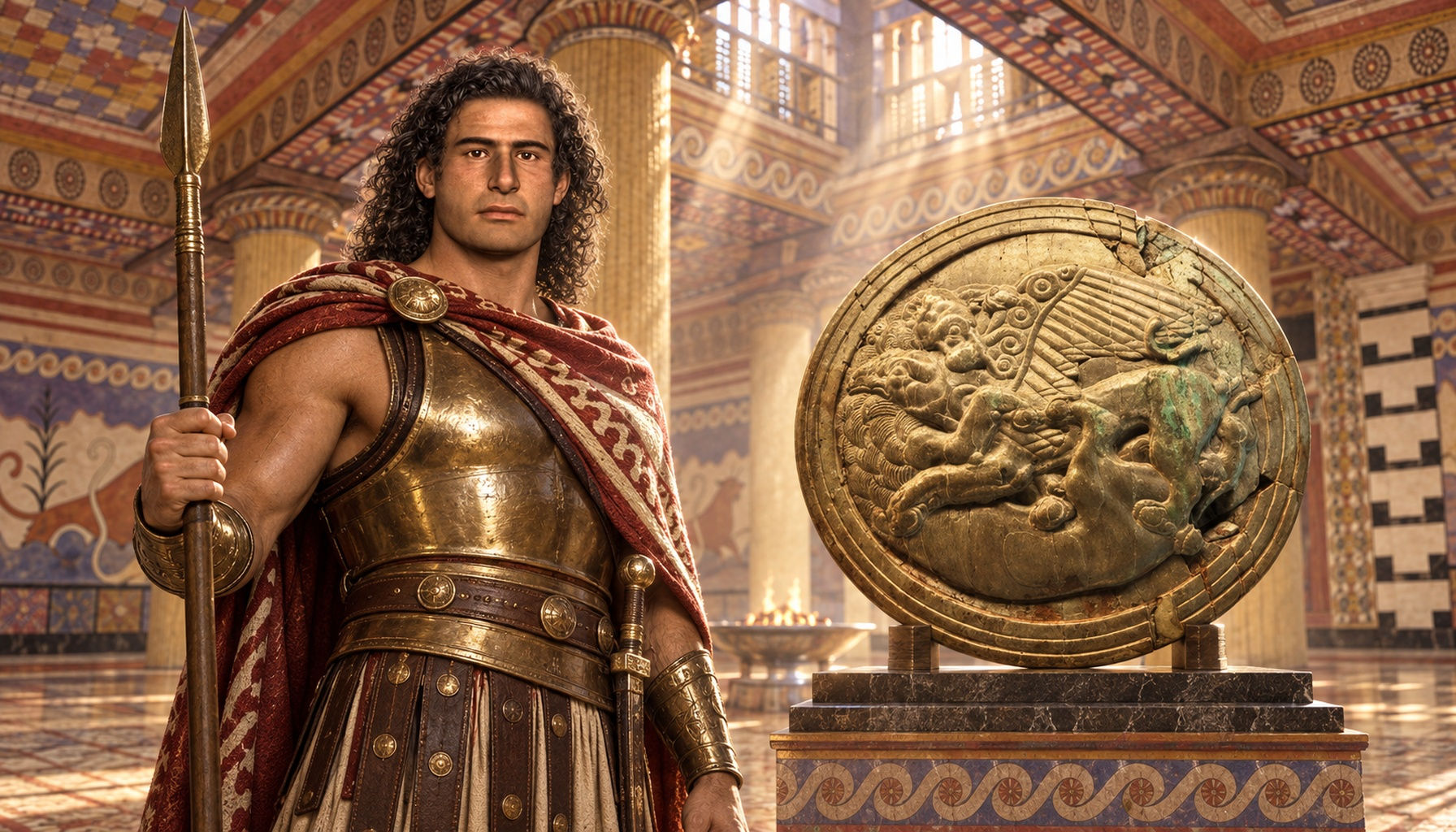
The man now known as the Griffin Warrior lived around 1440 BC in Messenia, in southwestern Greece, at the very moment when Mycenaean society was becoming something grander, richer, and more sharply hierarchical. He was buried near what would later become the Palace of Nestor at Pylos, and his grave is one of those rare archaeological discoveries that feels almost indecently informative: undisturbed, lavish, and full of clues about power, taste, warfare, and status at the dawn of the Mycenaean age.
He matters because he stands at a historical threshold. This was not yet the fully formed palace world of Linear B tablets and bureaucratic kingship, but the formative period out of which that world emerged. The Griffin Warrior’s burial shows an elite culture already in possession of splendid metalwork, imported or inspired luxury objects, and a visual language deeply entangled with Crete and the wider Aegean. In other words, this is early Mycenaean Greece before the curtain properly rises, and he is one of its best witnesses.
The Griffin Warrior was an adult male, about 30 to 35 years old at death, buried with extraordinary care and wealth. His nickname comes from an ivory plaque decorated with a griffin, one of thousands of objects placed in the shaft grave. These included weapons, armor, gold rings, precious vessels, sealstones, and the astonishing Pylos Combat Agate, a tiny carved masterpiece whose technical brilliance startled even seasoned archaeologists. It is a rather salutary reminder that Bronze Age craftsmanship could be far finer than our lazy modern assumptions allow.
Archaeologists interpret him as a member of the emerging ruling elite of early Pylos. That does not mean we can give him a personal name, a secure title, or a place in a neat royal family tree. We cannot. But the scale and character of the burial leave little doubt that he belonged to the uppermost stratum of society, part of the class that would eventually produce the palace-based order of Mycenaean Greece. He lived in a world shaped by competition, display, and connections across the Aegean, especially with Minoan Crete, whose artistic and symbolic influence is strongly visible in the grave goods.
Explore the Prehistoric Aegean
The biological sample associated with this individual is listed as Griffin Warrior Elite Palace of Nestor Pylos Ancient Greece, dated to about 1440 BC. In this case, the identification is strong at the archaeological level but not personal in the way it would be for a named king or saint. We are dealing with a securely excavated and highly distinctive burial, not a historically named individual known from written records. So the sample is securely linked to the man in the grave, but his ancient personal name remains unknown.
That distinction matters. Ancient DNA can test the ancestry of the man buried in this grave; it cannot magically tell us what his contemporaries called him. What makes the Griffin Warrior so valuable is the combination of context and preservation. Because the grave was undisturbed when discovered in 2015, researchers could study the skeleton and the objects together as a coherent funerary event. That gives unusual confidence when linking the DNA evidence to the archaeological story.
The broader significance of the burial lies in its timing. The grave belongs to the period when local elites in mainland Greece were building authority through martial display, exchange, and symbolic prestige. The finds suggest a man deeply embedded in that world, and the nearby development of the palatial center at Pylos makes the burial especially important for understanding how regional power crystallized in Mycenaean Messenia.
Ancient DNA adds a fascinating dimension to the Griffin Warrior, though it does not reduce him to a string of letters. His reported Y-DNA haplogroup is F. Y-DNA tracks the direct paternal line, from father to son to son, across many generations. Haplogroup F is a very broad and ancient paternal lineage high up in the human Y-chromosome tree, ancestral to many later branches found across Eurasia and beyond. In a case like this, the broad assignment is informative only in a limited sense; it marks his place on the paternal tree, but it does not by itself define his ethnicity, language, or social identity.
His mitochondrial DNA, or mtDNA, which tracks the direct maternal line from mother to child, is listed here as unknown. That means it was not determined, not reported in the supplied material, or not confidently assigned. It is better to say that plainly than to guess. Haplogroups are lineages, not labels for peoples, and unknown should remain unknown.
More revealing than the bare haplogroup label is the genome-wide picture discussed in research on Bronze Age Greece, including the study published in Science at https://www.science.org/doi/10.1126/science.abm4247. The important historical point is that the Griffin Warrior appears to have belonged largely to the local population of the region rather than representing some intrusive foreign conqueror. That is immensely useful, because lavish burials often tempt people into old-fashioned stories about outside warrior-princes arriving fully formed. The genetics push against that simple tale.
Within the very broad Y-DNA F umbrella, the Griffin Warrior sample I13519_d can be placed alongside many other ancient individuals assigned to F or broad F-linked branches from very different times and places, from Neolithic Anatolia samples such as cch076 and cch104, to Neolithic Georgia samples like ARO011, to later European cases such as MBG001 from Magdalenenberg and KNF005 from Roman-era England. The point is not that these people were close relatives in any historically meaningful sense; they were not. Rather, it shows how deep and widespread this paternal lineage framework is. For the Griffin Warrior, the useful conclusion is modest: his Y-line sits within an ancient, expansive Eurasian paternal tree, while his overall ancestry places him firmly in the local Aegean context of early Mycenaean Pylos.
As for mtDNA-linked comparison, the only supplied directly relevant sample is the Griffin Warrior himself, I13519_d, and the maternal haplogroup is not given here. So there is no sound basis for a broader maternal-line comparison in this article. That absence is itself a useful reminder of how uneven ancient genetic data can be: sometimes we have a dazzling tomb, a strong genome-wide ancestry signal, and yet a missing maternal lineage label.
Read about Ancient Greek DNA Links
The genetic evidence is historically interesting precisely because it is restrained. It does not reveal the Griffin Warrior’s name, office, or biography in miniature. It does not prove a dynasty. It does not tell us whether he won battles or merely dressed for them magnificently. What it does suggest is that one of the most spectacular early Mycenaean elite burials known so far belonged to a man who was largely local to the region in genetic terms. That helps us see the rise of Mycenaean power at Pylos not simply as the arrival of outsiders, but as a local society consolidating rank, wealth, and authority while drawing heavily on wider Aegean cultural connections.
Discover Greek Genetic History
At MyTrueAncestry, you can compare your DNA with ancient populations and archaeological samples from worlds like Bronze Age Greece and the wider Aegean. It is a way to explore deep genetic connections to past peoples and regions, while keeping clear the difference between broad ancestry signals and proven descent from any one famous individual.

Comments