Genomic Evidence for Changing Close‑Kin Marriage across the Roman Empire
– 9 min read


The article explores how Roman family life and marriage rules actually worked on the ground, not just in law books. Using ancient DNA from graves across Italy, the Balkans, and Anatolia, it follows real families from the Iron Age into the Early Middle Ages, and sets them against the backdrop of Roman law, imperial power, and stubbornly local customs.
At the heart of the Roman system stood a very particular kind of family. In central Italy, the household was formally ruled by the pater familias – the male head whose legal authority extended over children, slaves, and even adult sons. Within this framework, marriage was not simply about romance but about property, citizenship, and political strategy.
Roman law distinguished between a legally valid marriage (iustum matrimonium) and other unions. A lawful marriage, between people with the right to marry (conubium), produced legitimate heirs who could inherit land, names, and social standing. This became a powerful imperial tool after the decree known as the Constitutio Antoniniana (212 CE), which extended Roman citizenship to almost all free inhabitants of the empire. In theory, this spread Roman marriage law from Britain to Syria.
Yet the DNA evidence shows that, while the law stretched across provinces, people's intimate choices did not simply fall into line. Instead, families in different regions continued to arrange marriages in strikingly different ways.
Roman legal tradition pushed strongly toward exogamy – marrying outside the close family. The law counted degrees of blood relationship (gradus cognationum) and generally banned marriages up to the sixth degree. There were even cultural devices such as the ius osculi ("right of the kiss"), a social rule that allowed men to kiss certain female relatives and in doing so to "check" that boundaries of kinship were not being crossed.
The article shows that this exogamic ideal genuinely reshaped marriage patterns around the imperial core in Italy. Genomic data from the Italian peninsula reveal a strong move away from marriage between close relatives during the Roman Imperial period (1–200 CE). In DNA terms, people in central Italy began to pair up with partners who were far less related to them than in the preceding Iron Age.
The story is very different in the east. In Greek-speaking regions and Anatolia, endogamous traditions – marrying relatives to keep land and wealth within the family – were deep-rooted. In parts of Lycia, Caria, and Cilicia, inscriptions proudly preserve lineages full of first cousins and uncle–niece unions. The article tests whether this is just the noisy boasting of local elites on stone, or a broader social pattern embedded in village life.
The DNA is unequivocal: in Anatolia and the Balkans, high levels of close-kin marriage persist straight through the Roman Imperial period. Unlike Italy, these regions show no sustained break with older patterns. Local families continued to use marriage as a way of keeping property and alliances within a tight circle of kin.
The article contrasts the Roman household in Italy with other family models across the empire. In the Greek East, the household known as the oikos often followed its own inheritance logic, with sisters, cousins, and uncles playing roles that did not map neatly onto Roman expectations. In Gaul and Spain, mixed systems flourished, blending Roman rules with older customs.
This uneven landscape matters. Roman law might say that certain cousins could not marry, but a local Lycian family with a carefully guarded ancestral estate might see things quite differently. The genomic data shows that in the east, those older priorities often won.
Much of the article's power lies in its use of specific burial sites as windows into family strategy. Rather than simply listing legal rules, it follows the bones.
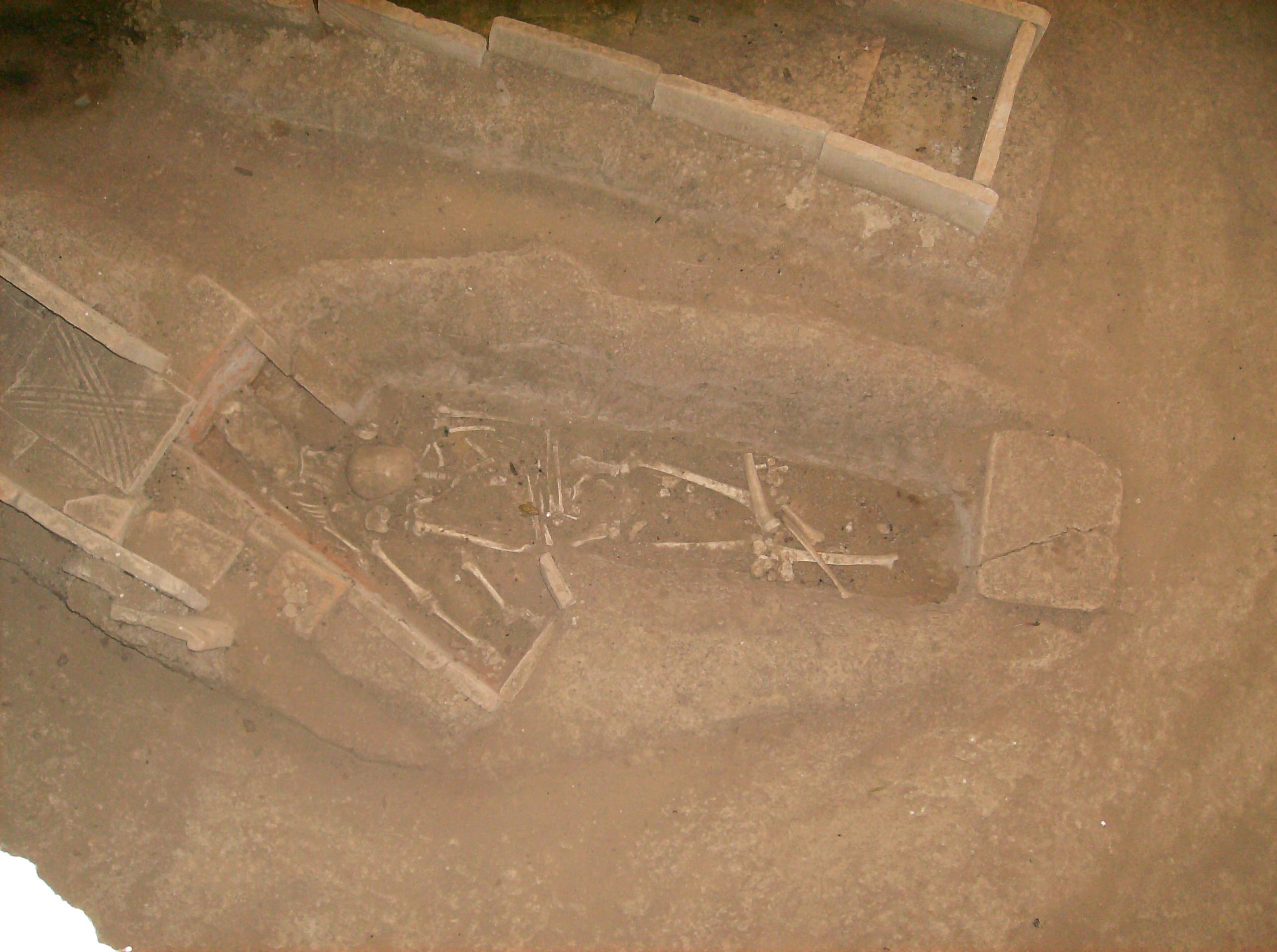
One of the most revealing sites is the Roman-era cemetery at Nevalı Çori in the Taurus foothills, above a side valley of the Euphrates. Here, in what seems to have been the burial ground of a small rural estate (villa rustica), lies an adult woman identified as NEV020.AG.
Her grave, a fragmented stone cist (Burial 33), cuts down through older Early Bronze Age layers. Radiocarbon dates place her between 81 and 227 CE, squarely within the high Roman Imperial period. Yet her DNA tells a story that would have made a Roman jurist blanche: she is the child of a very close-kin union, on the border between first- and second-degree relatives.
The article argues that this woman stands for more than just an odd family choice. She is the individual whose extreme genetic signal slightly distorts the statistics for Imperial Anatolia. Remove her, and the region looks almost unchanged over a thousand years; keep her, and she underlines the persistence of tight, rural endogamous networks in the shadow of Roman rule.
Perhaps the most dramatic find in the article is not a grand tomb but a modest infant jar burial from Late Antique Nicaea and a grave from a crowded frontier necropolis at Viminacium. Both individuals are the offspring of full-sibling incest – the very thing Roman society officially defined as beyond the pale.
At Yenişehir Kapı in Nicaea (modern İznik), excavators uncovered a trench used exclusively for infant burials. Among them, in Grave M3, lay a small "torpedo" jar orientated west–east, following late Roman and early Byzantine custom. Inside were the remains of two male infants.
Ancient DNA reveals that one of them, I14844, had parents who were full siblings. His genome is almost saturated with long stretches of identical DNA – the surest possible sign of incest between first-degree relatives. His jar-mate, I14843, however, is genetically unrelated to him; two strangers in life, sharing the same cramped ceramic coffin in death.
The article connects this context with the emergence of Christian charitable institutions, such as brephotrophia (asylums for infants) and orphanotrophia (institutions for older children). Nicaea, the site of the famous church council in 325 CE, later saw bishops and monasteries taking on formal responsibility for abandoned children – including those born from unions that could not be acknowledged openly.
I14844, then, is not just a rare biological anomaly. He is a likely foundling: the hidden child of a forbidden relationship, turned over to institutional care and finally laid to rest with Christian rites, among a community of unrelated infants whose lives had also slipped between the cracks of family and law.
On the Danube frontier, at the Roman city of Viminacium in Moesia Superior, lies another child of full siblings – this time an adult man known as R6750. His grave, G-360 in the Pirivoj necropolis, tells a very different story.
Genetically, he stands apart from the local Balkan population. In ancestry terms, he clusters with eastern Mediterranean groups, suggesting origins in Anatolia or the Levant. In life, he was a newcomer; in biological terms, he carried the mark of the most extreme form of incest.
His burial is simple – a pit grave, the body lying on its back. Yet two details leap out. Iron shoenails show that he was interred wearing footwear, and a bronze coin of Hadrian, minted between 118 and 122 CE, was carefully placed in his mouth. This is the classic "Charon's obol," a coin offered for the ferryman of the underworld, deeply rooted in Greco-Roman funerary custom, and in this case firmly dating the burial to the second century CE.
The body's posture is more ambiguous: the right lower leg was crossed over the left. In the absence of a coffin, excavators suggest this might reflect bindings placed on the legs at the time of burial. Some parts of the skeleton are missing, but in so crowded a necropolis this is best explained as later disturbance rather than deliberate mutilation.
The article situates R6750 among the "deviant burials" that Roman archaeologists find across the empire – burials where something about the position or treatment of the body falls outside the norm. Yet he is not an outcast thrown into a ditch. He has footwear, he receives the coin for the afterlife. If his life and origin marked him as "other," his death rituals still admit him to the community of the dead.
The study follows consanguinity – marriages between close relatives – across more than two thousand years, comparing three very different corners of the classical world: the Italian peninsula, Anatolia, and the Balkans. By reading long stretches of identical DNA in ancient skeletons, it traces how tightly or loosely communities married within their own kin, and how this changed under Roman rule.
In Italy, the story begins with Iron Age communities that later fed into the Roman state. Here, the genetic evidence shows fairly high levels of consanguinity: long stretches of identical DNA suggest that people often married within a narrow circle of kin. One key figure is R1015 from the Grotta Gramiccia necropolis at Veio, an early Etruscan centre just north of Rome. Dated to the 9th century BCE, this individual shows the clear signal of a second-degree close-kin union.
As the narrative moves forward into the Classical, Hellenistic and then Roman Imperial periods (600 BCE–200 CE), Italy undergoes a striking shift. Across cemeteries on the peninsula, the total amount of homozygous DNA drops. The genomes of Imperial Romans show much lower levels of consanguinity than their Iron Age predecessors.
This change fits the legal and social ideals of Rome itself. Roman law promoted marriage outside the close family, and the extension of citizenship and Roman marital rules under the emperors seems to have pushed Italians towards a more outward-looking marriage network. In the DNA, this "opening out" appears precisely in the period when Italy is politically and economically at the centre of the Mediterranean.
In Late Antiquity (200–600 CE), as the Western Empire fractures, Italy's genetic profile swings back toward its older pattern. The article shows that consanguinity levels in Late Antique Italy rise again to values indistinguishable from the Iron Age baseline. This rebound suggests that as imperial structures weaken, communities fall back on tighter kin-based networks.
In Anatolia, the pattern could hardly be more different. From the Iron Age down through the Roman Imperial and Late Antique periods, the amount of consanguinity detected in the genomes remains remarkably stable. Where Italy shows a dramatic dip in close-kin marriage under the Empire, Anatolia simply does not.
The most vivid illustrations come from small rural sites rather than great cities. At Kuriki Höyük, a small settlement at the confluence of the Batman and Tigris rivers, the article highlights I14635, a young adult woman buried in a stone cist grave sometime between the Iron Age and the Hellenistic period. Her DNA shows a second-degree parental relationship, so her parents were closely related. Yet nothing in her grave suggests she was treated as an outsider or anomaly.
At Değirmendere near Stratonikeia, the archaeology points to an agricultural production zone, with evidence for olive-oil workshops. Here, I20224, a juvenile male buried in the Archaic period (750–480 BCE), is again the child of a second-degree union. Even more tantalisingly, another skeleton in the same grave, I20225, turns out to be his biological father. The grave is thus a tiny family plot: father and son interred together, with the son also bearing the genetic legacy of a close-kin marriage.
The Balkans, stretching from the Danube frontier southwards, act in this article as a bridge between the Italian core and the Anatolian east. At the macro level, the region shows a remarkable stability in consanguinity over time. Unlike Italy, it does not exhibit a clear dip in close-kin marriage during the Roman Imperial period. Unlike Anatolia, it does not obviously stand out as highly endogamous either.
Yet within this apparent stability, individual lives leap from the ground with startling clarity, especially at the great frontier city of Viminacium. Here, R6750 stands as a man whose very DNA proclaims a taboo union, whose ancestry ties him to eastward lands, and whose burial posture hints at ritual control or anxiety. But he also receives the classic tokens of Roman funerary care.
Over centuries, the article shows a rhythm in family strategies. In Italy, the coming of empire and the expansion of citizenship drive marriage outward: fewer cousins, more distant partners, regularising the ideal of the legally neat Roman family. In Anatolia and the Balkans, by contrast, nothing so dramatic happens. There, the deep habit of marrying within the lineage survives Roman conquest, administrative reform, and the arrival of Christianity.
Then, as the Western Empire fragments in Late Antiquity, the pattern shifts again. Around the former imperial core, genomic signs of close kin marriage rise back to levels similar to those of the Iron Age. As towns shrink and economies localise, exogamic ideals are harder to maintain. People once more look close to home, and close to kin, for their marriage partners – just as their eastern neighbours had continued to do all along.
Throughout, the article keeps returning to graves, grave goods, and specific individuals. A terracotta jar at Nicaea, a cist grave over Bronze Age pottery at Nevalı Çori, a coin in a mouth at Viminacium, olive oil workshops at Değirmendere, grain silos at Kuriki Höyük: these are not just picturesque details. They are the material traces of how Roman law, local tradition, Christian charity, and everyday necessity came together to shape real families, one marriage – and one burial – at a time.
Original source article: https://www.researchsquare.com/article/rs-9509678/v1

Comments