Clan Ui Eidersceoil

– 2 min read


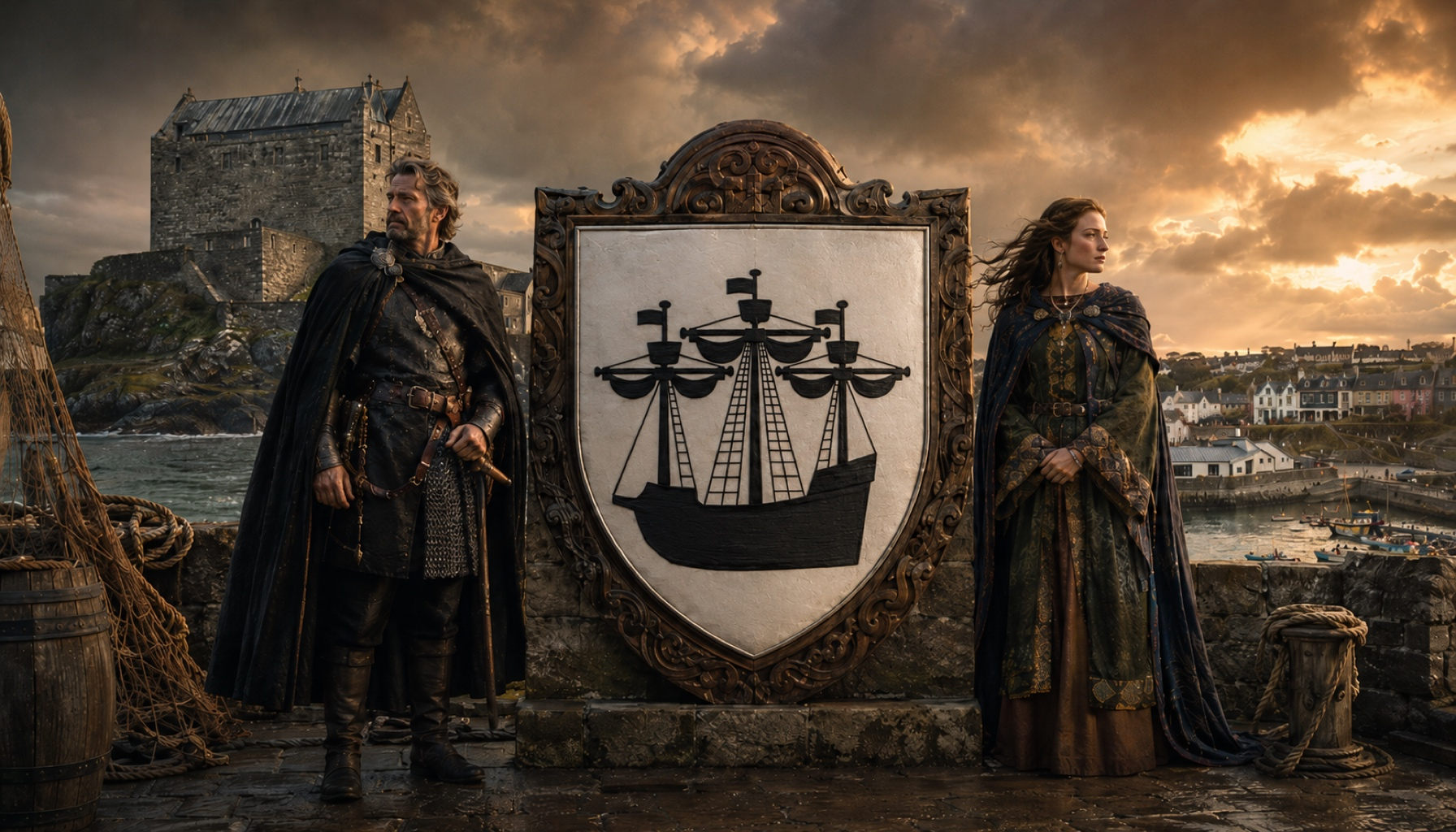
Clann Ui Eidersceoil was a Gaelic Irish family of south-west Ireland, remembered as part of that strongly local, sea-facing world where kinship, territory, and political authority were bound tightly together. Their identity belongs to the old Gaelic pattern in which a family was not simply a surname, but a lineage rooted in place, story, and inherited standing. In their case, that meant a coastal lordship shaped by boats, inlets, island routes, and the practical realities of rule along the Atlantic edge. The haplogroup most closely linked here is I2a1a2a1b1c1a, a lineage that adds a deep-time genetic dimension to a family memory already rich in regional character.
The Ui Eidersceoil tradition reflects a maritime kind of Irish lordship: local power exercised not only across land, but through access to harbours, coastal passages, fishing grounds, trade contacts, and defended shores. Like many Gaelic lineages, they preserved themselves through genealogy, oral remembrance, alliance, and attachment to ancestral territory. The family is also remembered through named figures such as Lughaidh Laidhe, whose presence in the historical tradition helps anchor the clan in the lived political culture of Gaelic Ireland, where reputation, descent, and local authority mattered enormously.
The family belongs to the south-western coastal zone of Ireland, in a landscape where peninsulas, coves, tidal waters, and sheltered anchorages shaped everyday life and power alike. This was not a marginal fringe, but a connected maritime region, tied into travel, exchange, raiding, fisheries, and communication by sea as much as by road. In historical context, that matters a great deal: a coastal Gaelic family could command movement, monitor approaches, build alliances across neighbouring territories, and participate in the wider seaborne networks that linked Irish lordships to one another and beyond. The ancestral setting associated with Clann Ui Eidersceoil is therefore best understood as both territorial and maritime, with identity fastened to a real coastline and the memory of local rule. In that sense, the landscape still speaks. Much of this south-west Irish coastal world can still be visited today, and for anyone interested in family history it remains one of the best ways to grasp how geography helped shape the endurance of Gaelic family memory.
The haplogroup tag associated here, I2a1a2a1b1c1a, also opens a window onto much older population history. It should not be read as proof of direct descent from any one ancient individual, but there are related or linked ancient DNA samples that help place the lineage in a broader prehistoric frame. Among them are Ancient Spain Els Trocs I0412, Neolithic Germany Esperstedt I0172, Ancient Gotlander Battleaxe Ajvide52X, Distillery Cave Oban Argyll and Bute Scotland I3133, Neolithic County Clare Ireland PB443, Neolithic Ireland CH448, and Ardcrony Tipperary Neolithic Ireland ARD2. Taken together, these samples show that lineages related to this branch appear across a wide map of prehistoric Europe and the Atlantic zone, including Ireland and western Britain. That does not turn a medieval Gaelic clan into a simple survival of the Neolithic, but it does remind us that family history and deep ancestry often overlap in fascinating ways.
If you are researching Ui Eidersceoil, south-west Irish roots, or the deeper story behind haplogroup I2a1a2a1b1c1a, consider uploading your DNA to MyTrueAncestry. It is a good way to place family tradition alongside ancient DNA matches and explore how your own story may connect with the long human past.
Comments