Clan Pringle
– 3 min read


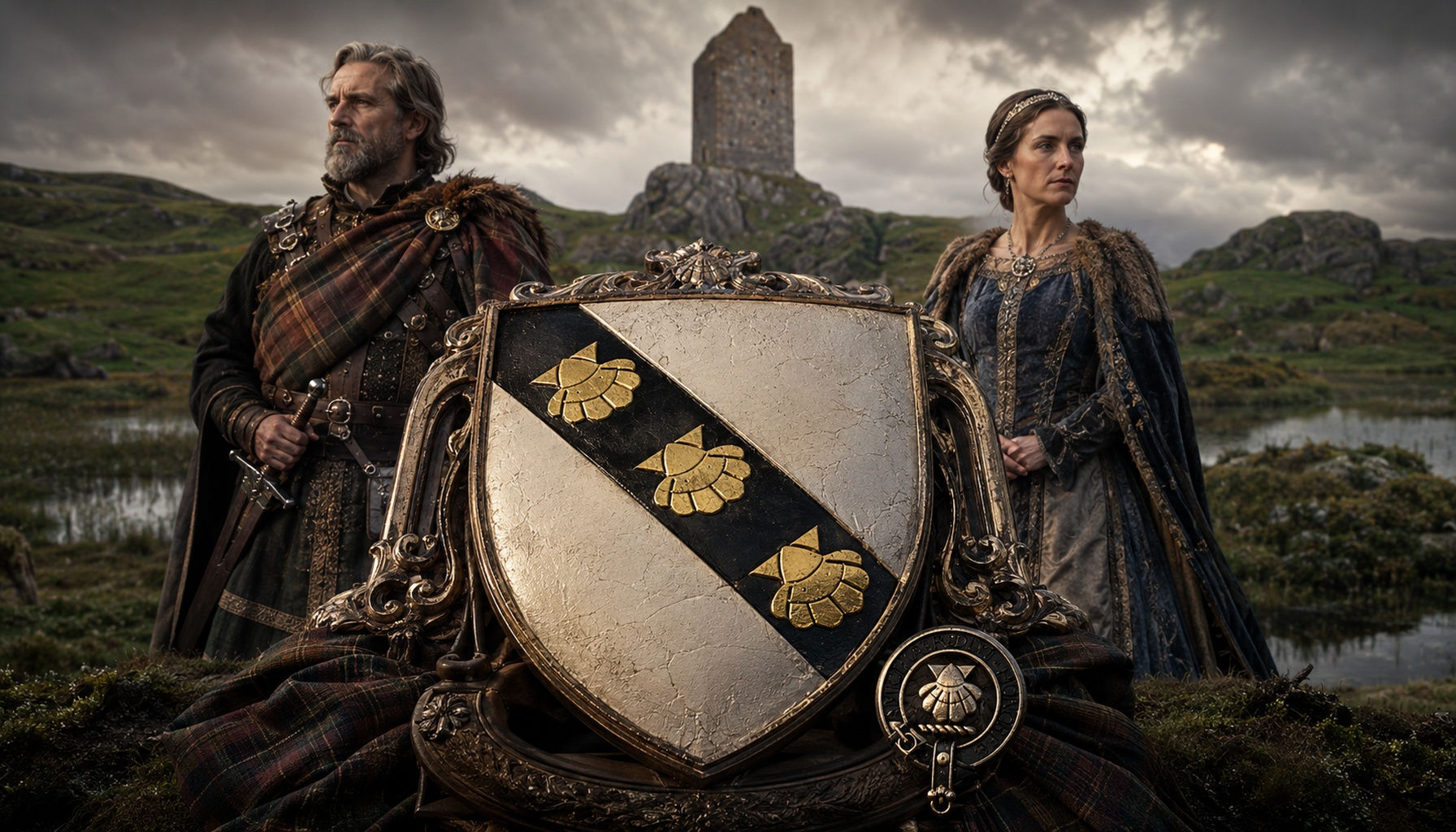
Clan Pringle was a Scottish Border family of the Tweed valley, rooted in the Lowland society of southern Scotland and remembered through landholding, local service, heraldry, and a remarkably durable surname tradition. Their primary DNA tag here is R1b1a1b1a1a1c2f, a haplogroup linked to a wide spread of ancient and early medieval samples across northern and western Europe. In historical terms, the Pringles are not a classic Highland clan built around a vast mountain territory and chiefly power, but a Border kindred: a family shaped by estates, feudal relationships, regional loyalties, and the hard practical business of survival in a frontier zone.
The family background is very much of the eastern Borders, where Scotland and England met in a landscape of farms, peel towers, legal disputes, raiding, diplomacy, and constant adaptation. The Pringles are associated above all with the district around Smailholm and the wider Tweed basin, and their development reflects the pattern of many Border surnames: first a local territorial identity, then consolidation through service and marriage, then continuity through heraldic memory and estate succession. Figures such as David Pringle, recorded in 1513, sit within that world of landed local society, where a family name could carry authority not because it ruled a Highland-style clan territory, but because it endured, negotiated, and remained anchored to place.
The great location anchor for Clan Pringle is Smailholm Tower, one of the best-known tower houses in the Scottish Borders. Standing near Kelso and looking out over the surrounding countryside, it is a classic Border stronghold: compact, defensive, and deeply tied to the unsettled history of the Anglo-Scottish frontier. The tower dates in its core to the 15th century and was held by the Pringles for generations, becoming one of the clearest architectural expressions of their local standing. It was not a grand palace, but that is exactly the point. In the Borders, power often looked like thick walls, a commanding view, and the ability to hold on. Smailholm Tower later became famous too through its association with Sir Walter Scott, who knew it in childhood. Crucially for visitors today, it has survived and is generally presented as a historic site open to the public, so it can still be visited as a very tangible link to the Pringle story.
On the DNA side, the Pringle haplogroup tag R1b1a1b1a1a1c2f connects them not to one single ancient people, but to a broad and fascinating network of related ancient samples from across Europe. Linked examples include Lombard-era and Lombard warrior elite individuals from Collegno in northern Italy such as COL_069, COL_069b, and COL_069x; Bronze Age central European material like LEU007 from Unetice Thuringia in Germany; Roman and post-Roman cases such as I15527 from Viminacium in Serbia and R11121 from Isola Sacra; Viking Age and Scandinavian-linked samples including urm160, urm160x, and CGG106724; Anglo-Saxon and migration-period individuals from England and northern Germany such as I11583, I11584, I20644, I20671, I20677, I20652, BUK012, BUK060, BUK064, BUK070, BUK007, OAI006, OAI013, DUN006, DUN009, DUN011, HID003, HID004, BRC006x, and RTW012; and a further spread of related lineages in Belgium, France, Austria, the Netherlands, Croatia, Hungary, Bavaria, and beyond, including ST0024, ST0323, ST0786, ST2969, CGG022456, CGG022425, CGG022419, CGG101214, RISE98, I12902, I11972, HVN003, HVN004, HVN005, SWG001, STR393b, STR316b, ELW003, TAQ013, HUNper2, K3per1_GE, K3per13_GE, AED92b, S3044, and Petersberg. None of this proves direct descent from any named ancient individual, and it should not be presented that way. What it does show is that the Pringle paternal line belongs within a deep and mobile European story, one that touches Bronze Age, Iron Age, Roman, Germanic, Anglo-Saxon, Viking, and medieval populations relevant to the long formation of Border Britain.
If you carry the Pringle surname, have Border roots, or simply want to see how your DNA may connect to the deeper history of Britain and Europe, upload your results to MyTrueAncestry and explore the ancient matches for yourself.
Comments