Clan Napier

– 3 min read


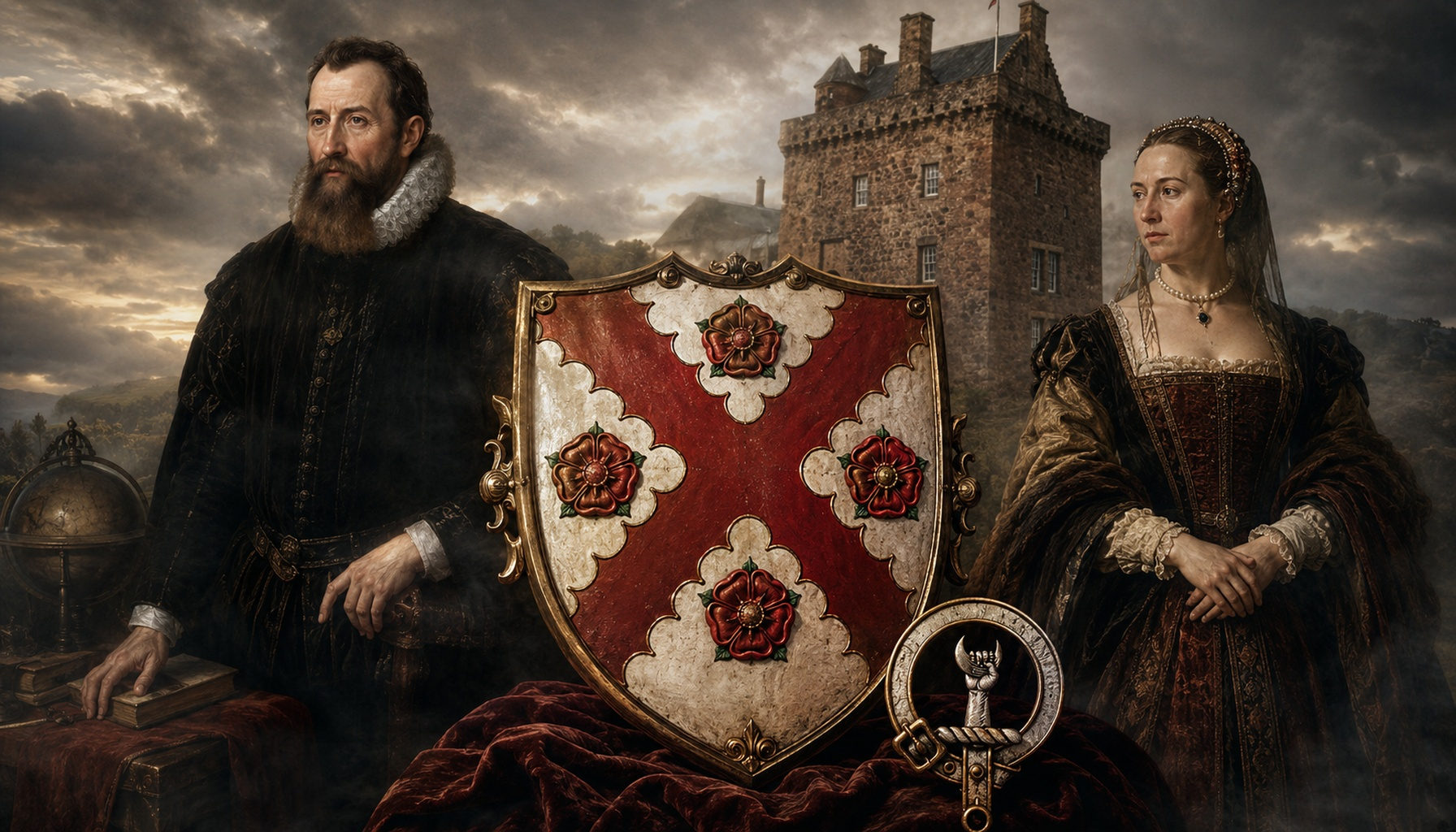
Clan Napier was one of those distinctly Scottish families in which land, learning, and public duty sat comfortably together. Associated above all with the Lennox and with Merchiston near Edinburgh, the Napiers belong to the Lowland world of charters, offices, heraldry, and estate identity rather than the more romanticised image of the Highland war clan. Their heritage is rooted in Scotland's learned and landed tradition: a family of proprietors, officials, soldiers, and scholars whose name became especially famous through John Napier of Merchiston, the brilliant mathematician who introduced logarithms. In genetic tagging terms, the primary family haplogroup linked here is R1b1a1b1a1a2c1a1e1, a branch within the wider R1b line so common across western Europe.
The Napier story makes best sense in its historical setting. This was a family shaped by medieval and early modern Scotland, where influence rested not only on fighting power but on literacy, legal skill, royal favour, and careful management of estates. Like many Lowland families, the Napiers built status through service in Scottish civic life, public office, military roles, and armorial identity. Their association with Merchiston gave them a durable territorial anchor, while their reputation for scholarship gave them something rarer: a legacy that travelled far beyond Scotland. Among the notable figures in the line is Sir Archibald Napier of Merchiston, remembered in the seventeenth-century family story and linked with the standing of the house in 1625, at a time when lineage, estate, and service still formed the grammar of noble identity in Scotland.
The great location anchor for Napier heritage is Merchiston Tower, the family seat in what is now Edinburgh. Originally a fortified tower house, it stands as a reminder that Lowland prestige was not airy or abstract but built in stone, with architecture doing the work of status, security, and continuity. Merchiston Tower is closely associated with John Napier of Merchiston and with the family's long presence in the district. Over time the old estate landscape around it changed dramatically as Edinburgh expanded, but the tower itself survived and remains one of the most tangible pieces of Napier history. It forms part of the campus of Edinburgh Napier University, which is rather fitting for a family remembered so strongly for intellectual achievement. Yes, it can still be visited in the sense that the building survives on a university site and is known as a historic landmark, though practical public access may vary depending on campus arrangements and events.
The haplogroup tag linked here, R1b1a1b1a1a2c1a1e1, places Napier heritage within a much wider network of related paternal lines found across Britain and Europe over a very long span of time. These ancient DNA samples are not presented as direct ancestors of the Napier family, but as related or linked examples that help sketch the deeper population background of the line. Among them are Roman Era England Knobbs Farm Somersham (KNF006); a notable cluster from Celtic Durotriges contexts at Duropolis, Winterborne Kingston in England including WBK12, WBK20, WBK29, WBK41, WBK05, WBK30, WBK43, WBK06, WBK08, WBK18, and WBK191; Imperial Roman Era Zadar Croatia (I26776); Bronze Age Orkney, Westray, Links of Noltland (KD061); Bronze Age Calabria, Cosenza, Grotta della Monaca, Sant Agata di Esaro (GMO015); Early Medieval Belgium Sint-Truiden Groenmarkt (ST2025); Medieval Belgium outsider Sint-Truiden Onze-Lieve-Vrouwekerk (ST1308); Gallic France Maisey-le-Duc (CGG023647) and Parancot (CGG023699); Post Roman Worth Matravers, Dorset (I11580); Merovingian Alt-Inden, North Rhine-Westphalia (IND013); Late Roman Klosterneuburg, Lower Austria (R10656); Late Roman Conimbriga, Portugal (R10488); Celtic Briton Yarnton, Oxfordshire (I21182); Iron Age Worlebury, Somerset (I11991); Iron Age Battlesbury Bowl, England (I21309); Bronze Age Trumpington Meadows, Cambridge (I3256); Bronze Age Amesbury Down, Wiltshire (I2417); Bell Beaker Upavon, Wiltshire (I4950); Bell Beaker Canada Farm, Dorset (I5379); Bronze Age Bedfordshire (I7576, I7577); Bronze Age Boatbridge Quarry, South Lanarkshire, Scotland (I5473); Celt Hinxton Iron Age (HI2); Early Bronze Age England Thames (I5377); Ireland Copper Age Rathlin2B; and even Norwegian Viking Age Iceland (STT-A2). Taken together, they evoke the long, braided history behind later Scottish families like the Napiers: ancient western European roots, movement across provinces and kingdoms, and the eventual emergence of named houses in medieval Scotland.
If you carry Napier ancestry, or simply want to see how your own DNA connects to the deeper story of Scotland and the wider ancient world, upload your DNA to MyTrueAncestry and explore the links for yourself.

Comments