Clan McNamara
– 3 min read


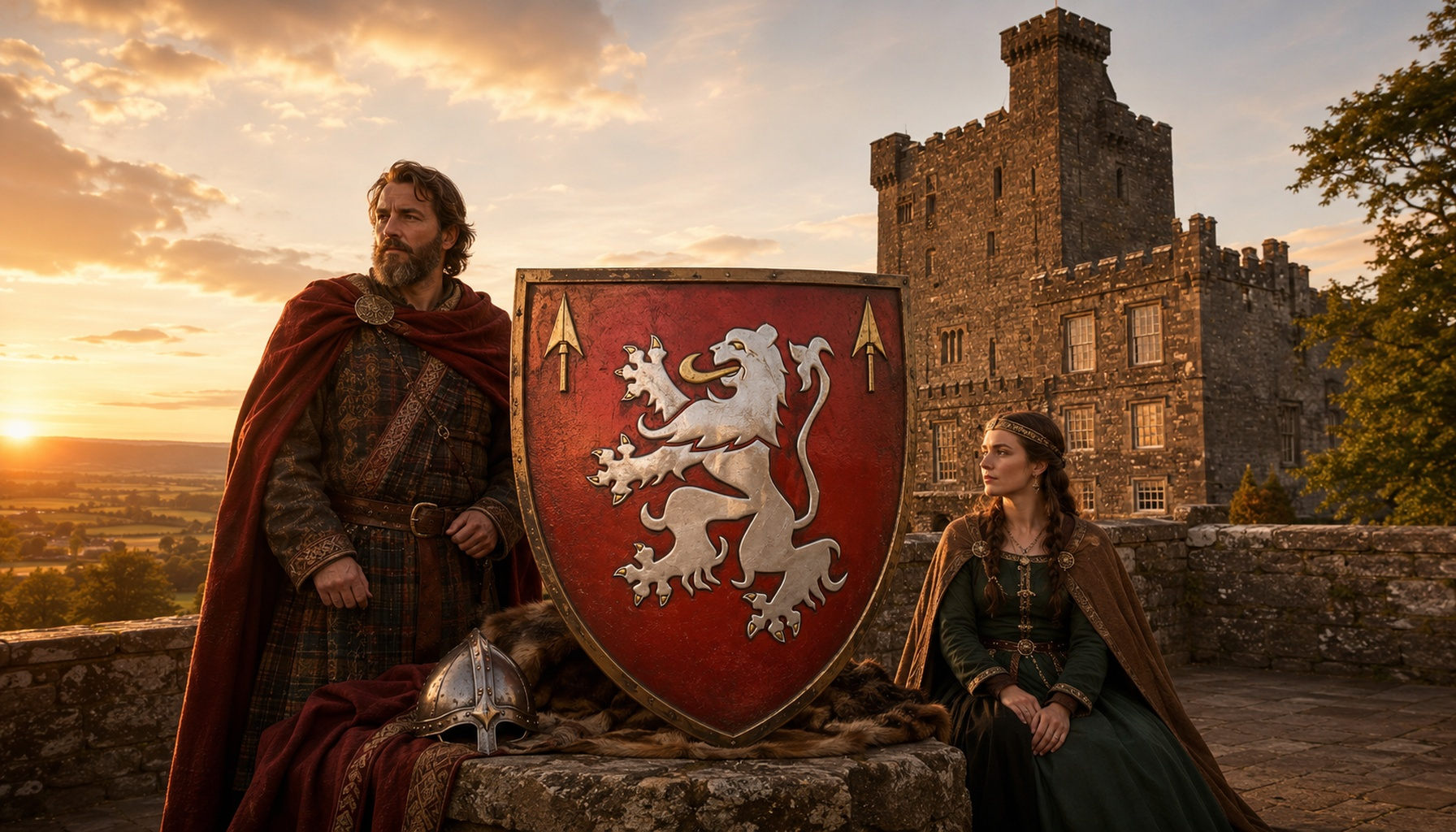
Clan McNamara was one of the notable Gaelic Irish families of Thomond, rooted above all in what is now County Clare, in the old Dalcassian world of western Ireland. Their name belongs to that landscape of ringforts, churches, tower houses, cattle wealth, lordship, and shifting alliances that made medieval Gaelic Ireland so politically alive. In historical terms, the McNamaras were not simply a surname group, but a noble kin-network: chiefs, military supporters, landholders, castle builders, and regional power-brokers tied to the fortunes of Thomond. The primary family haplogroup linked with the clan in this context is R1b1a1b1a1a2c1a4b2a1, placing them within a wider Atlantic-facing paternal lineage seen across parts of Ireland and Britain.
The family background is richer than any short label can capture. The McNamaras emerged in a society where ancestry mattered, but so did practical power: who held the land, who commanded fighting men, who maintained alliances, and who could endure when kingdoms fractured and new pressures arrived from outside. Their history is tied to hereditary lordship in Clare, to fortified residences, to bardic remembrance, and to adaptation across centuries of conquest and social change. One early named figure is Chieftain Cumara, recorded in 1099, a reminder that the family was already established in the political fabric of the region by the high medieval period. The McNamaras stand as a classic example of the Gaelic noble-clan pattern: descent, martial authority, territorial identity, and long memory rooted in the ground of Thomond itself.
A key location anchor for the family is Knappogue Castle, near Quin in County Clare, a site deeply evocative of McNamara history. The present castle is a 15th-century tower house, traditionally associated with the Mac Con Mara, or McNamara, lords. Its name comes from the Irish Cnoc Abu, often understood as the hill of the kiss, and it occupies exactly the sort of commanding local position one would expect from a Gaelic lordly seat: visible, defensible, and woven into the territorial life of the district. Like many Irish tower houses, it was both residence and statement, a stone expression of family authority in a landscape where kinship and control of land were inseparable. In later centuries the building passed through upheaval, decline, and restoration, but that is part of the story too, because the survival of such places lets us see how Gaelic lordship was transformed rather than simply erased. Knappogue Castle has been restored in modern times and is well known as a heritage site, and yes, it can still be visited, making it one of the most tangible places where people interested in McNamara history can stand inside the architecture of that older Thomond world.
From a DNA point of view, the McNamara-associated haplogroup R1b1a1b1a1a2c1a4b2a1 can be set within a broader network of ancient and historic samples that are related or linked to the same wider paternal branch, without claiming direct descent from any one burial. Among these are Celtic Durotriges individuals from Duropolis, Winterborne Kingston in England, including WBK12, WBK20, WBK29, WBK41, WBK05, WBK30, WBK43, WBK06, WBK08, WBK18 and WBK191, as well as later and geographically wider examples such as ATP_PSN_192 from medieval Cambridge, I26776 from imperial Roman era Zadar in Croatia, KD061 from Bronze Age Orkney, GMO015 from Bronze Age Calabria, ST2025 and ST1308 from medieval Belgium, CGG023699 from Gallic France, I11580 from post-Roman Dorset, IND013 from Merovingian Germany, R10656 from late Roman Austria, R10488 from late Roman Conimbriga in Portugal, I11991 from Iron Age Somerset, I21309 from Iron Age Battlesbury Bowl, I3256 from Bronze Age Trumpington Meadows, I2417 from Bronze Age Amesbury Down, I4950 from Bell Beaker Upavon, I7576 and I7577 from Bronze Age Bedfordshire, I5473 from South Lanarkshire, HI2 from Iron Age Hinxton, I5377 from Early Bronze Age England Thames, and Rathlin2B from Copper Age Ireland. What this shows is not a neat single-family trail, but a deep western European story: lineages moving through Bell Beaker, Bronze Age, Iron Age, Roman, and medieval populations, eventually forming part of the genetic backdrop from which later Irish dynastic families such as the McNamaras emerged.
If you are curious whether your own family story connects with the world of Thomond, Gaelic Ireland, or haplogroup R1b1a1b1a1a2c1a4b2a1, upload your DNA to MyTrueAncestry and explore the ancient connections behind your surname history.
Comments