Clan Mar

– 3 min read


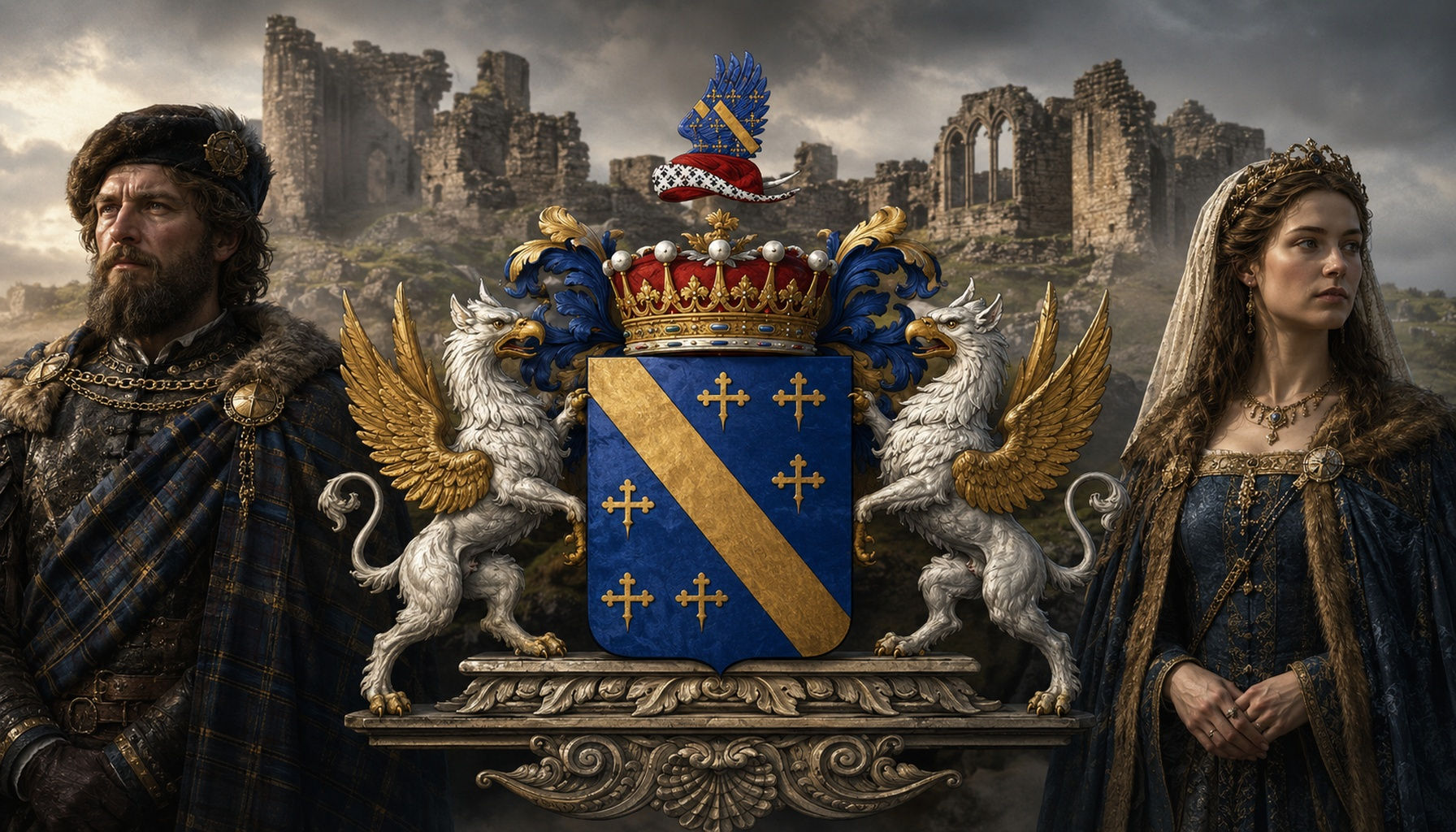
Clan Mar was one of the great noble families of medieval Scotland, rooted in the ancient earldom of Mar in the northeast of the country, in what is now Aberdeenshire. Their story is not that of a later Highland clan gathered around a single chief so much as that of an old territorial aristocracy: regional rulers, royal allies, political players, and sometimes dangerous rivals. The identity of Mar was bound up with land, title, lordship, and memory, and in that sense the family stands as a classic example of the old Scottish high-noble pattern. The haplogroup linked here with Clan Mar is R1b1a1b1a1a2c1a5c3b1a3a, a line that fits into the wider tapestry of northern and western European paternal ancestry.
The earldom itself reaches back deep into the early medieval kingdom of the Scots, when regions such as Mar were governed by powerful local rulers before being drawn more tightly into the framework of the Scottish crown. One early named figure is Donald, Mormaer of Mar, recorded in 1014, a reminder that this was already an established lordship in the age before Scotland looked anything like the later centralized kingdom. Over the centuries the earls of Mar were woven into the great business of Scottish history: royal service, succession struggles, noble faction, dynastic marriage, and the management of a strategically important region. Their heritage survives not only in pedigrees and titles, but in castles, heraldry, and the long afterlife of aristocratic memory that clings to ancient families.
The great location anchor for Mar heritage is Kildrummy Castle, one of the most impressive noble fortresses in Scotland and long associated with the earls of Mar. Set in Aberdeenshire, it was built in the 13th century, probably under Gilbert de Moravia, bishop of Moray, and became a major stronghold of the earldom. Its design is striking: a large shield-wall castle with a powerful gatehouse and massive round towers, showing the kind of architectural ambition that belonged to a family of very high rank. Kildrummy was not merely a residence but a statement in stone, expressing lordship over the surrounding territory and the authority of one of Scotland's oldest aristocratic houses. It also played its part in national events, including the Wars of Scottish Independence, when it was besieged and burned after serving as a key Bruce supporter stronghold. Even in ruin it remains one of the great survivals of medieval noble Scotland, and yes, it can still be visited today as a historic site.
From a DNA perspective, the Clan Mar association here is tagged with haplogroup R1b1a1b1a1a2c1a5c3b1a3a. As ever, that does not mean we can simply point to an excavated skeleton and say, "there is an earl of Mar." What we can do is place this line in a broader genetic landscape through related or linked ancient samples. These include Anglo-Saxon Kingdom of Northumbria Yorkshire Britain Fox Holes Cave Clapdale Ingleborough Hill (I16392), Germanic Weklice Poland (R10626), Iron Age Hill Fort Fin Cop Derbyshire England (I20628), Celtic Briton Stanton Harcourt Oxfordshire (I21272), Celtic Briton Stanton Harcourt Oxfordshire (I21277), Viking Age Skara Varnhem Sweden (VK405), and Bronze Age Covesea Cave Scotland (I3132). Together, such samples sketch a long and complicated northern European backdrop, stretching across Bronze Age, Iron Age, Celtic, Germanic, Anglo-Saxon, and Viking Age worlds. They are best understood not as proof of direct descent, but as useful genetic neighbors that help illuminate the deeper ancestry context into which a family like Mar may be placed.
If you want to see how your own DNA connects with the wider story of Scotland, ancient Britain, and lineages linked with families such as Clan Mar, you can upload your DNA to MyTrueAncestry and explore the matches for yourself.
Comments