Clan MacThomas

– 3 min read


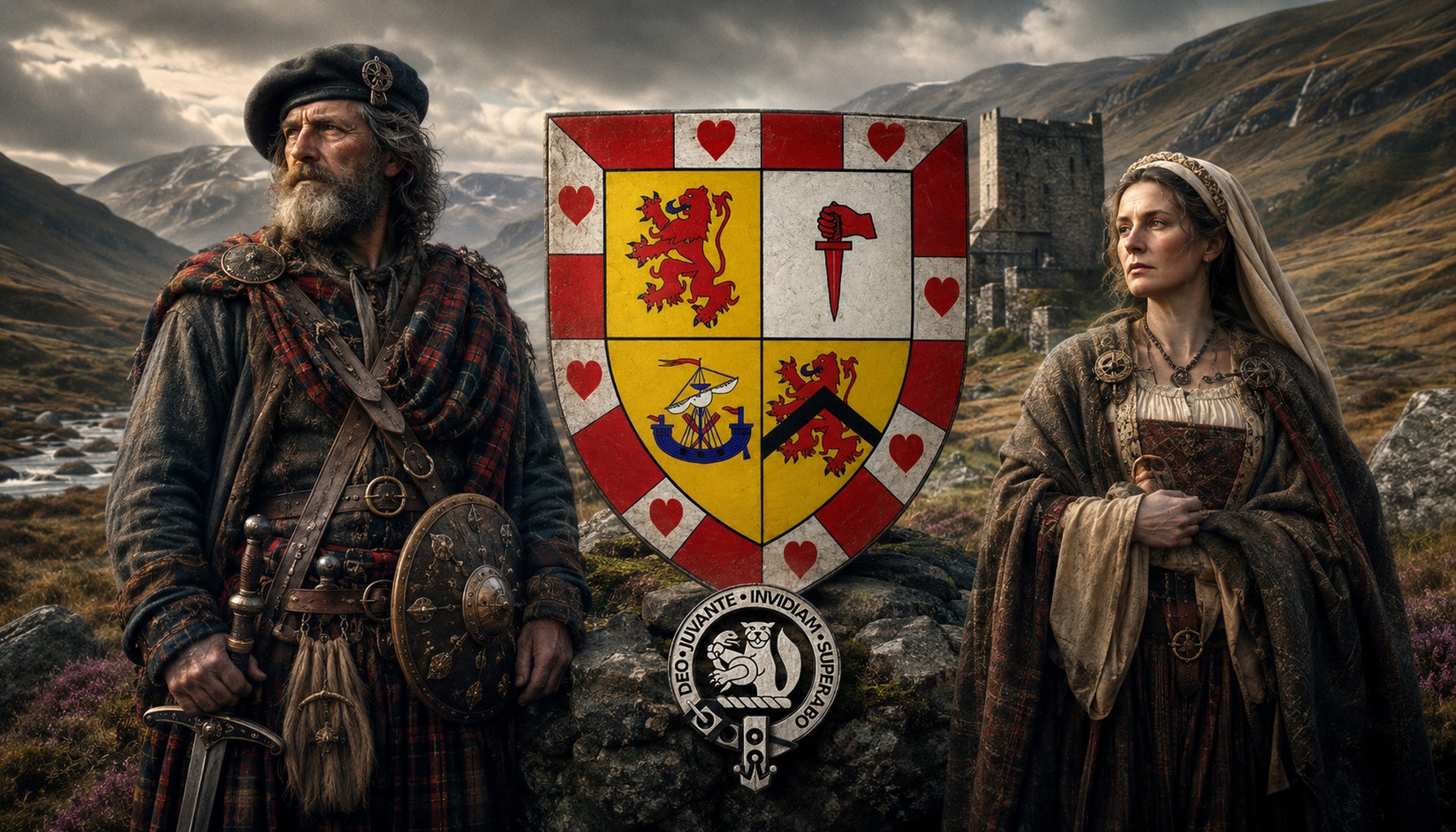
Clan MacThomas was one of the smaller but very characteristic Highland Scottish clans, rooted in Glenshee in eastern Perthshire and shaped by the Gaelic traditions of Highland kinship society. This was a clan made not simply by surname, but by land, memory, obligation, and the practical business of survival in a competitive world of neighboring powers, shifting loyalties, and local authority. The MacThomases emerged from a Highland setting where family identity was tied to chiefs, fighting capacity, inherited reputation, and attachment to a particular landscape. Their primary family haplogroup is tagged here as R1b1a1b1a1a1b, a lineage widely associated with much of later western European male ancestry and one that sits comfortably within the broad genetic story of Atlantic and Celtic world populations.
The family background is richer than the old shorthand version of clan history. Clan MacThomas belongs to that recognisable Highland pattern: Gaelic roots, territorial attachment, solidarity around a named ancestor, and persistence through change. The traditional founding figure is Thomas Tomaidh Mor, remembered around 1430, whose name lies behind the clan designation itself, the children or descendants of Thomas. Like many Highland kindreds, the MacThomases preserved themselves through oral tradition, heraldry, chiefly descent, and continuing connection to ancestral ground even when political circumstances became awkward or dangerous. Their story reflects the fate of many lesser Highland clans, not always dominant, often pressured by larger neighbours, yet stubbornly durable.
If you want one place that anchors Clan MacThomas in the land, it is Clach na Coileach, the clan stone associated with the MacThomases in Glenshee. It is one of those wonderfully Highland survivals where history, landscape, and tradition meet in a single object. The stone stands as a gathering point and emblem of belonging, a physical reminder that clans were not abstractions but communities tied to place. Accounts connected with Clach na Coileach describe it as the clan's rallying stone, a marker of assembly and identity in the glen, and part of the living memory of the MacThomas presence there. In other words, this is not just scenery; it is the sort of site that tells you how Highland society actually worked, through repeated acts of gathering, remembering, and claiming continuity. It is also a place that can still be visited, which gives modern descendants and interested visitors a rare chance to stand in a landscape that remains meaningfully connected to the clan's historic home.
On the ancient DNA side, the MacThomas primary family haplogroup R1b1a1b1a1a1b belongs to a very broad and well-attested western Eurasian lineage with many related or linked ancient samples across Britain and Europe. These do not prove direct descent from Clan MacThomas, of course, but they help place the clan's paternal line within a long historical backdrop. Relevant linked examples include Pict-era Scotland from Rosemarkie Cave on the Black Isle such as KD001, KD001_2, KD001_3, KD001_4, KD001_6a, and KD001_6b, along with early medieval Pict-era Lundin Links samples such as LUN004 and its related burials. From Britain more broadly there are Roman and post-Roman linked cases like NWC009 from Eddington, ARB003 from the high-status Arbury wooden coffin burial, DUX003 from Duxford, and several Celtic Durotriges individuals from Winterborne Kingston including WBK106, WBK17, WBK192, and WBK10. Farther afield, linked R1b1a1b1a1a1b examples appear among elite Celtic burials in Germany such as Magdalenenberg MBG013 and Hochdorf HOC001, HOC001b, and HOC001c, as well as Bronze Age and later individuals across France, Iberia, Central Europe, Scandinavia, and the medieval North Atlantic. What this suggests, in broad public-history terms, is that the MacThomas line sits inside a deep and mobile story stretching from Bronze Age and Iron Age Europe into the historic Celtic, Pictish, British, and medieval worlds.
If Clan MacThomas is part of your family story, DNA can add another layer to the history already preserved in names, places, and tradition. Upload your DNA to MyTrueAncestry to see how your results compare with ancient and historic samples linked to haplogroup R1b1a1b1a1a1b and to explore the deeper human past behind your Highland roots.
Comments