Clan Leslie
– 3 min read


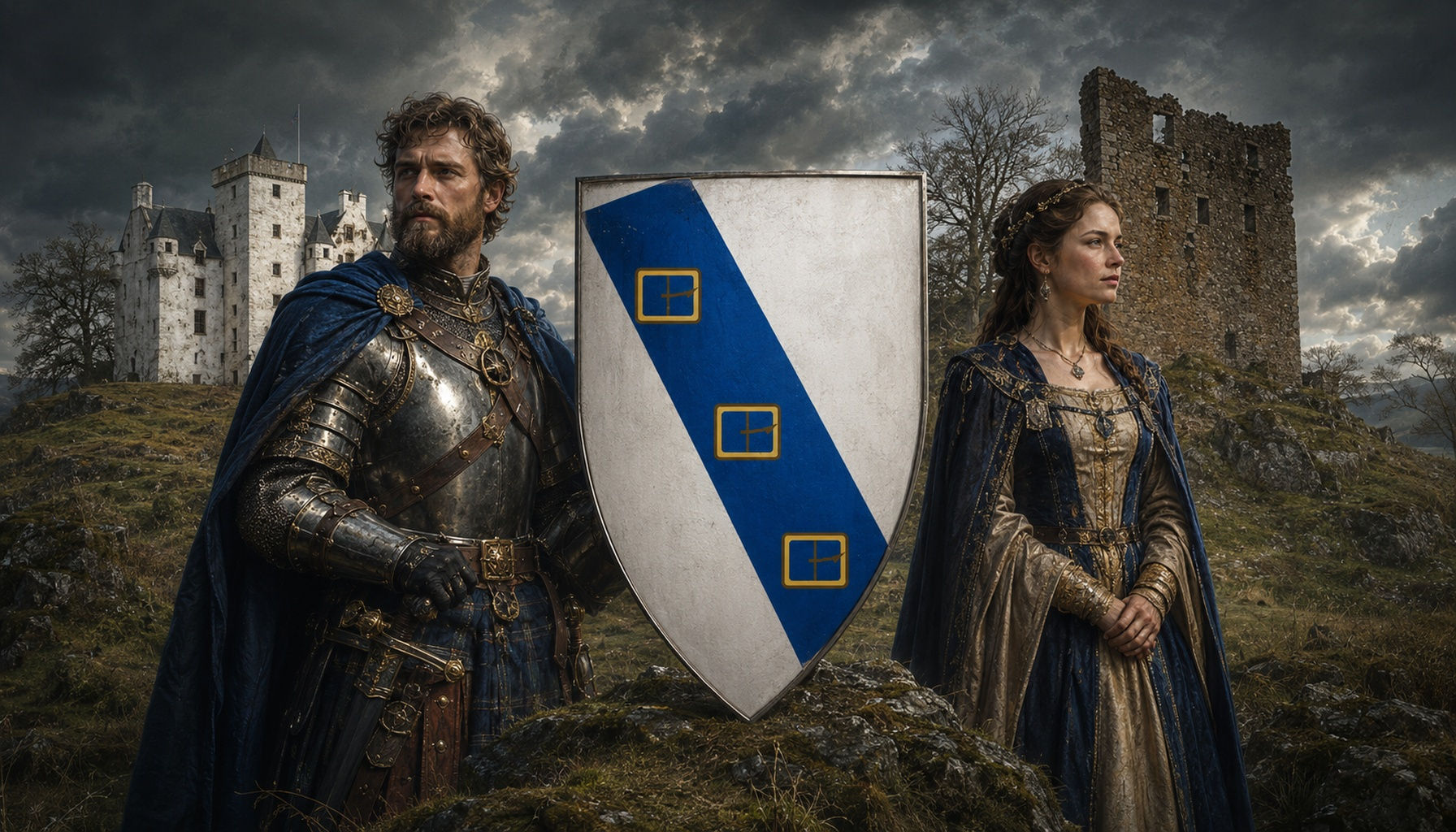
Clan Leslie was one of the notable noble families of Lowland Scotland, rooted above all in Aberdeenshire and long woven into the political, military, and landed life of the kingdom. Their story is not that of an isolated Highland clan in tartan romance, but of a powerful Lowland house built through estates, royal service, marriage alliances, and a talent for remaining useful to crown and country across generations. In that sense, the Leslies are a very Scottish kind of family: locally anchored, ambitious, outward-looking, and able to carry their name well beyond their home region. The primary haplogroup linked with the family is I1a3a1a2a1, a branch that sits within a wider northern European paternal landscape.
The traditional origin of the family places them in the north-east of Scotland, where they became major landholders and figures of consequence in medieval society. Their rise belongs to the historical world of feudal Scotland, when land, service, and kinship mattered intensely, and when a family could turn local authority into national significance. Over time the Leslies accumulated estates, honours, and influence, while also participating in the wider military and diplomatic networks that tied Scotland to continental Europe. Among the notable figures in the line is George Leslie, Earl of Rothes, recorded in 1447, a reminder that the family had by then already secured a place among the recognized noble houses of the realm.
A key location anchor for Clan Leslie is Balquhain Castle in Aberdeenshire, one of the great historic seats associated with the family. The castle stands near Chapel of Garioch and became closely identified with the Leslies of Balquhain, a branch of the wider family that played an important part in north-eastern Scottish history. The site reflects exactly the kind of power base that sustained families like the Leslies: not simply a residence, but a statement of lineage, status, defence, and regional authority. The surviving structure is largely a ruined tower house and later courtyard castle, with building phases that speak to centuries of occupation and adaptation. Even in ruin, Balquhain has the atmosphere of a place where family memory and local power were once inseparable. It is not a fully staffed visitor attraction in the modern sense, but the castle remains a known historic site and can still be visited from the outside, reasonably supported by its continuing visibility and documented location.
The Leslie-associated haplogroup I1a3a1a2a1 also has an interesting wider ancient-DNA background. Related or linked samples have appeared in a number of historical contexts across Europe, which helps place this lineage in a broader early medieval and late antique world. These include Migration Period Hungary at Rakoczifalva (RKF054), an Early Avar elite grave in Hungary at Kunpeszer (KUP014), Late Antique Roman Viminacium in Moesia, Serbia (VIM5), a Gothic grave at Aul of Kan Omurtag, Han Krum Village, Bulgaria (I41203), Gothic-associated Wielbark culture burials from Maslomecz in Poland (PL057, PL059, PL062, PL071), Migration Period Grodek nad Bugiem in Poland (GRK021), and a Frankish Empire post-Avar context in Hungary at Tiszafured-Majoros-halom (TMH-509). These are not evidence of direct descent from any one ancient individual, and they should not be read that way. What they do show is that the same broader paternal branch was present among populations moving through and interacting across Europe in the centuries before and during the making of medieval noble lineages.
If you are curious whether your own family story connects to lineages like I1a3a1a2a1, or to the deeper historical world behind clans such as the Leslies, you can upload your DNA to MyTrueAncestry and explore the ancient populations linked to your results. It is a fascinating way to place family history into a much older human story.
Comments