Clan Cogan
– 3 min read


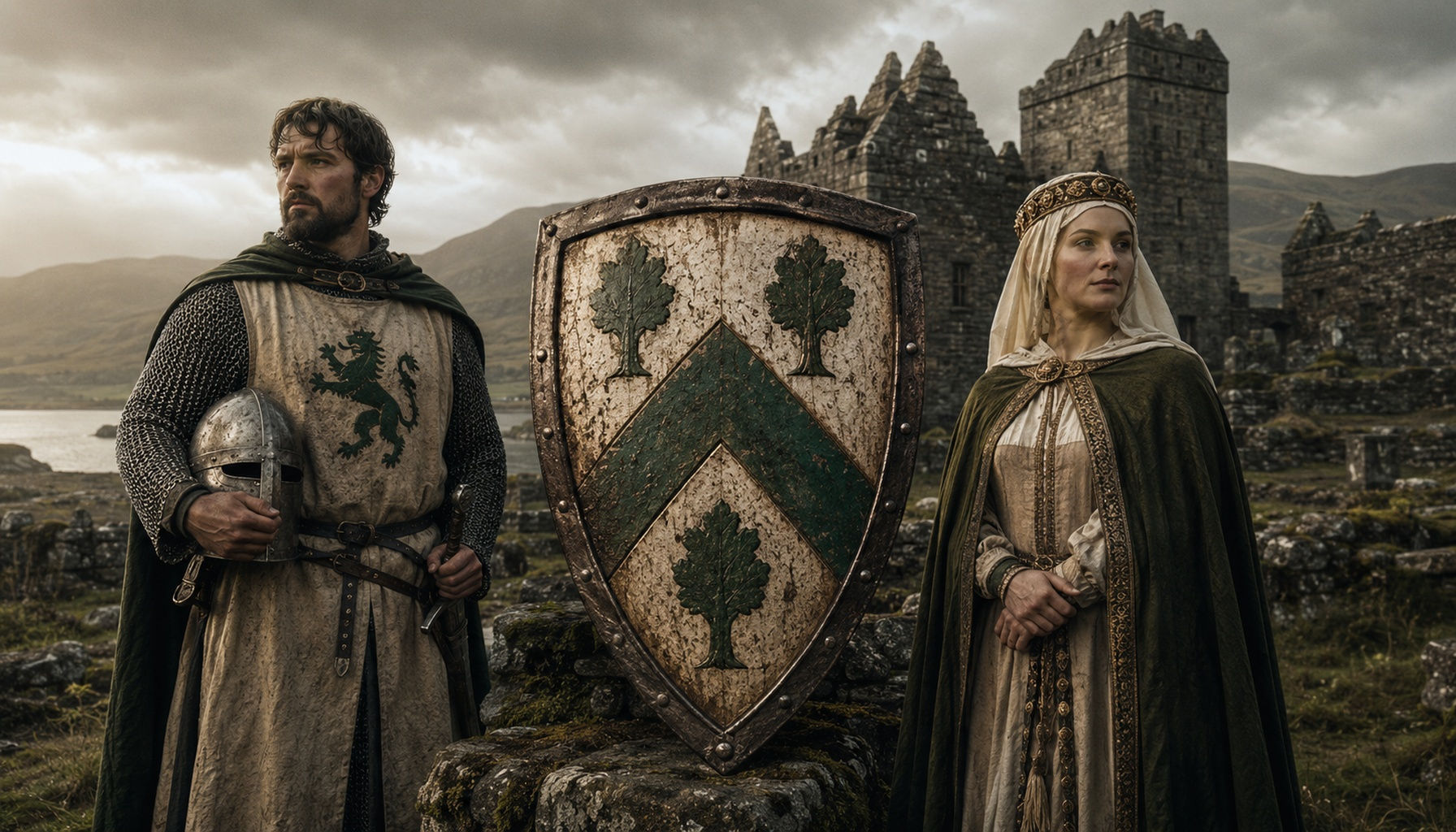
Clan Cogan belongs to that fascinating Anglo-Norman and Irish story in which a family arrives as part of the medieval conquest and then, over generations, becomes woven into the fabric of Ireland itself. The Cogans are remembered as a Norman-origin family associated with landholding, military service, local authority, and the gradual shaping of Norman-Irish society. In haplogroup terms, the primary family line is here linked with R1b1a1b1a1a2c1a1a1a1a1a1a1a1a, a branch within the great western European R1b world that appears again and again in medieval and later populations across Ireland and Britain.
The surname Cogan is generally associated with a place-name origin in the Welsh Marches and the wider Anglo-Norman frontier world, very likely tied to Cogan in Glamorgan, South Wales, before the family took part in the expansion into Ireland in the late 12th century. This was the age when ambitious Marcher families, warriors, and retainers crossed the Irish Sea in search of land, influence, and royal favour. A key named figure is Milo de Cogan, who died in 1182, one of the best-known early members of the family in Ireland. He belongs to that first generation of adventurers whose careers were built on castle-building, campaigning, and securing lordship, but whose descendants often had to do something much subtler: survive, adapt, marry locally, and become part of Ireland's changing political landscape. That is really the Cogan story in miniature, not simply conquest, but settlement and continuity.
The strongest location anchor for the family tradition lies in the old Marcher-Norman zone of Glamorgan, especially Cogan near Penarth in South Wales, from which the surname is widely understood to derive, and from there in the south of Ireland, particularly Munster, where the family established itself after the invasion period. This is exactly the kind of movement one sees with many Norman families: a local place-name in Britain or Wales becomes a surname, the surname travels through conquest and colonisation, and then the family develops a second homeland in Ireland. In Irish historical memory, the Cogans are especially linked with the early Anglo-Norman settlement of Cork and the wider Munster region. Depending on the specific site tied to the family branch being discussed, parts of that landscape can still be visited today, whether in the Welsh place of origin or in the medieval towns, castles, and church sites of Munster where Norman-Irish lordship took root. That physical survivability matters, because it reminds us that these were not abstract pedigrees on parchment; they were families grounded in roads, river crossings, churches, estates, and defensible settlements.
From a DNA perspective, the haplogroup tag linked here to Clan Cogan, R1b1a1b1a1a2c1a1a1a1a1a1a1a1a, can be placed in a broader medieval Irish context through related or linked ancient DNA samples rather than any claim of direct descent. Among the medieval individuals relevant to this wider haplogroup landscape are numerous Ballyhanna, County Donegal burials, including samples such as Sk197an, Sk197y, Sk197q, Sk197am, Sk197s, Sk197ab, Sk197u, Sk197t, Sk197r, Sk197ad, Sk197x, Sk197n, Sk197aa, Sk197z, Sk197ak, Sk197w, Sk197ai, Sk197m, Sk197ah, Sk197ag, Sk197v, Sk197ac, Sk197al, Sk197af, Sk197ae, Sk197o, Sk197aj, HAN197x, Sk197a, Sk197b, Sk197c, Sk197d, Sk197e, Sk197f, Sk197g, Sk197h, Sk197i, Sk197j, Sk197k, Sk197l, Sk197p, and HAN197, along with linked medieval Irish material from Kilteasheen in Roscommon, including KIL041, KIL044, and KIL014. These samples do not prove that a modern Cogan line descends from any one excavated man. What they do provide is a vivid population backdrop: medieval Ireland contained many men from closely related paternal lineages, showing how deeply rooted this wider R1b pattern was in the island's past, including in the very centuries when Norman and Irish identities were mixing on the ground.
If you carry the Cogan surname, or suspect Norman-Irish ancestry in your family, DNA can add another layer to the documentary story. Upload your DNA to MyTrueAncestry to explore ancient links, compare your results with medieval samples, and place your family history in a much bigger historical landscape.
Comments