Clan Barron
– 3 min read


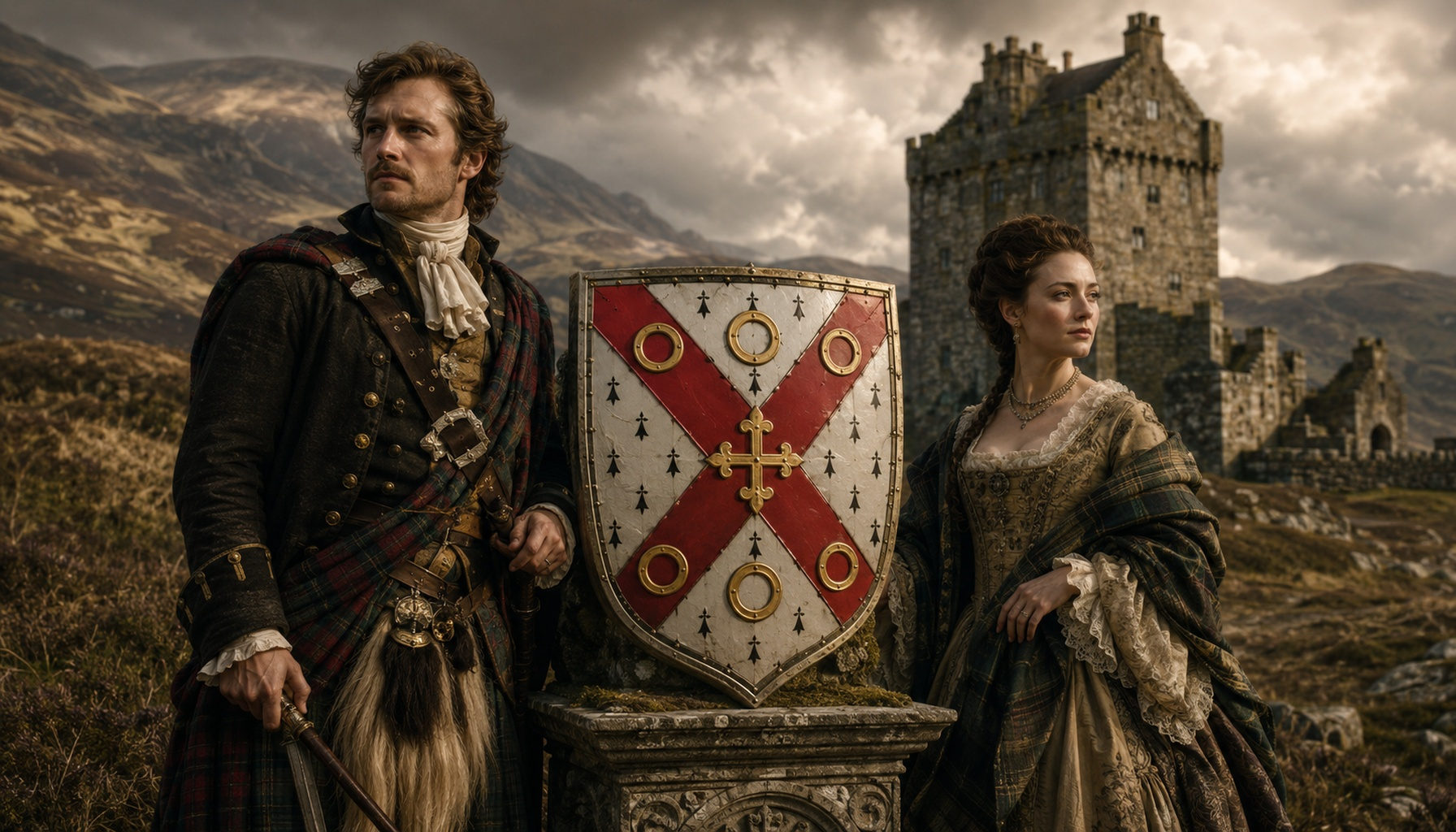
Clan Barron belongs to that wide and very recognisable Scottish and Irish world of surname heritage, where identity was carried not by vast crowns and princely courts, but by family continuity, local standing, memory, and the stubborn persistence of a name. The Barron tradition is tied to communities in the British Isles where families were shaped by land, parish, kinship, and service, and where surnames became anchors through centuries of upheaval. In genetic terms, the family is here tagged with haplogroup R1b1a1b1a1a1c1a2b, presented as the primary family haplogroup linked with this heritage profile.
The surname Barron has Scottish and Irish associations, and like many such names it likely gathered strength through regional roots rather than through one single founding lord. Families bearing the name appear in a historical landscape marked by shifting borders, lordships, religious change, migration, and adaptation. That is often the true story of British Isles families: not uninterrupted grandeur, but endurance. One notable historical figure is Bonaventure Baron, born in 1610 and died in 1696, the Irish Franciscan scholar and writer whose career reminds us that family history is not only about landholding, but also learning, faith, and public life. Clan-style identity in this sense means a remembered people, not merely a formal Highland polity.
The Barron name is best understood through its local anchors in Scotland and Ireland, where surname identity was often bound to district, parish, and long familiarity with place. In such settings, families developed reputations over generations through farming, tenancy, trade, church life, military service, and the daily business of belonging to a community. The historic context is important: from the medieval period into the early modern age, families moved between regions of Scotland, Ulster, and other parts of Ireland, sometimes by opportunity, sometimes by pressure, yet often retaining a clear surname identity. Where a Barron-associated site, settlement, church, burial ground, or district survives in the historical record, it can often still be visited today, which is one of the pleasures of this kind of family history: the landscape itself remains part of the archive, and walking it brings the surname story back into human scale.
The haplogroup R1b1a1b1a1a1c1a2b links the Barron family profile to a broad and fascinating network of ancient and medieval European males, though this should not be read as proof of direct descent from any named individual. Rather, these are related or linked samples that help place the lineage in a wider historical frame. Among them are Elek Bathory Hungarian Knight Pericei (PER01) and Ferenc Bathory Hungarian Knight Pericei (PER03-1), Merovingian Bavaria at Altheim in Germany (Alh_247), Medieval Jutland at Vor Frue Kirkegard Aalborg (CGG100493), several medieval individuals from Sint-Truiden in Belgium including ST0052, ST1232, ST0632, and ST3006, Belgic Suessiones samples from Bucy-le-Long in Iron Age France including CGG022463, CGG022431, and CGG022438, Batavi Germanic tribe samples from Valkenburg Marktveld in the Netherlands including CGG107745, CGG107754, and CGG107751, Medieval Poland Piast Dynasty Lad (PCA0193), Saxon Coast Lower Saxony at Dunum (DUN010), Early Anglo-Saxon Buckland Dover in England (BUK059 and BUK027), Etruscan Roman Republic Tarquinii in Italy (R10339), Roman Klosterneuburg Fortress in Lower Austria (R10659), Late Bronze Age Teplice Bohemia (I13788), Germanic Iron Age Teplice Radosevice Bohemia (I15950), Iron Age Briton Cambridgeshire England (I11149), Early Iron Age Vlaardingen-Krabbeplas Netherlands (I17019), Late Iron Age Frisian Boy at Aak Uitgeest-Dorregeest Holland (I12907), an elite Germanic warrior from Bavaria (AED106), Viking Age Ribe Jutland (VK323), and Medieval Villa Magna Italy (R58). Taken together, they show a lineage present across Iron Age, Roman, Germanic, Anglo-Saxon, Viking, and medieval worlds, which suits a surname heritage rooted in the long population history of northwestern Europe.
If you carry the Barron surname, or have Barron lines in your family tree, DNA can add an entirely new layer to the story. Upload your DNA to MyTrueAncestry to explore ancient links, compare your results with historical samples, and place your family history within the deeper human past.
Comments