Clan Agnew
– 2 min read


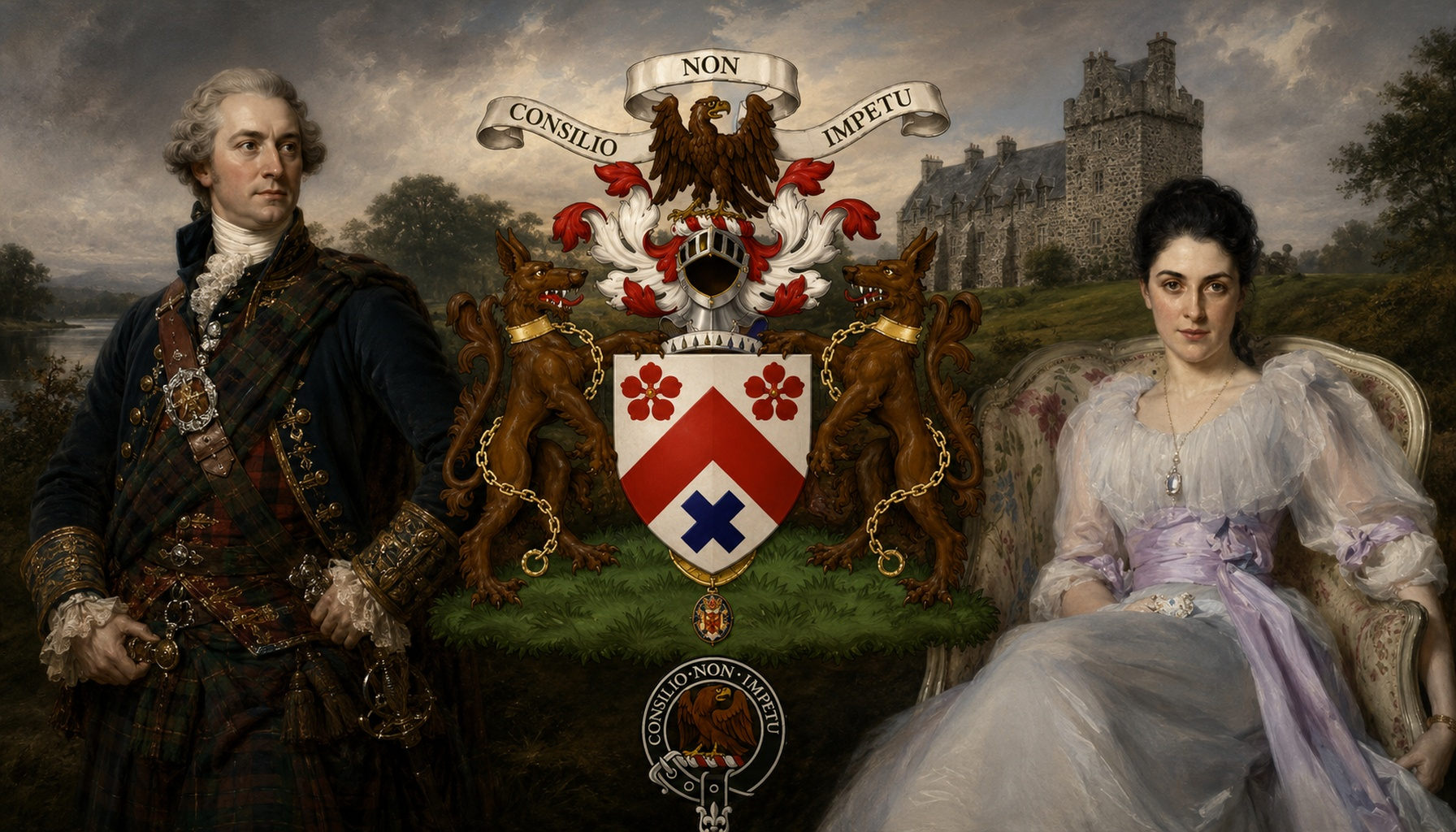
Clan Agnew was a Scottish family of the south-west, rooted above all in Galloway and closely tied to the lands of Lochnaw in Wigtownshire. This was not a clan story built mainly around the later Highland image of chiefs and glens, but a distinctly Lowland and borderland pattern of power: landholding, legal office, crown service, heraldry, and long continuity on an estate. In DNA terms, the primary family haplogroup linked with Clan Agnew is I2a1b1a1a1a1a1b3, a branch that helps place the family within a much deeper human story stretching far back beyond the written record.
The Agnews emerged in a historic landscape shaped by Norse-Gaelic contact, the lordship politics of Galloway, and the growing reach of the Scottish crown into the south-west. Their identity developed through authority as much as ancestry: they became especially associated with the hereditary sheriffship of Wigtownshire, making them one of those Scottish landed-service families whose status came from administering a region as well as owning parts of it. One early named figure is Alastair Agnew, recorded in 1299, a reminder that by the late 13th century the family was already visible in the documentary world of medieval Scotland.
The great location anchor for Clan Agnew is Lochnaw Castle, near Stranraer in Dumfries and Galloway. The site is an impressive layered stronghold rather than a single-period building, with a medieval tower house at its core and later additions reflecting centuries of occupation by the Agnews. Set beside Lochnaw Loch, it was both a defensible residence and a statement of territorial control, exactly the kind of seat that suited a family whose importance rested on estate continuity and regional office. The castle is traditionally associated with the Agnews of Lochnaw, including the line of hereditary sheriffs of Wigtownshire, and it remained the symbolic heart of the family for generations. It is still known as a historic site and can be viewed and visited in a limited heritage sense, reasonably supported by its continuing recognition as a notable castle in the area, though access arrangements may vary.
The haplogroup I2a1b1a1a1a1a1b3 also opens a wider ancient-DNA perspective. We should be careful here: these are not claims of direct descent from named archaeological individuals, but related or linked samples that show the long time-depth and geographical spread of this broader paternal line. Among them are Medieval England Augustinian Friars, ATP_PSN_527; a Celtic Briton from Cliffs End Farm, England, I14866; Neolithic Wales from Orchid Cave, Denbighshire, I16491; Iron Age East Lothian, Scotland, I16418; MacAurthur Cave, Oban, Argyll and Bute, Scotland, I2657; a Bell Beaker period individual from Upavon, Wiltshire, England, I4949; ancient Carrowmore, Ireland, car004; and Pabay Mor, Isle of Lewis, Scotland, I2655. Taken together, these linked samples suggest a lineage with deep roots across Britain and Ireland, fitting well with the old, layered population history of south-west Scotland in which families like the Agnews later emerged into recorded history.
If you are researching the Agnews, Galloway families, or the deeper history behind haplogroup I2a1b1a1a1a1a1b3, DNA can add another dimension to the paper trail. Upload your DNA to MyTrueAncestry to explore ancient samples, regional links, and the deeper past behind your family story.
Comments