Cheddar Man
– 5 min read


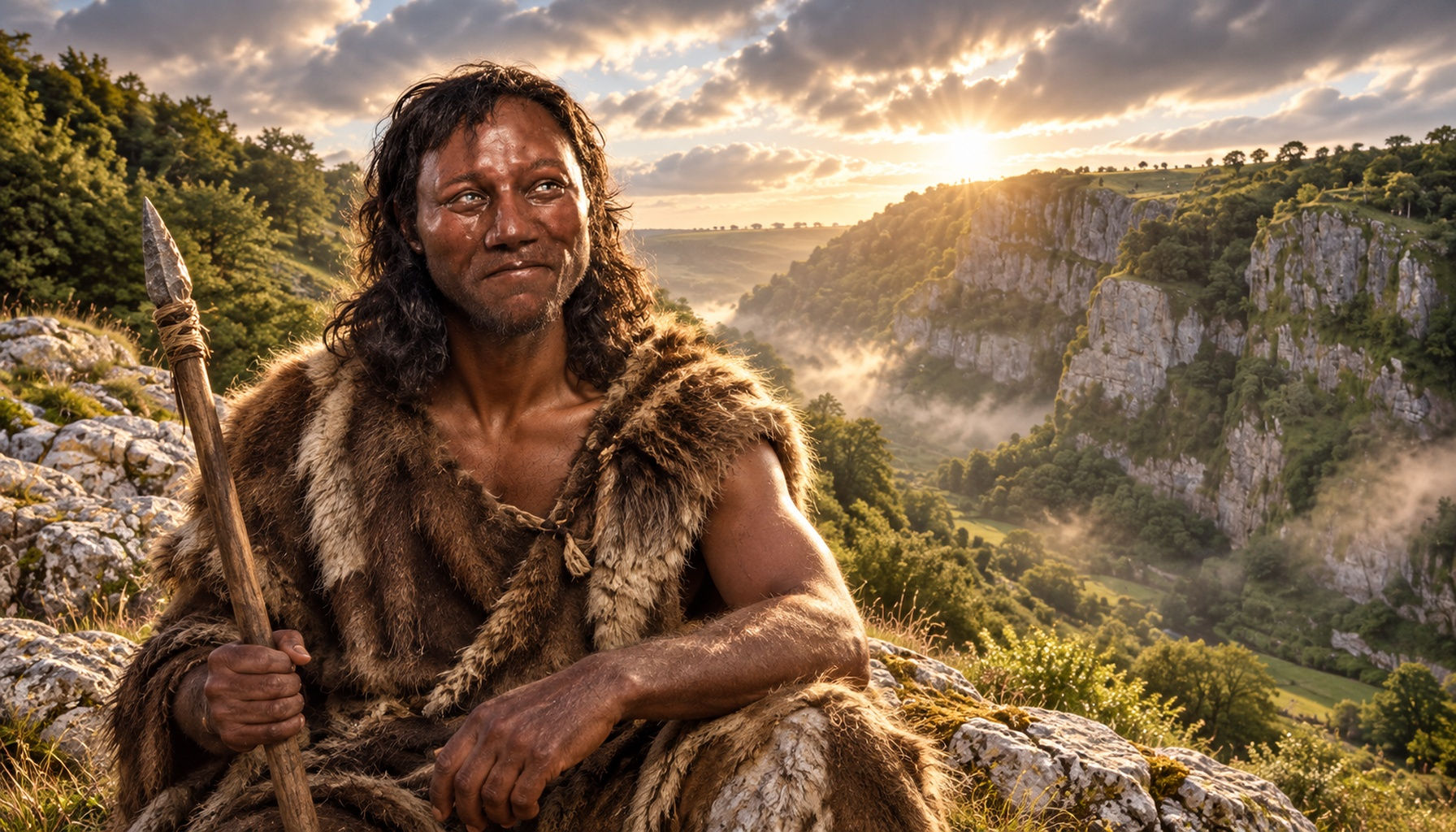
Cheddar Man is one of those prehistoric figures who somehow escapes the mist of deep time and becomes almost disconcertingly personal. He was a Mesolithic hunter-gatherer who lived in Britain around 7150 BC, at the beginning of the Holocene, when the great Ice Age world had recently given way to warmer forests, rising seas, and a transformed landscape. His remains, found in Gough’s Cave at Cheddar Gorge in Somerset in 1903, are among the most famous human discoveries ever made in Britain.
What makes him so important is not simply that he is old, though he certainly is. It is that he gives a human face to a world before villages, before monuments like Stonehenge, and long before farming reached Britain. Ancient DNA has shown that he belonged to the western European hunter-gatherer population that spread across much of Europe after the last Ice Age. Modern reconstruction work, drawing on genetic evidence discussed by the Natural History Museum, also suggested a combination of dark skin pigmentation and light-coloured eyes, a finding that challenged many comfortable assumptions about what early Britons “should” have looked like.
Cheddar Man did not live in a country called England, still less in a kingdom or tribe we could name from written history. He lived in a post-glacial landscape of woods, rivers, wetlands, and coasts that looked rather different from today’s map. Britain itself was still part of a broader northwestern European world only recently cut and reshaped by rising seas. Communities like his survived by hunting, fishing, and gathering wild plants, moving through seasonal landscapes rather than living in permanent farming settlements.
That is precisely why Cheddar Man matters. He is not a king, warrior, or saint known from chronicles. He is something rarer: an actual individual from a period that usually speaks only through stone tools, butchered bones, and traces of camp life. His skeleton offers a direct encounter with the people who inhabited Britain thousands of years before the arrival of Neolithic farmers. In that sense, he stands at the far beginning of Britain’s human story, before the island’s later layers of Beaker migrants, Celtic-speaking communities, Romans, Anglo-Saxons, Vikings, and Normans.
The biological sample associated with this individual is recorded here as Cheddar Man Somerset England, dated approximately to 7150 BC. His nearly complete skeleton was discovered in Gough’s Cave, part of the dramatic limestone landscape of Cheddar Gorge in Somerset. That alone makes the find exceptional: Mesolithic human remains from Britain are rare, and a skeleton this substantial is rarer still.
In this case, the identification is secure in the straightforward archaeological sense. “Cheddar Man” is the conventional name given to the skeleton found in the cave; it is not a disputed attribution to some named person from written history. We do not know his original name, his kin group, or the exact circumstances of his death. Nor should we pretend otherwise. What we do know is that the remains come from a real Mesolithic individual recovered from a well-known archaeological context, and that they have become central to the study of early post-Ice Age Britain.
Gough’s Cave is itself a site with a very long human story, used in different ways across prehistoric time. Cheddar Man belongs to one chapter of that longer history, and his presence there hints at the varied meanings caves could have for Mesolithic communities: shelter, place of deposition, or landscape marker. Archaeology can frame those possibilities, but it cannot tell us his biography in the way written texts can for later ages.
Cheddar Man’s DNA is historically interesting because it lets us move beyond general talk of “hunter-gatherers” and examine one person within a much wider prehistoric population history. His Y-DNA haplogroup was I2a1b2a, which traces his direct paternal line: father to father to father back through time. His mtDNA haplogroup was U5b1, which traces his direct maternal line: mother to mother to mother. These are lineages, not ethnic labels, and they do not by themselves tell us his language, identity, or culture.
The broader pattern fits what ancient DNA has revealed about Mesolithic Europe. Haplogroups within Y-DNA I2 are often associated with European hunter-gatherer males, while mtDNA U5 lineages are especially well known among Mesolithic foragers. In Cheddar Man’s case, the larger value of the DNA is not the haplogroup label on its own, but the fact that his genome places him firmly within the western European hunter-gatherer population. That population occupied large parts of Europe after the last Ice Age and before the major spread of farming ancestry into Britain.
A short paternal comparison is useful here. Cheddar Man’s I2a1b2a lineage also appears in a wide scatter of later ancient individuals, including Mesolithic and Neolithic samples such as Vovnigi II in Ukraine, Ertebølle and Kongemose-related individuals in Denmark, and Sramore in Ireland, as well as much later burials from Iron Age, medieval, and even post-medieval contexts across Britain and Europe. Samples such as MBG008 from Magdalenenberg, a range of Durotriges individuals from Winterborne Kingston, and Parisi burials from Wetwang Slack show that this paternal lineage, or branches closely related to it, persisted across very different societies over millennia. That does not make those men Cheddar Man’s close relatives in any simple sense; it shows instead the astonishing durability of one paternal thread through repeated cultural change.
His maternal lineage, U5b1, tells a similarly deep story. U5 is one of the classic mitochondrial lineages of European hunter-gatherers, and Cheddar Man’s U5b1 fits that pattern neatly. In this instance, the directly supplied linked sample is Cheddar Man himself, which is a reminder that mtDNA evidence can sometimes be more illuminating at the population level than through a long list of famous named matches. What it tells us clearly is that his direct maternal ancestry belongs within a very old forager horizon in Europe.
The famous reconstruction of Cheddar Man’s appearance deserves a word of caution as well as interest. The Natural History Museum has explained that the prediction of dark skin pigmentation and light-coloured eyes was based on genetic analysis and statistical inference, not on a colour photograph hidden in the bone. It is a serious scientific reconstruction, but like all reconstructions it carries probabilities rather than certainties. Even so, it has been invaluable in reminding the public that prehistoric appearance does not map neatly onto modern ideas of ancestry or nationality.
Read about Post-Ice Age Hunter-Gatherers
Cheddar Man’s DNA helps place one Mesolithic Briton in the wider peopling of Europe after the Ice Age. It shows that early Holocene Britain was inhabited by people closely related to western European hunter-gatherers, and it adds precious detail to the long prehistory before farming transformed the islands. What it cannot do is tell us his personal name, the language he spoke, or whether any modern person with a similar haplogroup is his direct descendant. Shared haplogroups point to broad paternal or maternal connections in the distant past, not to a family tree you could draw neatly on paper.
That, in a way, is what makes Cheddar Man so compelling. He is both intimate and elusive: a man with a face, a skeleton, and a genome, yet still mostly beyond biography. Archaeology and genetics together let us see him not as a legend but as a real inhabitant of Mesolithic Somerset, living in a Britain that was ancient even before history began.
With MyTrueAncestry, you can compare your DNA to ancient populations and archaeological samples from worlds like that of Mesolithic Britain, exploring whether your genetic story shows connections to the deep human past revealed by archaeology and ancient DNA.



Comments