Bolesław III Duke of Płock

– 5 min read


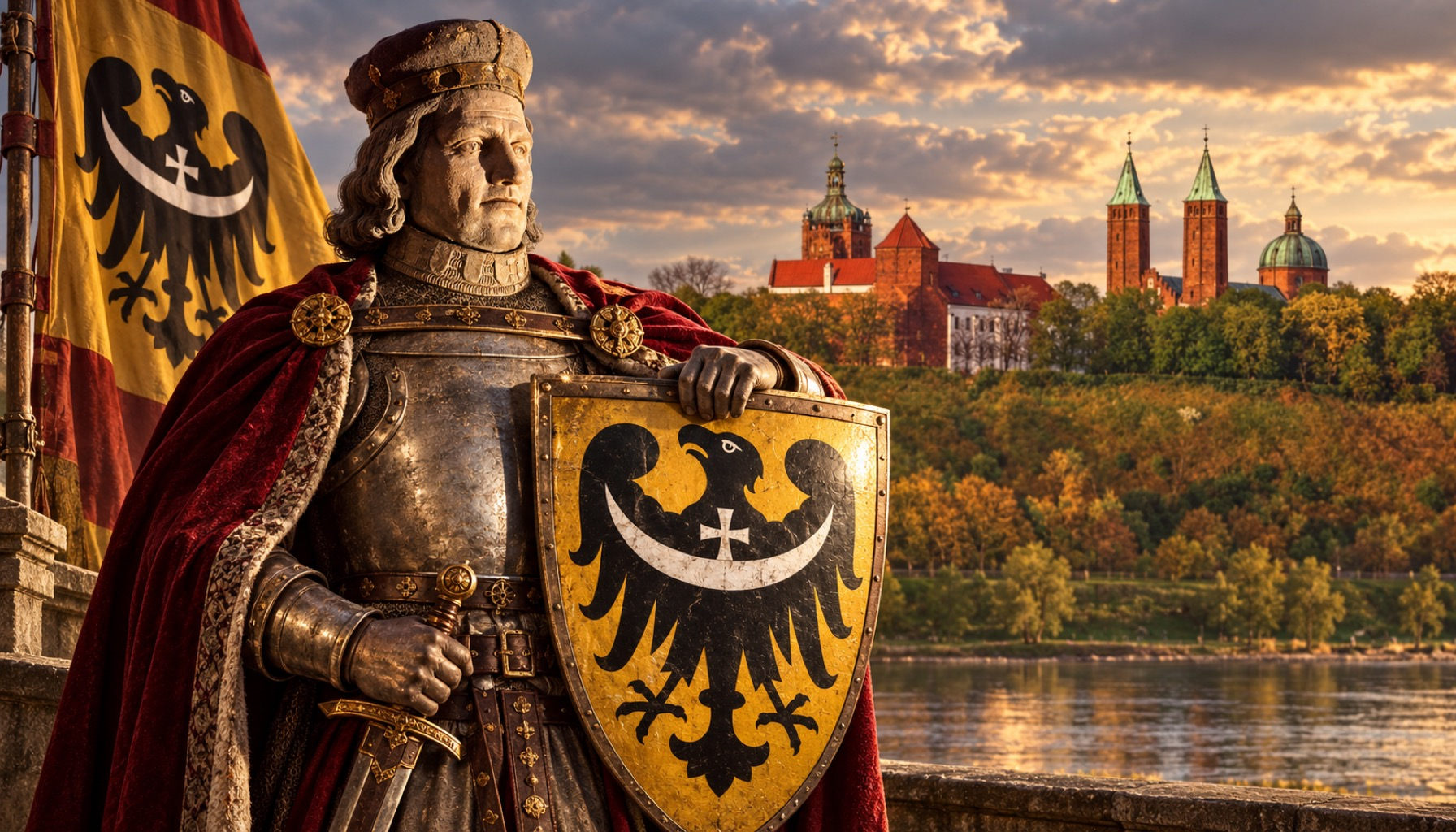
Bolesław III of Płock was a fourteenth-century prince of the Masovian branch of the Piast dynasty, a ruler from a world where frontiers were never merely lines on a map but zones of negotiation, pressure, and occasional violence. He was the only son of Wenceslaus of Płock and Elisabeth, also known as Dannila, a daughter of the Lithuanian ruler Gediminas. That parentage alone placed him at the junction of two important political worlds: the Piast principalities of Masovia and the expanding Lithuanian sphere to the east.
He inherited the Duchy of Płock in 1336 after his father’s death, first under a regency and later in his own right. His duchy lay in a delicate position between the Kingdom of Poland, the Bohemian Crown, Lithuania, and the Teutonic Order. In other words, Bolesław did not have the luxury of being a quiet provincial duke. His career belongs to the crowded, complicated politics of east-central Europe in the age of Casimir III the Great.
The Masovian Piasts were relatives of the wider ruling house that had shaped medieval Poland, but by Bolesław’s time the dynasty’s lands were fragmented into duchies whose rulers had to survive by tact as much as force. Płock was one of those strategically exposed territories. Formally, Bolesław remained connected to the Bohemian monarchy, yet he also cooperated with the Polish king Casimir III. That balancing act was not inconsistency; it was practical politics in a region where allegiance, influence, and military necessity overlapped.
He later acquired Wizna and Sochaczew, adding to his importance within Masovia. His mother’s Gediminid background also reminds us that dynastic marriage linked Latin Christian principalities and the still partly pagan Lithuanian ruling house long before modern national borders tried to tidy the story up. In 1351 Bolesław joined a military expedition against Lithuania and was killed during the campaign. It is one of those medieval ironies that a prince with Lithuanian maternal ancestry died fighting in a conflict involving that same frontier world. He died unmarried and without children, and his lands then became a matter of redistribution between the Polish crown and his Masovian Piast relatives. His death mattered because in medieval politics an heirless corpse could be as consequential as a living ruler.
Explore the House of Gediminid
The genetic sample associated with him is listed as Boleslaw III Duke of Plock Piast Dynasty, with an approximate date of 1351 AD. That is a valuable label, but it is worth being careful about what it does and does not tell us. The supplied material identifies the sample as belonging to Bolesław III of Płock, yet it does not provide, here, the full archaeological chain of evidence for the remains, such as the precise burial context, the skeletal element sampled, or the exact method by which the identification was established.
So the most responsible way to describe this is as a sample attributed to the historical individual in a research context, rather than to invent certainty beyond the information provided. If the underlying study securely tied the remains to the duke through tomb context, dynastic comparison, inscriptions, or kinship analysis, that would strengthen the case considerably; but where those details are not supplied, they should not be guessed. This distinction matters enormously in ancient DNA work. A glamorous name is not itself proof. The interest of this sample lies precisely in the fact that it has been treated as belonging to a known Masovian Piast ruler from the mid-fourteenth century, a period from which securely attributed elite remains are comparatively rare and historically rich.
The reported Y-DNA haplogroup for Bolesław III is R1b1a1b1a1a, while his mitochondrial DNA haplogroup is W1. These two results trace very different lines of ancestry. Y-DNA is passed down the direct paternal line, from father to son, so Bolesław’s Y haplogroup speaks only to his strict male-line lineage. mtDNA, by contrast, is inherited through the direct maternal line, from mother to child, so his mtDNA W1 reflects his maternal-line descent.
Neither haplogroup is an ethnic badge, and neither can tell us that Bolesław was “really” this or that nationality. Medieval identity did not work that way, and genetics does not rescue us from the complexity. What these lineages do offer is a way of placing one ruler within much broader patterns of human ancestry. The broader R1b family is widespread across much of Europe and has deep prehistoric roots there, while W1 is a maternal lineage also found across parts of western Eurasia. But the important point is not broad modern frequency. It is that, in a named medieval prince, these lineages become part of a concrete historical story.
This is especially useful for dynastic questions. In a ruling family such as the Piasts, Y-DNA can help test direct paternal continuity between male-line relatives when comparative samples exist. mtDNA can illuminate the direct maternal chain, though that is a narrower historical tool unless matching relatives are also sampled. On their own, these haplogroups do not prove dynastic legitimacy, ethnicity, or political allegiance. They are clues, not coronation regalia.
The R1b1a1b1a1a assignment links Bolesław’s sample to a very broad and long-lived paternal lineage seen in other ancient individuals from strikingly different places and periods. Among the related examples listed are another Piast-associated male, Piast Masovian Dynasty Male (PCA0646), and Piast Dynasty Prince (PCA0621), which are the most immediately relevant comparanda for dynastic questions. Beyond that, the same wider lineage appears in individuals from Bronze Age France, Bell Beaker and Corded Ware contexts, Iron Age Celtic burials, medieval England, Scandinavia, Iberia, and central Europe. That does not mean all these people were close kin of Bolesław. Far from it. It means they belonged, at different distances in time, to branches of the same larger paternal tree.
The mtDNA result, W1, is also directly attested in the listed Bolesław III sample itself and is best read cautiously unless more close maternal comparisons are available. Maternal haplogroups are often historically revealing in aggregate, but for a named ruler they are most informative when used alongside documented genealogy, burial context, and genome-wide kinship evidence. The broader lesson is rather elegant: one prince of Płock can be connected by deep lineage markers to a vast web of prehistoric and medieval people, but the meaningful historical interpretation still depends on archaeology and records, not haplogroup shorthand.
The study context referenced here, including work published in Nature Communications, is historically interesting because it brings together a named medieval ruler, a dynastic setting, and genetic data that can be compared across related individuals. For Bolesław III, the real value of DNA is not that it somehow replaces the chronicles. Rather, it adds a biological thread to a political life already known from medieval history: a Piast duke of Masovia, born into a frontier dynasty, tied by blood to both Polish and Lithuanian ruling networks, and dead in 1351 before he could found a line of his own.
MyTrueAncestry lets you compare your DNA with ancient populations and archaeological samples from the historical worlds that shaped people like Bolesław III of Płock. You may discover genetic connections to medieval eastern Europe, Piast-era populations, or deeper prehistoric lineages reflected in ancient DNA research.




Comments