Bolesław II of Masovia
– 5 min read


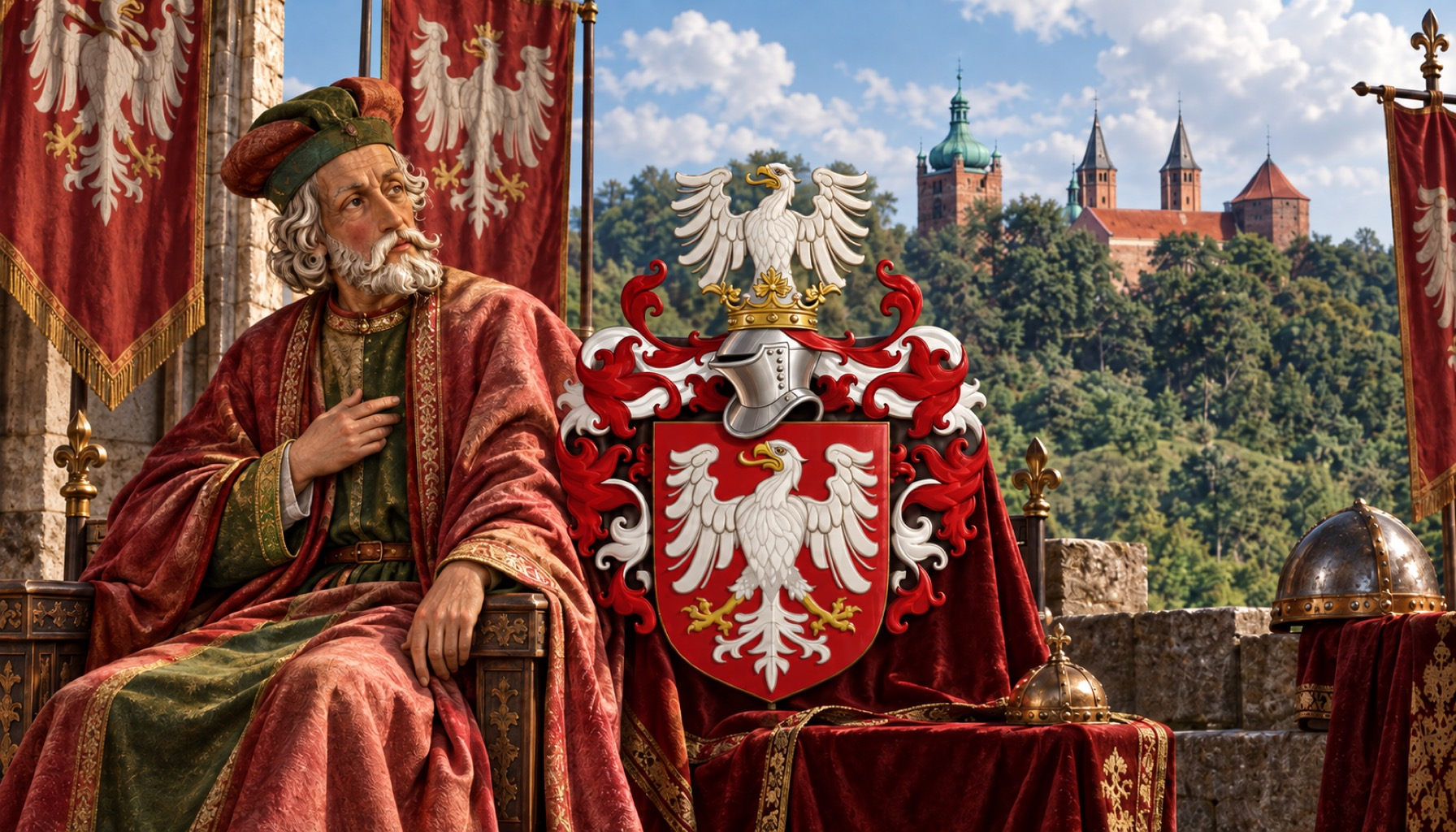
Bolesław II of Masovia was a Piast prince who lived in the later thirteenth and early fourteenth century, dying in 1313, at a time when Poland was not yet a single firmly reunited kingdom but a patchwork of competing duchies ruled by rival branches of the same dynasty. He was the son of Siemowit I of Masovia and belonged to the Masovian line of the Piasts, a branch that stood at the exposed eastern edge of the Polish world, facing not only other Polish princes but also the political pull of Lithuania, Bohemia, and the Baltic frontier.
That made Bolesław a figure of more than local interest. He became Duke of Płock and, after the death of his brother Konrad II, ruler over much of Masovia. He also joined the larger contest for Kraków and the seniorate, the old prize that still carried the idea of supremacy within fragmented Poland. His life is a useful reminder that medieval rulership was rarely tidy: family alliances, marriages, shifting loyalties, and regional ambition mattered just as much as grand national narratives that were written later.
Bolesław inherited power in a hard world. The Piast lands had splintered into principalities, and every duke had to think simultaneously about kin, rivals, bishops, neighbours, and inheritance. In Masovia, that meant guarding a frontier region centred on places such as Płock and the lands around the middle Vistula. His first marriage, to Gaudemante Sophia, connected him to the Lithuanian ruling house, while his second, to Kunigunde, sister of King Wenceslaus II of Bohemia, tied him into the formidable Přemyslid orbit. Those marriages were not romantic footnotes; they were instruments of policy in a world where dynastic marriages could alter the balance of an entire region.
His political career also brushed up against the struggle over Kraków, the symbolic heart of the seniorate. Like other Piast rulers, Bolesław had to navigate the rise of Bohemian power under Wenceslaus II, the ambitions of fellow Polish dukes, and the uneasy reality that alliances could sour quickly. Even when his connection with Bohemia fell apart, he remained a significant regional ruler. He is also remembered as one of the princes associated with the early development of Warsaw, which was then still far from the great capital it would later become. After his death in 1313, his sons divided the Masovian lands, continuing the familiar Piast pattern of fragmentation and creating later branches of the Masovian line.
The biological sample associated with him is described as Piast Dynasty Prince Boleslaw II of Masovia, with an approximate date of 1310 AD. That date fits well with the closing years of Bolesław’s life. What matters here, however, is a point historians and archaeologists are always right to insist on: a name attached to a sample is not automatically the same thing as an identification proven beyond doubt.
Based on the information supplied here, the sample is attributed to Bolesław II of Masovia, but the precise chain of identification is not described in detail. We are not told in this prompt exactly which element was sampled, how the burial context was established, or whether the attribution rests on tomb location, inscription, historical records, kinship testing, or a combination of methods. So the careful way to phrase it is that this is a proposed historical attribution presented by the study context, rather than an identification whose entire evidential trail can be reconstructed from the information given here alone.
That caution is not pedantry; it is the heart of responsible ancient DNA work. Medieval princely burials are often disturbed, reburied, or entangled with later commemorative traditions. The strongest cases come when archaeology, written sources, physical anthropology, and genetics all point in the same direction. The reference article in Nature Communications provides important scientific context for the study of Piast-associated remains, but one should avoid filling in gaps that the supplied material does not explicitly explain.
The reported Y-DNA haplogroup for this sample is R1b1a1b1a1a2, while the mtDNA haplogroup is H3s. These two markers describe different lines of ancestry. Y-DNA follows the direct paternal line, passed from father to son, so in principle it is the line most relevant to dynastic questions in a medieval ruling house such as the Piasts. mtDNA follows the direct maternal line, passed from mother to children, and so it tells us about one maternal branch of ancestry rather than the whole family tree.
The broader Y-chromosome family R1b is widespread across Europe and beyond, but that does not make it an ethnic badge, still less a dynastic certificate by itself. What is historically interesting here is not that the haplogroup exists in Europe, but that a named medieval Piast prince has been associated with a specific paternal lineage through ancient DNA analysis. In a dynastic context, such data can potentially help compare male-line relatives and test whether different remains attributed to the same ruling house are biologically consistent with one another.
The mitochondrial haplogroup H3s likewise represents a maternal lineage, one branch within the very broad and long-lived mtDNA diversity of western Eurasia. It gives us a glimpse of one maternal thread in Bolesław’s ancestry, but only one. It cannot tell us the identity of all his female ancestors, nor can it by itself reveal whether he was “Polish,” “Lithuanian,” “Bohemian,” or anything else in cultural terms. Medieval identity came from language, politics, religion, law, and allegiance as much as from biology.
What the DNA can do, more modestly and more usefully, is help anchor a historical person in the biological record. For a prince whose life was shaped by dynastic politics, the Y-DNA result is especially interesting because it bears on the paternal line through which Piast rulership was conventionally transmitted. The mtDNA result adds another layer, reminding us that even the best-known medieval princes were not simply embodiments of a single bloodline, but the products of many ancestral connections.
Read about Piast genetic genealogy
Bolesław II matters because he stood at the intersection of dynasty, frontier politics, and state formation. His marriages linked Masovia to Lithuania and Bohemia; his ambitions touched Kraków; his rule belonged to the long, messy Piast story out of which a more unified Polish kingdom would eventually emerge. DNA does not replace that history, and it certainly does not reduce him to a haplogroup. But it does add something rare and arresting: a biological trace connected with a prince known from charters, chronicles, and dynastic memory.
That is the real fascination of this kind of research. It allows us to set the documentary Bolesław beside the excavated and sequenced Bolesław, while still keeping our feet on the ground about uncertainty. Ancient DNA can help test identifications, compare lineages, and illuminate dynastic relationships. It cannot, on its own, tell the whole story of power, identity, or legitimacy in medieval Masovia.
Discover the Přemyslid dynasty
MyTrueAncestry lets you compare your DNA with ancient populations and archaeological samples from the worlds that shaped medieval Europe, including the dynastic and frontier landscapes in which rulers like Bolesław II of Masovia lived. You may discover genetic connections to broader populations and lineages linked to that historical setting, without assuming direct descent from any one prince.



Comments