Bishop Peder Winstrup
– 4 min read


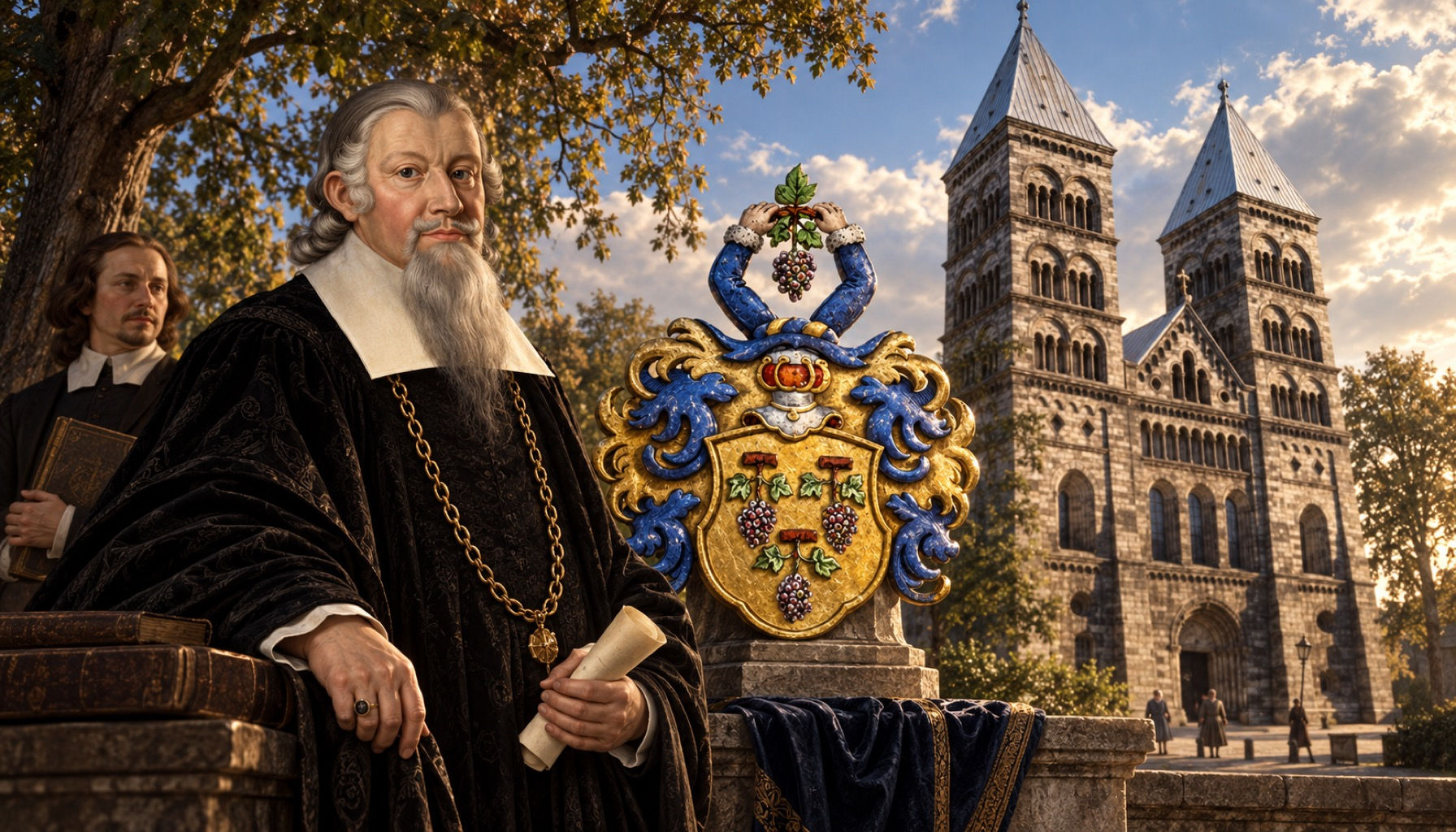
Peder Winstrup was a 17th-century Lutheran bishop of Lund, born into the educated clerical world of the Danish kingdom and remembered today for two rather different reasons. In life he was a churchman, scholar, political operator, and advocate for learning in a borderland province. In death he became one of Scandinavia’s most extraordinary preserved historical individuals, his naturally mummified body surviving with clothing, skin, hair, and even internal tissues intact.
That combination is what makes him so compelling. Scania, where Lund stands, changed hands from Denmark to Sweden during Winstrup’s lifetime, and he lived directly through that upheaval. So when modern researchers examine his remains, they are not dealing with an anonymous body from the past, but with a named man whose career can be traced in documents and whose biology can now be studied with imaging and DNA. It is a rare meeting point of archive, cathedral, and molecule.
Winstrup lived in the hard-edged political world of 17th-century northern Europe, when crowns, confessions, and frontiers were all entangled. As Bishop of Lund, he held office in a region that had long been part of Denmark but was transferred to Sweden after the Treaty of Roskilde in 1658. That was no tidy administrative change. It came in the wake of war between the two rival Scandinavian monarchies and altered the loyalties, language of power, and institutional life of Scania. A bishop in Lund was therefore never merely a parish pastor in grander dress; he was a public figure standing close to the hinge of state formation.
He was also a learned man in an age that prized scholarship as part of ecclesiastical authority. Winstrup is associated with the intellectual and institutional life of Lund, including support for the university founded there under Swedish rule. That matters because early modern bishops were often brokers between crown, clergy, and educated society. They preached, governed, corresponded, argued, and helped shape the cultural order of their day. Winstrup’s long life, ending in 1679, stretched across a period when confessional Lutheranism, royal government, and university culture were all being consolidated in the region.
The biological sample associated with this historical figure is straightforwardly described as Bishop Peder Winstrup, dated to about 1679 AD, the year of his death. This is not a speculative attribution to some possible bishop or nobleman. The remains are securely associated with the historical Peder Winstrup, who was buried in Lund Cathedral and later found to be exceptionally preserved through natural mummification.
That preservation is the real marvel. Instead of the usual archaeological pattern of skeleton and fragments, Winstrup survived with soft tissue and clothing, allowing researchers to study not only his bones but elements of his lived body. Modern investigation has included medical imaging, anatomical study, and DNA work. In a case like this, the mummy is not merely a relic; it is a historical archive in biological form. It can illuminate health, bodily condition, and family questions in ways that written sources alone cannot.
The bioRxiv study linked to his remains helped frame Winstrup as a bridge between conventional history and molecular archaeology. The value of such work lies partly in authentication and partly in context: a named individual from documented early modern Scandinavia can be placed into wider patterns of disease, ancestry, and kinship without pretending that genetics replaces history. It does not. It adds another layer to it.
DNA analysis from Winstrup’s remains identified his Y-DNA haplogroup as R1b1a1a2a1a2 and his mitochondrial DNA haplogroup as H3b7. These two results describe different lines of ancestry. Y-DNA tracks the direct paternal line, passed from father to son. mtDNA tracks the direct maternal line, passed from mothers to all their children, though only daughters pass it on further.
Winstrup’s Y-DNA lineage, R1b1a1a2a1a2, belongs to a broad paternal branch widely found in western and parts of northern Europe across both ancient and modern contexts. That does not make it a badge of nationality, still less a proof of being “Danish” or “Swedish.” It simply places his direct male line within one large and well-travelled Eurasian paternal lineage. His mtDNA lineage, H3b7, is a maternal branch within haplogroup H, another lineage long present in Europe. Again, this is best understood as a lineage marker, not an ethnic label.
Ancient-DNA comparisons are interesting here because related R1b1a1a2a1a2-linked samples appear in a spread of European contexts, including Winstrup himself as LUND1n, as well as individuals from post-Roman Hungary at Scarbantia Hegyko Barbaricum (HMU064), medieval Sigtuna in Sweden (mbs092), medieval Vasterhus in Sweden (mbv151), Viking Age mixed-context Sigtuna (stl002), Viking Age Stockholm Gorla (gor358), and Carolingian-era Groningen in the Netherlands (GRO024). That does not mean these people formed one family in any recent sense. What it does show is that Winstrup’s paternal line sat within a lineage already present across a broad swathe of northern and central Europe over many centuries.
The mtDNA picture is more limited. For H3b7, the specifically relevant ancient sample named here is Bishop Peder Winstrup himself, LUND1n. That makes his maternal line historically valuable in a different way: not because it can yet be tied to a crowd of ancient comparanda, but because it adds a rare, securely identified early modern Scandinavian maternal lineage to the growing ancient-DNA record.
The real historical importance of Winstrup’s DNA is not that it reveals some hidden identity, but that it lets us study a documented bishop as a biological individual. His genetics can contribute to questions of lineage, preservation, and population context. They may also help anchor kinship studies or comparisons with other Scandinavian and European samples. But they cannot, on their own, tell us his language, loyalties, theology, or political convictions. Those belonged to the historical world he inhabited: the contested Scanian frontier, the Lutheran church, and the rivalry of Denmark and Sweden.
In that sense Winstrup is almost a perfect archaeogenetic case. We know who he was. We know where he was buried. We know why he mattered in his own century. And because his remains are so well preserved, science can investigate the body of a man whom history already knows by name. That is far more interesting than turning haplogroups into slogans.
Discover Baltic Genetic History
With MyTrueAncestry, you can compare your DNA with ancient populations and archaeological samples from the wider world that shaped people like Peder Winstrup: medieval Scandinavians, Viking Age communities, and other historic Europeans preserved in the ancient-DNA record. It is a way to explore genetic connections to the past without confusing shared ancestry with proven descent from any one famous individual.
Comments