The Grand Princes of Kiev
– 3 min read


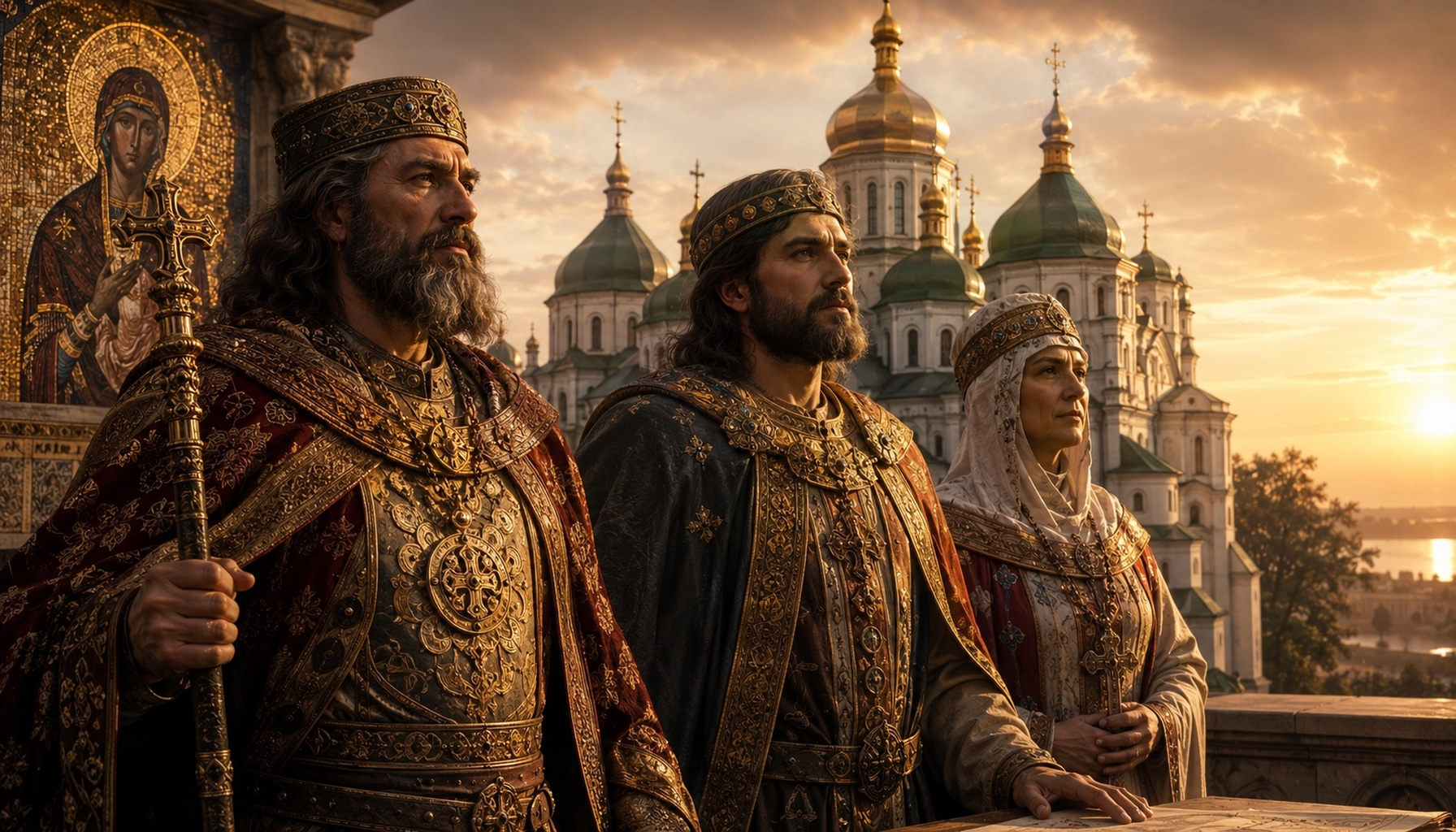
The Grand Princes of Kiev were the ruling dynasty at the heart of Kievan Rus, the great medieval polity that grew along the river routes of Eastern Europe with Kiev as its symbolic and political center. In family-history terms, they were not a single modern surname family but a dynastic tradition of princes whose power rested on bloodline, tribute, war bands, control of trade, and carefully chosen marriages. Their linked primary haplogroup here is N1a1a1a1a1a1a, a lineage that also appears in a wider northern and eastern European ancient DNA landscape. The world they came from was shaped by the Dnieper and related river systems, where Slavic communities, Norse adventurers, Byzantine missionaries, and steppe peoples all met, traded, fought, and intermarried.
That is what makes the Grand Princes of Kiev so fascinating: they belong to one of those early medieval ruling houses that sat at a crossroads and became, in effect, a machine for turning geography into power. From the late first millennium onward, Kievan Rus emerged as a networked state rather than a neat modern nation, and its princes ruled through moving courts, fortified centers, armed followings, and kin-based claims that could unite the realm one year and fracture it the next. Among the better-known figures are Vladimir II Monomakh, Mstislav I of Kiev, Yaropolk II of Kiev, Viacheslav I of Kiev, Yuri Dolgorukiy, Iziaslav II of Kiev, Rostislav I of Kiev, Yaroslav II of Kiev, Roman the Great, Rurik Rostislavich, Ingvar of Kiev, Mstislav III of Kiev, Rostislav II of Kiev, Vladimir IV Rurikovich, Daniel of Galicia, Alexander Nevsky, Lev I of Galicia, Yaroslav of Tver, Yuri I of Galicia, Andrew of Galicia, and Lev II of Galicia. Through them we can watch the Rus world evolve from a river empire tied to Constantinople into a looser constellation of princely centers whose legacies fed later Ukrainian, Belarusian, Rus, and Russian historical traditions. The adoption of Orthodox Christianity was central to this transformation, because it gave princely rule a sacred language, a literate church culture, and a durable connection to Byzantium.
Explore the House of Gediminid
A particularly evocative location anchor for this family story is Yaroslav's Court in Novgorod, one of the most important commercial and political spaces in the medieval Rus world. Traditionally associated with Yaroslav the Wise, the site stood on the Trade Side of Novgorod and functioned as a princely and mercantile hub, where the interests of rulers, merchants, and the wider city met in sometimes productive and sometimes tense fashion. This was not just a palace yard in the romantic sense. It was part of the living machinery of Rus politics, connected with markets, assemblies, churches, and long-distance exchange stretching toward the Baltic, the steppe, and Byzantium. In other words, if Kiev was the great dynastic center, Yaroslav's Court helps us see how princely authority actually operated on the ground, amid bargaining, display, ritual, and commerce. The area, as preserved within Veliky Novgorod's historic landscape, can still be visited today, which gives it that rare quality of being not merely a name in chronicles but a real place where the medieval Rus past remains visible.
Explore Viking settler history
From an ancient DNA perspective, the key point is caution as well as connection. We should not claim direct descent from ancient samples unless that has actually been demonstrated. What we can say is that haplogroup N1a1a1a1a1a1a is linked to a broad set of related or comparable samples across northern, Baltic, Scandinavian, and eastern European contexts, which helps frame the wider genetic world around the Grand Princes of Kiev. These include Pre-Vendel Age Oland Sandby Borg Sweden samples snb014, snb019, and snb019a; Early Goth Pommerania Pruszcz Gdansk Pruszcz Wielbark PCA0522; Soldier of Napoleon Grande Armee Mass Grave Vilnius Latvia YYY089B; Early Medieval Croatia Velim-Velistak VEM032 and VEM003; Baltic Iron Age Denmark Bornholm Island Slusegard CGG106751; Iron Age Baltic Tribes Lithuania Berciunai CGG017690; Medieval Poland Piast Dynasty Lad PCA0417; Germanic Iron Age Sweden Uppsala Fullero ful001; Viking Age Skara Varnhem Sweden VK399 and VK406; Viking Age Gnezdovo Russia VK224; Vendel Age Saaremaa Salme VK481, VK550, VK505, and VK508; Viking Age Oland Sweden VK533; Viking Age Gotland Frojel Sweden VK430; Viking Age Nordland Norway VK419; and even Late Bronze Age Estonia VII4. Taken together, these linked samples do not prove one princely family line, but they do place this haplogroup within the kind of northern and northeastern European genetic tapestry that formed the background to the Rus world.
Read about the medieval Piast rulers
The Grand Princes of Kiev stand at the beginning of a very large story: the making of medieval Eastern Europe through dynastic rule, Christian kingship, trade corridors, and constant negotiation with neighbors near and far. If this is part of your own family curiosity, upload your DNA to MyTrueAncestry and see whether you match the Grand Princes of Kiev story or related ancient DNA samples from the wider Rus, Baltic, and Viking-age world.
Comments