Haplogroup R1b1a1b1a1a2b1c1a1

– 5 min read


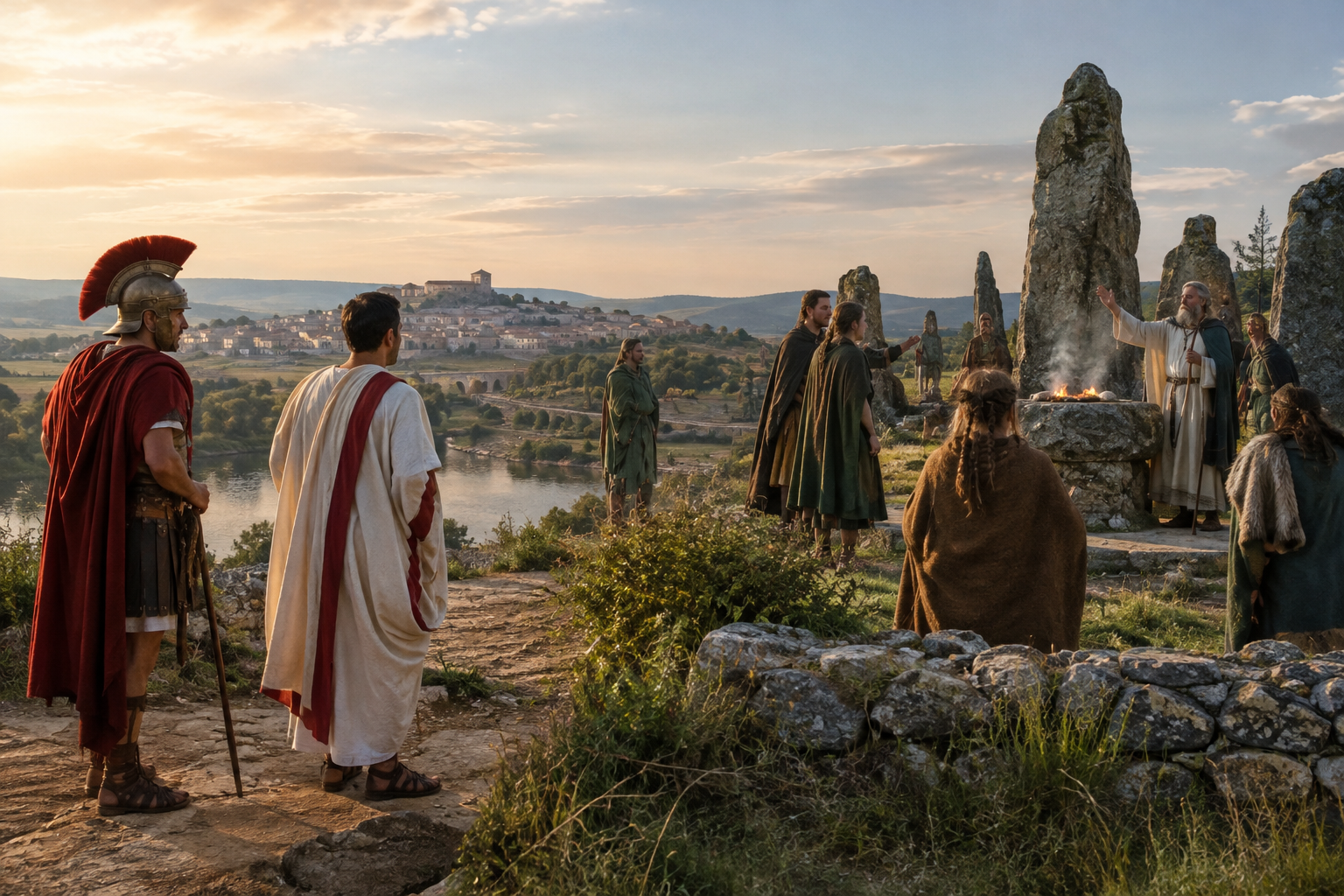
At Sarria de Ter, near Girona in northeastern Spain, one man from the late Roman world has become an unexpectedly useful signpost for the Y-DNA haplogroup R1b1a1b1a1a2b1c1a1. The individual known as I20390, dated to around AD 337, belonged to imperial Roman Spain at a moment when the western empire was still functioning but already changing in visible ways. A single Y-chromosome lineage never tells us everything about a person, but it does preserve one direct paternal thread, and in this case that thread appears in a corner of Iberia where Roman administration, local ancestry, and long regional continuity all overlapped.
The second ancient clue comes from a very different setting: I19916 from Roquepertuse in Bouches-du-Rhône, southern France, dated to around 300 BC. Roquepertuse is famous archaeologically as a Celtic sanctuary, and the appearance of this same narrow paternal branch in that context gives the lineage a more interesting shape than a simple "Roman" label would suggest. Rather than belonging to one people or one empire, this branch seems to sit inside a wider western European story linking Iron Age southern Gaul and late Roman northeastern Iberia.
Roquepertuse has long attracted attention because it belongs to the ritual landscape of Iron Age Mediterranean France, where local Celtic-speaking communities lived in close contact with Greek Massalia, Etruscans, and later Rome. That matters here because I19916 is not just an isolated chromosome label. He comes from a place already known for showing how indigenous communities in southern Gaul were neither sealed off nor simply absorbed, but active participants in a connected Mediterranean frontier.
Placing R1b1a1b1a1a2b1c1a1 in this sanctuary context does not prove that the branch was uniquely "Celtic," still less that all men at Roquepertuse shared it. What it does suggest is that this paternal line was present among Iron Age populations of southern France before the full Roman political takeover. That is an important distinction. It means the later Roman-era appearance of the branch in Spain need not be read as something newly imported by imperial movement alone.
Celtic Origins and Ancient DNA
The sample I20390 from Pla de l'Horta, Sarria de Ter, near Girona, belongs to a later and more bureaucratic world. By the fourth century AD, Hispania was deeply Roman in law, taxation, urban culture, and Christianity, yet genetically it remained a mosaic. Some lineages had deep local roots; others reflected movement from elsewhere in the empire; many people carried ancestry that had already been mixed for generations.
That is what makes I20390 valuable. He shows this paternal branch in Roman Iberia, but not in a way that forces a dramatic migration tale. Northeastern Spain was one of the most connected regions of the peninsula, linked by roads, ports, military traffic, and commerce to southern Gaul and the broader western Mediterranean. In such a setting, a lineage found earlier at Roquepertuse and later near Girona fits a plausible regional pattern: continuity, mobility, and contact across the Pyrenees rather than a single one-off episode.
Recent work on Roman-period Iberia has increasingly emphasized that the peninsula cannot be reduced to one genetic profile. Some communities show strong continuity from earlier local populations, while others reveal newcomers from other parts of Europe, North Africa, or the eastern Mediterranean. In that larger picture, a branch like R1b1a1b1a1a2b1c1a1 is best understood as one paternal thread moving within a western provincial world, not as a badge of a fixed ethnic identity.
The full label R1b1a1b1a1a2b1c1a1 is a very narrow twig on the much broader R1b tree. That broader family of lineages is widely associated with western Europe in later prehistory and history, but it would be careless to pour all of that huge background straight into this exact subclade. A deep branch name is useful because it marks a more precise paternal relationship, yet the narrower the branch, the more important it is not to overstate its age, homeland, or historical role without direct evidence.
Here, the safest observation is also the most interesting one: the branch appears in two archaeologically meaningful settings on either side of the western Mediterranean corridor, first in Iron Age southern France and later in Roman northeastern Spain. That is a real pattern, even if the sample count is still small. It hints at a paternal line circulating in populations shaped by both local continuity and interregional contact.
There is also a methodological point worth making. When ancient DNA identifies a rare or narrow lineage in two quite different contexts, the temptation is to narrate a straight-line saga from one to the other. Archaeology is usually messier than that. Between 300 BC Roquepertuse and AD 337 Girona lie centuries of alliance, conquest, trade, recruitment, intermarriage, resettlement, and ordinary family history. The chromosome marks descent through fathers; history supplies the many ways that descent could have moved.
To modern eyes, southern France and Catalonia are separate national regions. In antiquity, they often formed a connected zone. People, goods, and institutions moved through the lower Rhône, along the coast, and across the eastern Pyrenees. Long before modern frontiers, this was a corridor linking Celtic communities, Greek traders, Roman soldiers, provincial towns, and later Christian networks.
That shared geography helps explain why these two samples matter together. Roquepertuse represents the pre-Roman and early contact world of southern Gaul; Girona represents the mature Roman province in nearby Iberia. A paternal lineage appearing in both places need not indicate elite power or famous dynasties. Its importance is subtler and, in some ways, more revealing: it traces the durable human background of a region often described only through conquests and state borders.
A broader ancient DNA study of western Eurasian populations, published in Cell, is the kind of research framework that has made such comparisons increasingly possible, even when the historical value lies less in one spectacular grave than in connecting well-dated individuals across time and place.
Madrid's Diverse Ancient Origins
Two samples do not define the whole history of a haplogroup, but they can define a worthwhile question. In this case, the question is whether R1b1a1b1a1a2b1c1a1 belonged to a western European paternal background that remained in circulation from the Iron Age into late Roman times in the lands between the Rhône and northeastern Iberia. That is a modest claim, but a strong one.
It also fits well with what archaeology already tells us about the region: cultural change was real, sometimes abrupt, but populations were rarely replaced in neat blocks. Sanctuaries became Roman territories; indigenous communities became provincials; local men could serve empires without losing all connection to older regional histories. Y-DNA is especially good at illuminating this sort of continuity because it follows one lineage through historical transformations that would otherwise seem complete breaks.
Roman Iberia Population Change
For someone researching R1b1a1b1a1a2b1c1a1 today, the most responsible takeaway is not a promise of a named tribe or a noble pedigree. It is something more historically solid: this branch is attested in an Iron Age sanctuary in southern France and in late Roman northeastern Spain, suggesting a paternal line embedded in the long human traffic of the western Mediterranean frontier. That is a small archive, but a meaningful one, and it places the lineage in a real archaeological landscape rather than in a vague map of modern distributions.






Comments