Haplogroup G1a1a1b2b

– 5 min read


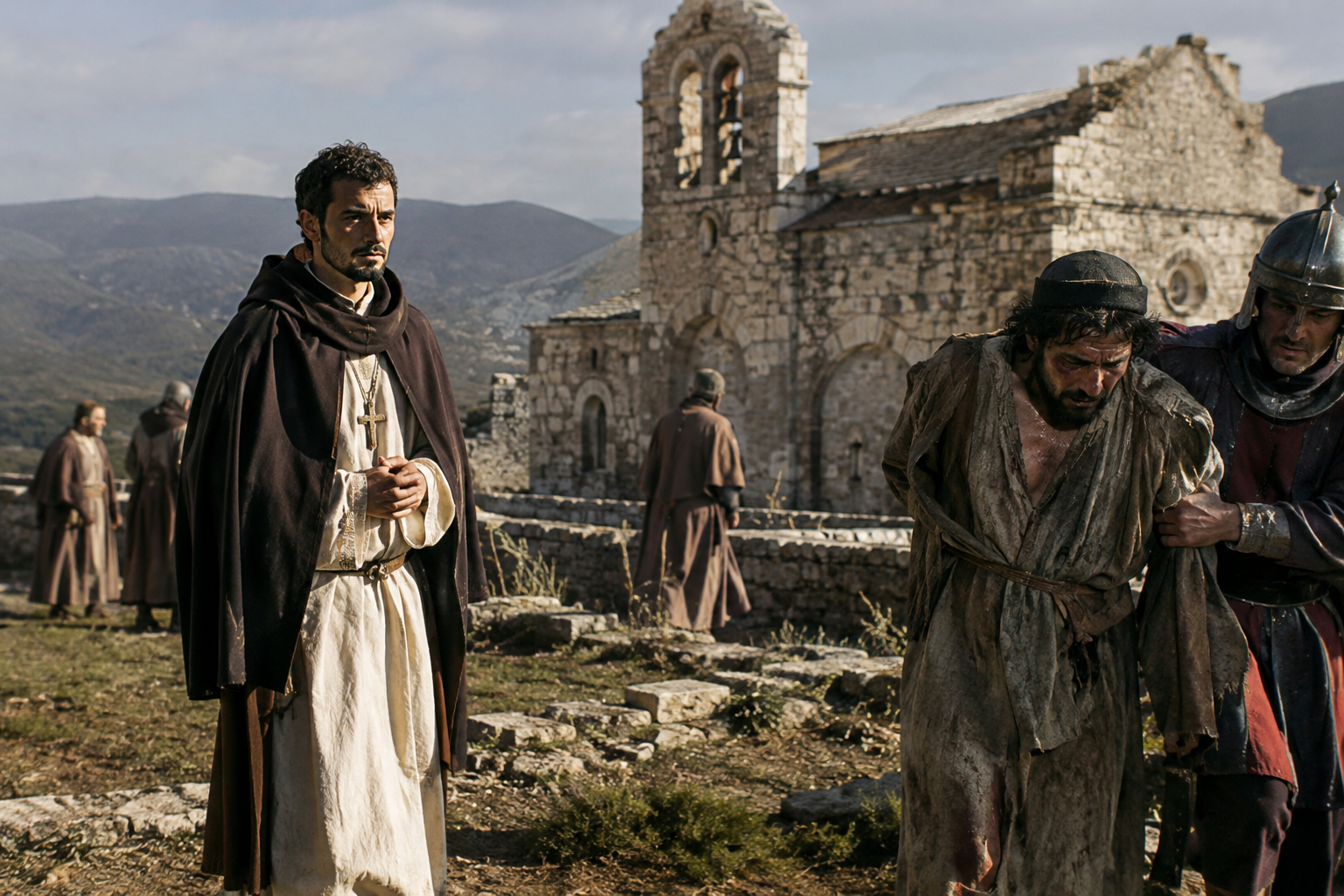
At Amiternum in Abruzzo, an early medieval burial identified as ASM_S21 offers one of those wonderfully awkward reminders that paternal lineages do not stay politely inside the borders historians later draw on maps. The man lived around AD 800, in central Italy, at a site with deep Roman roots and a long afterlife into the early Middle Ages. He is associated here with the Y-DNA branch G1a1a1b2b, a very specific paternal line whose appearance in medieval Italy is striking precisely because it is uncommon in most western European ancient datasets.
That matters because Amiternum was not some isolated hilltop fantasy of continuity. It was a real place in a changing world: a former Roman town in the Abruzzo interior, living through the centuries when imperial institutions had fractured, local elites adapted, and populations were being reshaped by movement, marriage, and the ordinary churn of human settlement. A genetic study of the area explored these transitions in ancient Amiternum and helps frame why an individual like ASM_S21 is interesting without turning one burial into a grand migration myth: research on ancient Amiternum from Roman to early medieval Italy.
Haplogroup G1a1a1b2b is a narrow branch of the broader Y-DNA haplogroup G. That broader family has a long history across parts of western Eurasia, but the exact subclade in this article should not be casually treated as if it shares every route and every historical association of all G lineages. Y-DNA traces one direct paternal line only: father to son, through many generations. It is powerful evidence, but it is not the whole ancestry of a person, still less a ready-made ethnic label.
What makes G1a1a1b2b notable here is not abundance, but context. The current sample set places it in two very different medieval settings: one in inland Italy around AD 800, and one in fourteenth-century Catalonia in a Jewish community destroyed during the violence of 1348. That is a small amount of evidence, to be sure, but it is enough to suggest that this paternal line could appear within quite different social and religious worlds in medieval southern Europe.
ASM_S21 comes from Santa Maria in Civitate at Amiternum, a landscape layered with Roman and post-Roman occupation. By around AD 800, central Italy was no longer the Italy of emperors issuing decrees from Rome, yet it was hardly empty of structure. Churches, local estates, older road systems, and surviving towns continued to organize life. That is exactly the kind of environment where unusual paternal lines can turn up without fanfare: not through dramatic invasion stories every time, but through generations of mobility, service, trade, clerical networks, marriage, and settlement.
The important point is that ASM_S21 shows G1a1a1b2b present in early medieval Italy, in a setting where ancient DNA has repeatedly shown that communities were neither frozen remnants of the Roman world nor simple replacements. They were mixed, local, and historically specific. A lineage like this could have arrived generations earlier, or persisted quietly from prior movements into Italy; the evidence from one individual cannot decide between those possibilities on its own.
Still, it does give the haplogroup a firm archaeological foothold. We are not dealing only with a modern test result floating in abstraction, but with a man buried in a known medieval landscape, attached to a former Roman center whose population history is now being reconstructed grave by grave.
The second sample, ROQ4, comes from a very different setting indeed: Tàrrega in Catalonia, dated to AD 1348. This individual is identified as a victim of the Tàrrega pogrom, one of the outbreaks of anti-Jewish violence that accompanied the Black Death years. Here the historical context is sadly clear. We are no longer looking at the slow transformations of a post-Roman town, but at a documented medieval Jewish community caught up in persecution and mass death.
That makes ROQ4 important beyond haplogroup classification alone. A lineage associated with G1a1a1b2b appears here inside a medieval Iberian Jewish context, reminding us that paternal branches travel through communities, not civilizations in the abstract. They can be preserved through endogamy, dispersed through migration, or survive catastrophe only in fragments. Research publicized on the Tàrrega burials has highlighted how genetics can help recover the biological history of people erased by violence: an ancient DNA study of the medieval Jewish community in Tàrrega.
For this article, the significance is not that ROQ4 somehow explains the entire history of the branch. It does something more useful. It places the lineage in a named medieval community, at a known historical moment, in a burial context shaped by one of the most traumatic events of fourteenth-century Europe.
At first glance, early medieval Abruzzo and plague-era Catalonia do not belong in the same story. Yet that is exactly what a rare Y-lineage can do: it forces us to think about the connective tissue of medieval history. Italy and Iberia were not sealed worlds. Clerics, merchants, soldiers, captives, craftsmen, pilgrims, and families moved across the Mediterranean and across the old Roman road networks for centuries.
That does not mean ASM_S21 was an ancestor of ROQ4, nor that both men belonged to the same ethnic or religious tradition. It means only that the paternal branch now appears in two historically real southern European settings, and that both settings make sense within the broader mobility of the medieval Mediterranean. If anything, the contrast is the point. One branch can pass through very different languages, loyalties, and communities while remaining genetically traceable along the male line.
This also fits a growing body of archaeogenetic work showing that medieval Europe was more connected, and often more locally diverse, than old national histories liked to admit. Roman legacies, late antique reshuffling, Jewish diasporic networks, and regional marriage patterns all helped shape who ended up where.
Quite a lot, if one asks the right question. They do not tell us the origin-point of G1a1a1b2b, and they do not license confident claims about a single migration route. They do, however, show that this branch was present in medieval Europe in settings that matter archaeologically and historically: a central Italian community rooted in the long aftermath of Rome, and a Catalan Jewish community caught in the violence of 1348.
That is already more informative than a bare haplogroup label. It suggests that men carrying this paternal line could be part of established local populations rather than recent strangers, and that the branch may have circulated through networks broader than any one kingdom or confession. For people exploring their own Y-DNA, that is often the most useful historical lesson: your direct paternal line may have a history that is narrower than your total ancestry, but also more geographically surprising.
There is also a methodological lesson here. Ancient DNA is at its best when it ties lineage to place. ASM_S21 and ROQ4 are not just codes. They are men from specific communities, buried in specific historical moments, and that groundedness is what keeps genetic history honest.
So the most distinctive thing we can responsibly say about G1a1a1b2b from the present evidence is this: it turns up in medieval southern Europe not as a grand imperial signature, but in the lived reality of two very different communities. One man lay in early medieval Amiternum, in a landscape still shaped by Rome's ruins and institutions. Another, centuries later, belonged to the Jewish community of Tàrrega, whose dead bear witness to one of the darkest episodes of plague-era violence. For someone researching this paternal branch today, that is a meaningful clue: your Y-line may belong to a history of movement, survival, and local belonging that crossed more than one medieval world.

Comments