Haplogroup J2a1a1b2a1b1b2

– 5 min read


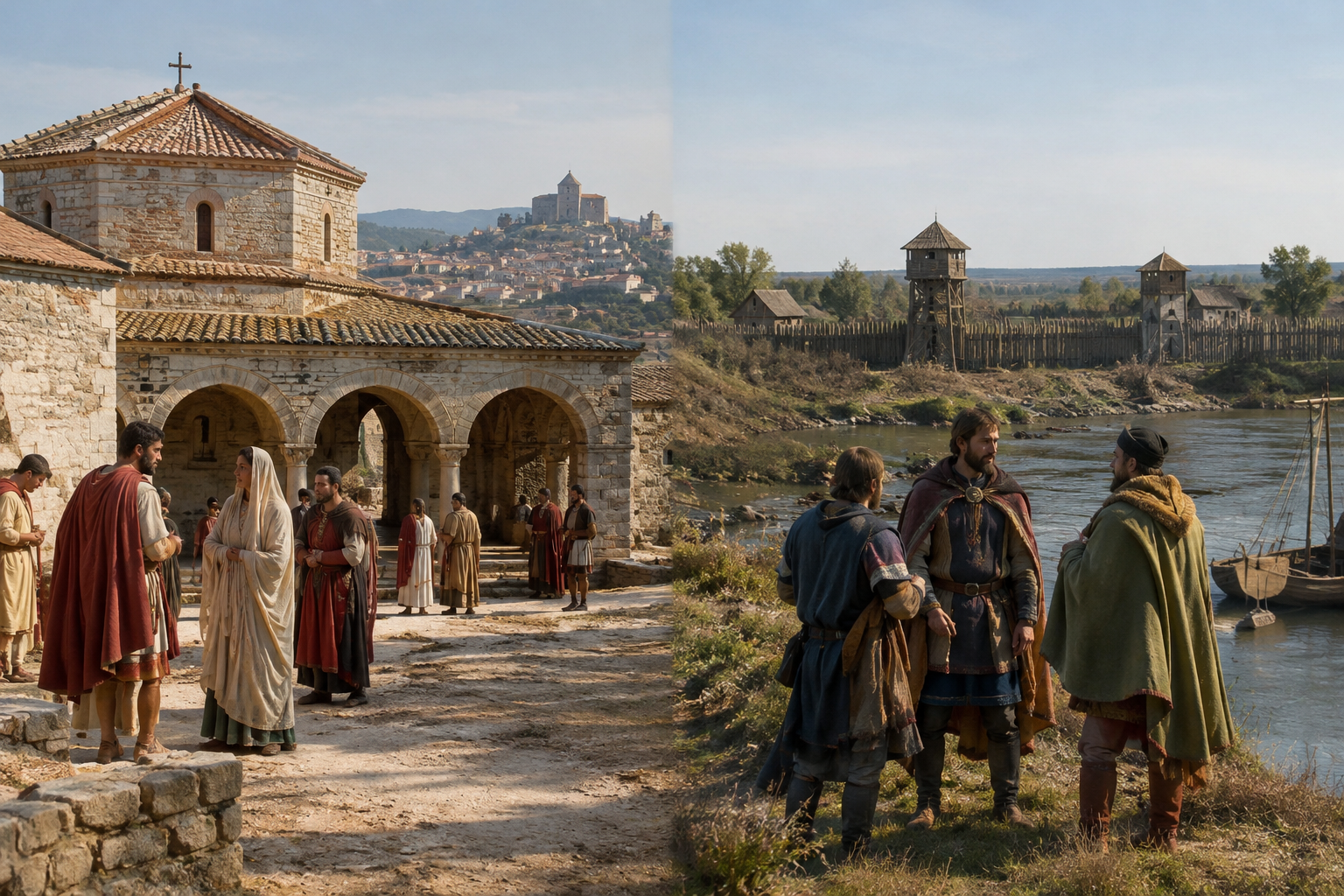
At Lucena in Cordoba province, a Late Roman burial from the basilica of Cortijo del Basilica del Coracho has produced one of the clearest ancient signposts yet for the paternal line J2a1a1b2a1b1b2. The individual, sample I37207, is dated to around AD 450, right at the moment when Roman rule in Hispania was fraying but not yet gone. That makes the find more than a dry haplogroup label: it places this lineage inside a real community living through the last century of Roman Spain.
A second appearance, this time in the Carolingian world at Zalavar-Varsziget in western Hungary, comes from sample AHS19, dated to around AD 850. Two samples do not create a dynasty or a migration map by themselves, but they do give this branch a striking historical frame: one man in Late Antique Iberia, another in an early medieval frontier zone of Central Europe. For a Y-DNA line, which traces only the direct paternal line rather than a person's whole ancestry, that is already a useful and quite vivid pattern.
The important thing to say first is that J2a1a1b2a1b1b2 is a very specific twig on a much larger paternal tree. The broader haplogroup J2 has a long and complicated history across the Mediterranean, the Near East, and parts of Europe, and it turns up in many different historical settings. That larger history should not simply be pasted onto this narrower branch as though every subclade followed the same route.
What these ancient finds do show is that a lineage associated with this precise branch, or very close to it, was present in two strongly interconnected but quite different worlds: Late Roman southern Spain and the Carolingian-era Carpathian region. In other words, this is not a story about an isolated tribe or a single ethnic label. It is a story about paternal continuity moving within societies already shaped by empire, Christianity, local traditions, and mobility.
That wider Iberian context has become much clearer through recent archaeogenetic work on Roman and post-Roman populations. A genetic study of ancient Iberia published in Cell has highlighted just how mixed, regionally varied, and historically layered the peninsula remained into Late Antiquity.
Sample I37207 comes from Lucena, in the province of Cordoba, at the Cortijo del Basilica del Coracho site. Around AD 450, this part of Hispania was living through political change without any neat break in daily life. Roman institutions were weakened, imperial authority was contested, and new powers were emerging, yet towns, estates, churches, and burial grounds continued to function. Archaeology often shows continuity first and collapse second.
That is why a paternal lineage like J2a1a1b2a1b1b2 is so interesting here. Southern Iberia had been tied for centuries into Mediterranean networks of movement, trade, administration, slavery, military service, and religion. A Y-chromosome branch found in such a setting may reflect family lines established generations earlier, perhaps long before the fifth century itself. We do not need to invent a dramatic final journey for I37207; the real point is that this man belonged to a population already shaped by centuries of Roman-era mobility.
And Lucena is not some random dot on the map. Baetica, the Roman region that included much of modern Andalusia, was one of the best integrated provinces of the western empire. Elite landholding, urban life, Christian institutions, and Mediterranean connections all ran deep there. A lineage like this appearing in that context is perfectly plausible, and in fact rather historically sensible.
The second sample, AHS19, comes from Zalavar-Varsziget in present-day Hungary, dated to around AD 850 and described here in a Carolingian imperial context. This is a very different landscape from Lucena. Instead of Late Roman southern Iberia, we are in the western Carpathian Basin, a region where Frankish influence, local populations, Christianization, and earlier Avar-period legacies all intersected.
Zalavar matters because it sat in a zone of contact. Frontier regions are rarely simple ethnic blocks; they are places where political control, marriage, military service, clerical networks, and older local communities overlap. A paternal lineage found here does not announce a single origin story, but it does remind us that male lines could persist and reappear in settings that were politically and culturally quite distinct from one another.
An ancient DNA study examining post-Roman and early medieval communities in the Carpathian Basin, published in Science Advances, has reinforced that point: this was a region of population complexity rather than tidy replacement. For J2a1a1b2a1b1b2, AHS19 suggests that the branch belonged to the broad human traffic of early medieval Europe, not just to one Mediterranean pocket.
It is tempting, when two ancient samples share a lineage, to imagine a straight line between them. Usually history is messier than that. The value of these two finds lies less in proving one direct route than in showing the kinds of societies in which this branch appears. Both men lived in worlds built from earlier imperial connections. Both inhabited Christian-era burial landscapes. And both belonged to regions where older Roman or Mediterranean patterns still mattered, even when political power had changed hands.
That pairing also fits what archaeogenetics has been teaching again and again: Europe in Late Antiquity and the early Middle Ages was not a chessboard of pure peoples moving in neat blocks. It was full of communities with mixed ancestry, mixed affiliations, and mixed histories. A Y-lineage can persist through all that, carried quietly from father to son while language, rulers, and local identities shift around it.
For southern Iberia, that means J2a1a1b2a1b1b2 may sit comfortably within the long afterlife of Roman Mediterranean connectivity. For Zalavar, it means the same paternal line could exist in a frontier society linked to Frankish power and regional reshaping. The haplogroup is the same; the historical settings are emphatically not.
One of the easiest mistakes in popular DNA history is to turn a haplogroup into a people. J2a1a1b2a1b1b2 is not the genetic equivalent of "Roman," "Spanish," "Hungarian," or any other cultural label. Sample I37207 lived in Late Roman Hispania; sample AHS19 lived in a Carolingian-era setting in Hungary. Those are historical worlds, not biological essences.
Just as importantly, a precise subclade like this one should not automatically inherit every claim ever made about broader J2. The ancient evidence here is modest but useful. It anchors the branch in documented burials from two different periods and places, and that is better history than an extravagant map full of unsupported arrows.
If you are interested in how Mediterranean-linked paternal lines can surface in later island and coastal populations as well, medieval southern Europe offers useful comparisons.
For J2a1a1b2a1b1b2, the most distinctive insight is not a grand claim of conquest or royal descent. It is the quieter fact that this paternal line is already visible in two heavily connected historical worlds: Late Roman Andalusia and early medieval western Hungary. That combination suggests a lineage at home in the long, entangled corridors of Mediterranean and European history, where families endured across political upheaval and regional change.
For someone researching this Y-DNA branch today, the responsible takeaway is not that your direct paternal ancestor was specifically a Roman official or a Carolingian settler. It is that your line has ancient evidence in populations shaped by mobility, empire, and local continuity - and that is a substantial historical story in its own right.






Comments