Haplogroup J2a1a1a2b2a1b1a

– 5 min read


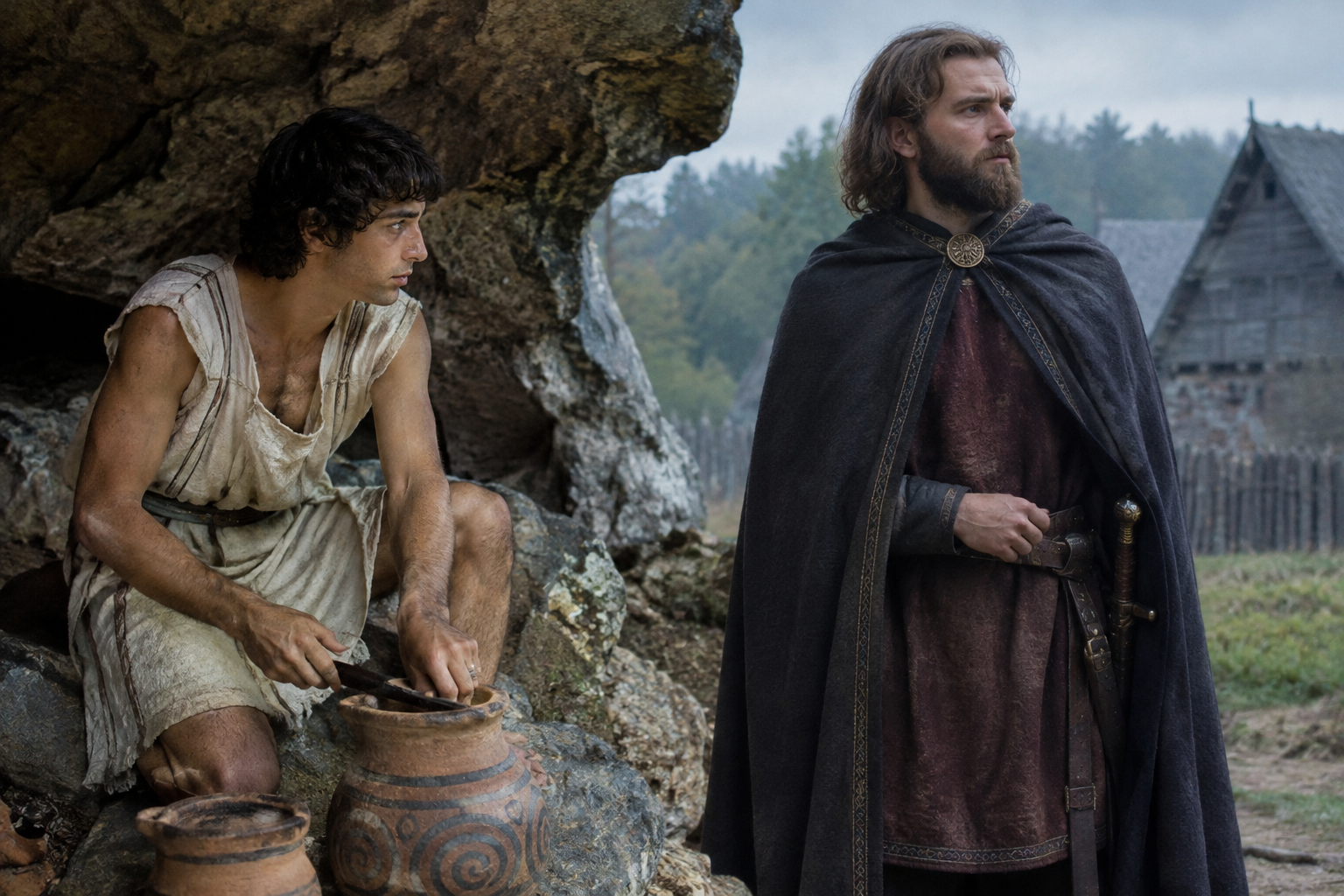
At Hagios Charalambos Cave in Lasithi, on Crete, ancient DNA has put an unexpectedly fine point on an old archaeological question: how much continuity sits beneath the famous Bronze Age cultures of the Aegean? One Early Bronze Age man from the cave, sample HGC009, dated to around 1972 BC, has been associated here with the Y-DNA lineage J2a1a1a2b2a1b1a. That matters because the cave is not just any site. It belongs to the world of early Minoan Crete, where farming villages, exchange networks, and the first steps toward the island's later palatial civilisation were already taking shape.
The second striking appearance comes much later and much farther north: Mln5, from Moemlingen in Germany, dated to about AD 650 in a Merovingian-period Frankish context. Two men, separated by more than 2,500 years and by a great sweep of Europe, are not enough to tell the whole history of a paternal line. But they are enough to make this branch interesting. They place this lineage in two very different archaeological settings: one in Bronze Age Crete, another in the early medieval world that emerged after Rome.
J2a1a1a2b2a1b1a is a very specific branch within the broader Y-DNA haplogroup J2, a lineage long associated in ancient DNA studies with parts of the Near East, the Aegean, Anatolia, and later many Mediterranean populations. Still, the wider history of J2 should not simply be pasted onto this narrower subclade. A terminal branch like J2a1a1a2b2a1b1a represents one particular paternal line within that much larger family tree, and its own documented ancient appearances are what matter most here.
Y-DNA tracks a direct paternal line only: father to son, and so on. It does not describe a person's whole ancestry, language, or cultural identity. Even so, when the same paternal branch turns up in well-dated archaeological contexts, it can help sketch the routes by which male lineages persisted, moved, or became absorbed into new societies.
A broader ancient DNA study of the prehistoric Aegean helps frame why a Cretan sample like HGC009 is so useful, because it sits within long debates over ancestry, kinship, and population structure in early island communities; for readers interested in that larger setting, see this research on the ancient Aegean.
Hagios Charalambos Cave is one of those sites that reminds us how misleading tidy textbook labels can be. "Minoan" often summons images of Knossos, frescoes, and palaces, but HGC009 belongs to an earlier horizon, before the full flowering of those later centres. In the early second millennium BC, Crete was already tied into wider Aegean and eastern Mediterranean networks, yet local communities still had their own deeply rooted histories.
The importance of HGC009 lies precisely in that combination of place and date. A man carrying a lineage associated here with J2a1a1a2b2a1b1a was present in Bronze Age Lasithi at a time when Cretan society was becoming more complex, not through some single dramatic "arrival," but through generations of mixing, continuity, and regional development. That makes this sample a useful counterweight to older narratives that tried to explain Aegean civilisation through simple invasions or neat ethnic packages.
Crete's Bronze Age populations were never isolated curiosities. They were part of a maritime world linking the island to the Cyclades, mainland Greece, and Anatolia. A paternal line found in this setting therefore fits well with what archaeology already suggests: that eastern Mediterranean male lineages were woven into the demographic fabric of the Aegean long before the classical Greek world took shape.
The jump from HGC009 to Mln5 at Moemlingen is not a straight line, and it would be irresponsible to pretend otherwise. We are not looking at a documented chain of descent from one excavated man to another. What we do have is a narrow paternal branch showing up again in a very different age: the Merovingian period, around AD 650, in what is now Germany.
That context matters. Merovingian Europe was not a sealed-off "Germanic" world in any simple biological sense. It was the heir to the Roman frontier, to military recruitment, to local continuity, and to movements of people across the Rhine and beyond. By the seventh century, communities labelled Frankish could contain lineages with far older roots in the Roman provinces or the Mediterranean, alongside others whose recent ancestry lay farther north or east.
So Mln5 is interesting not because it proves an Aegean migrant in Merovingian Germany, but because it shows that this paternal branch had become part of the population mosaic of early medieval western Europe. That is exactly the sort of pattern ancient DNA has been revealing again and again: labels such as Frank, Goth, Roman, or Alemannic describe political and cultural worlds, not neat genetic boxes.
A recent study of early medieval genomes has sharpened that picture of post-Roman Europe as a place of mixture rather than purity; for the wider background to burials like the one at Moemlingen, readers can explore this ancient DNA research on early medieval populations.
Roman-Frankish Frontier Mixing
Moemlingen sits in a region shaped by the long afterlife of Rome. Even after imperial administration faded from much of the west, roads, estates, military zones, church structures, and older settlement patterns continued to influence how communities formed. A seventh-century man like Mln5 may have belonged to a Frankish political order, but that tells us little by itself about the deeper age of his paternal line.
This is where a lineage such as J2a1a1a2b2a1b1a becomes historically suggestive. In the Roman and post-Roman west, Mediterranean-connected ancestry did not vanish when emperors disappeared. It remained in towns, countryside, army communities, and trading networks. Some paternal lines may have arrived centuries earlier; others may have moved during the upheavals of Late Antiquity. The point is not to force a single route, but to recognise that early medieval Europe was built from many layers.
Seen in that light, Mln5 belongs to a Europe that had already been cosmopolitan for a very long time. The Franks inherited landscapes populated by descendants of Iron Age communities, Roman provincials, soldiers, merchants, and incomers from several directions. A J2-derived paternal line in this setting is not an anomaly. It is a small but telling reminder of that complexity.
With only two ancient anchors supplied here, the safest interpretation is also the most historically interesting. J2a1a1a2b2a1b1a appears in an Early Bronze Age Cretan individual and again in a Merovingian-period man from Germany. That does not map a single migration event. What it does suggest is endurance: a paternal line present in the eastern Mediterranean world of Bronze Age Crete and later incorporated into the mixed societies of early medieval Europe.
For someone exploring this haplogroup today, that is the real value of the evidence. It places your direct paternal line within a documented archaeological range that stretches from the Aegean's early complex societies to the post-Roman west. Not a royal myth, not a tidy tribal label, but something more convincing: a lineage that survived by becoming part of different worlds.






Comments