Haplogroup G2a2b1a2

– 5 min read


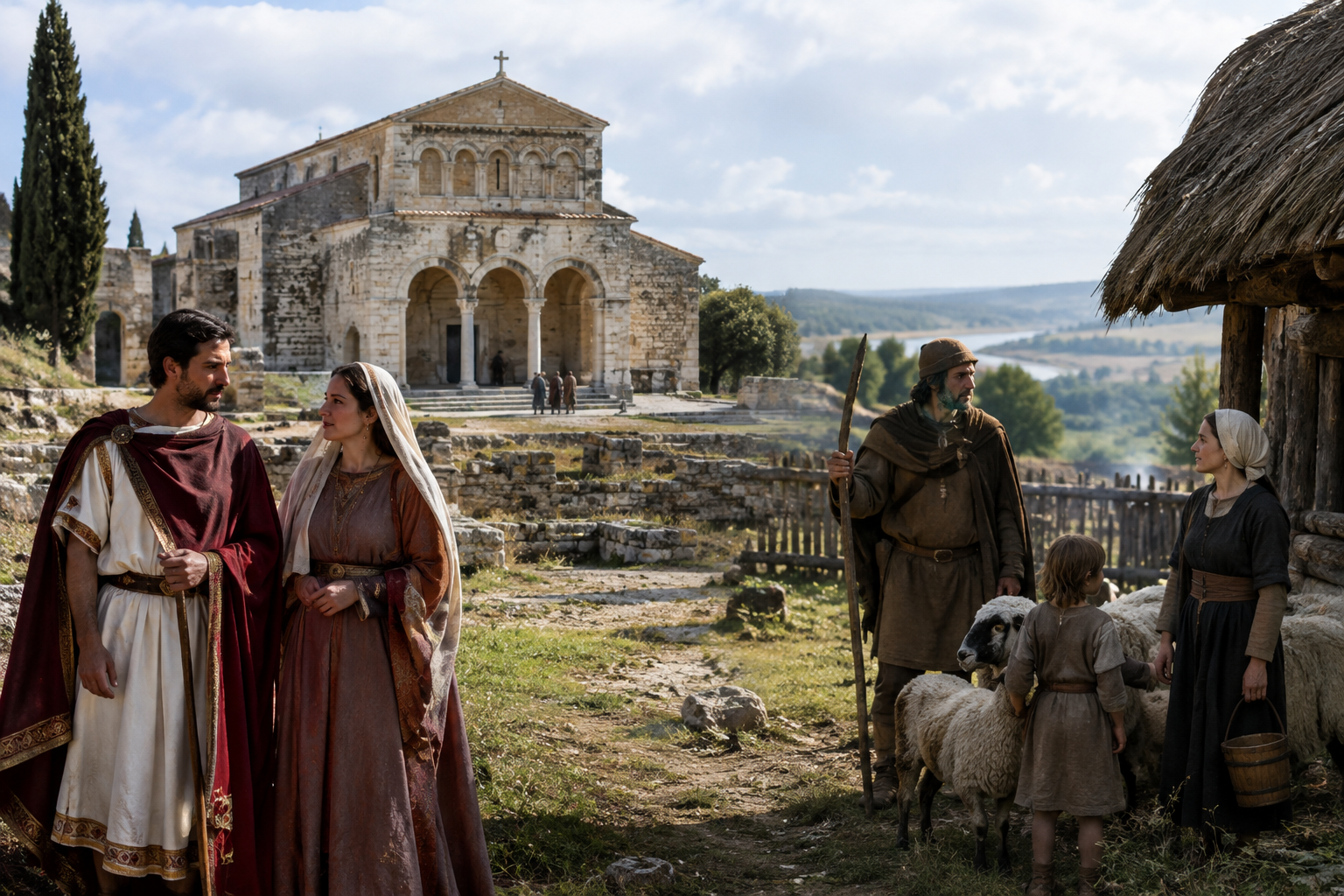
At Lucena in Cordoba, in southern Spain, one late Roman burial from the Cortijo Basilica del Coracho stands out not because of treasure or legend, but because of a Y-chromosome result. The individual identified as I37210, dated to around AD 450, has been associated with the paternal haplogroup G2a2b1a2. That is a small clue, but in archaeology small clues are often the most revealing. They show how a lineage once famous in much earlier European prehistory could still surface in the very different world of late Roman Hispania.
What makes this especially interesting is the setting. By the fifth century, Roman rule in the West was fraying, provincial society was changing, and communities in Iberia were living through political upheaval without ceasing to be deeply local. A Y-DNA result like G2a2b1a2 does not tell us everything about a man's ancestry or identity; it traces only one direct paternal line. But when that line appears in both late Roman Spain and early medieval Hungary, it hints at something worth following: not a single tribe or dynasty, but the long survival of an old paternal branch inside very different societies.
Haplogroup G is one of the classic lineages of early farming populations in western Eurasia. In broad terms, branches of G2a are strongly associated with the spread of Neolithic farmers into Europe. That larger history matters here, because G2a2b1a2 sits inside that wider family. But it would be a mistake to assume that every later carrier of this narrower branch was simply a "Neolithic survivor" in any simple sense, or that the branch had one fixed ethnic or geographic identity.
By late antiquity and the early Middle Ages, paternal lineages had already travelled through millennia of migration, local continuity, assimilation, and social change. So the real significance of G2a2b1a2 in this article is not that it proves a neat migration story. It is that it appears in two very different archaeological contexts, showing how a deeply rooted paternal line could remain present long after the worlds that first spread it had vanished.
For broader background on Iberian genetic persistence and change under Rome, see this related discussion:
The site of Cortijo Basilica del Coracho belongs to a period when southern Iberia was still shaped by Roman institutions, Roman religion in its Christian form, and Roman habits of settlement, even as imperial authority weakened. Sample I37210 comes from that late Roman environment in Cordoba province, around AD 450. The label alone does not let us invent a life story for him, but it places his paternal line firmly within a real historical landscape: one in which local communities carried on amid imperial fragmentation.
That matters because late Roman Spain was not a sealed box. It was connected to Mediterranean exchange, military movement, church structures, and regional mobility. Yet not every unusual genetic signal in this period implies a recent immigrant. Sometimes the more striking possibility is continuity: a paternal line with much older roots still present among the people of late Roman Baetica.
An ancient DNA study of Roman and post-Roman Iberia, published in Cell, has helped sharpen exactly this sort of question by examining how population structure changed, and how much endured, across the peninsula. Without overclaiming for one burial, I37210 fits neatly into that larger picture of a province shaped by empire but not genetically erased by it.
The second key sample is AHPS209W from Bodajk Homoki in Transdanubia, dated to around AD 800. By then we are in a very different historical world. The Roman Empire had long since retreated from Pannonia, and the Carpathian Basin had seen centuries of movement, reorganization, and cultural transformation. Early medieval Hungary was a zone where post-Roman communities, Avar-period legacies, and new regional formations overlapped.
That is precisely why the recurrence of G2a2b1a2 is so useful. It reminds us that early medieval central Europe cannot be reduced to a parade of incoming peoples replacing everyone before them. Some lineages certainly arrived through migration; others clearly persisted locally; many became entangled through marriage, mobility, and changing political loyalties. A paternal branch found in AD 450 Iberia and AD 800 Transdanubia is not evidence of one simple corridor between the two. It is evidence that this branch remained part of the wider European human landscape.
Research on post-Roman and early medieval populations in the Carpathian Basin, including work published in Science Advances, has increasingly shown just how mixed and regionally varied those communities were. A lineage like G2a2b1a2 fits that complexity rather well: old in Europe, but never confined to one people, one kingdom, or one historical label.
If you want a companion piece on this region's shifting communities after Rome, this article is especially relevant:
Individually, each sample is only one man. Together, they say something more interesting about scale. G2a2b1a2 does not appear here as the badge of a conquering elite or a single named people. Instead, it turns up in ordinary archaeological contexts separated by both geography and historical setting: late Roman southern Spain and early medieval Transdanubia.
This is often how ancient DNA becomes most useful. Not by providing an easy answer, but by complicating the map in productive ways. We are used to thinking in grand blocks - Roman, Visigothic, Avar, early medieval Hungarian - but paternal lineages do not obey those labels. They pass quietly through them.
There is also a nice historical irony here. Haplogroup G2a is so often discussed in connection with Europe's first farmers that readers can be tempted to leave it stranded in the Neolithic. These later samples show the opposite. Ancient branches do not disappear when textbooks turn the page. They continue inside later provinces, villages, cemeteries, and families, sometimes in places we would not particularly expect to find them.
The Lucena sample is especially valuable because Iberia is one of those regions where continuity and change have always had to be weighed carefully against each other. Roman colonization, trade, army service, Christianity, and later migration-period contacts all affected the peninsula. Yet ancient DNA has repeatedly shown that local population history was neither static nor wholly replaced from outside.
For that reason, a lineage such as G2a2b1a2 in late Roman Cordoba may speak less to dramatic movement than to survival within a region of deep demographic layering. Southern Spain had absorbed influences from across the Mediterranean for centuries, but it also retained older local ancestry in many forms. One paternal branch alone cannot decide among those layers, but it fits a wider pattern in which Roman-era Iberians were often biologically more varied, and more locally continuous, than older stereotypes allowed.
A closely related regional case is explored here:
The real lesson of G2a2b1a2 is modest but powerful. In the current evidence, it appears not as a headline empire-builder but as a durable paternal thread visible in late Roman Spain and early medieval Hungary. That suggests a branch with real staying power across major historical transitions, from the fading western empire to the reshaped societies of post-Roman central Europe.
For someone researching this haplogroup today, that does not promise descent from any famous house, nor does it pin your paternal line to one ethnicity. What it does offer is something archaeologically better: a place in a long European story of continuity, adaptation, and survival through changing worlds.
For another look at how paternal and maternal histories can diverge across time, this related post is worth exploring:






Comments