Haplogroup N1a1a1a1a1a2a

– 5 min read


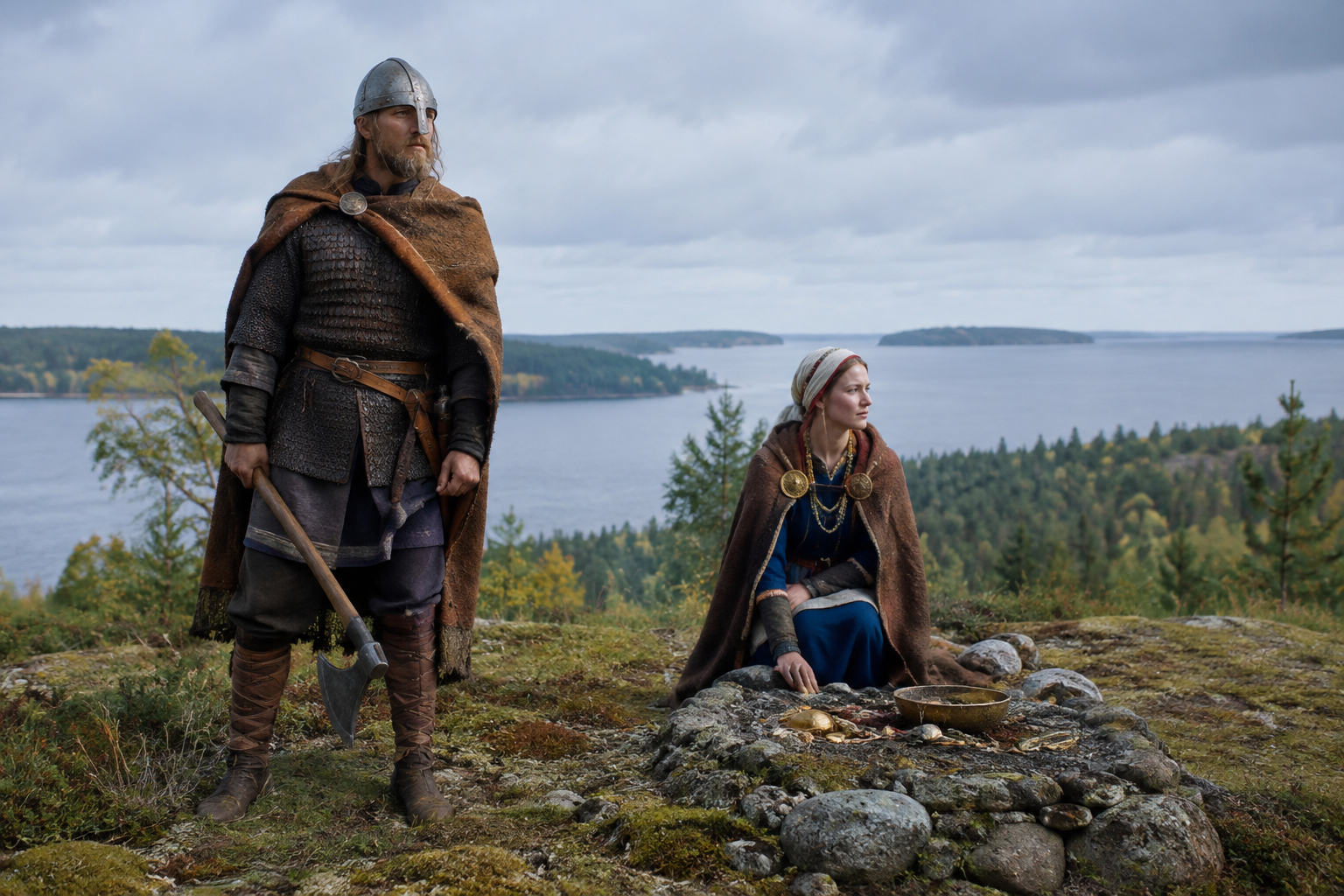
At Luistari in Eura, one of Finland's most famous medieval cemeteries, an individual labelled TU481 has been dated to around AD 1222 and identified in MyTrueAncestry's records as belonging to Y-DNA haplogroup N1a1a1a1a1a2a. That is already enough to make the burial interesting. Luistari is not some vague dot on a map: it sits in Satakunta, on Finland's western side, in a region deeply entangled with Baltic trade, local power, and the slow reshaping of society during the Christian Middle Ages.
A second man, PYL004 from the Pernio Yliskyla cemetery in southwest Finland, dated here to around AD 1125, points in the same direction. Two medieval burials, two sites in southwestern Finland, and one very specific paternal line: that is the real story worth following. Not because a Y-chromosome can tell us everything about identity - it cannot - but because a direct paternal line can sometimes pin a branch of population history to particular places and moments with striking clarity.
The haplogroup name is forbidding, but the historical point is fairly simple. N1a1a1a1a1a2a is a narrow twig on the wider Y-DNA tree of haplogroup N, a paternal lineage especially important in northern Eurasian population history. A man carrying this branch is not "defined" by it in any total sense; he also had thousands of other ancestors. But along his strict father-to-son line, this marker lets us trace one thread through medieval Finland.
That thread matters especially in Finland because paternal lineages linked to haplogroup N have long been central to discussions of Finnic and broader Uralic-speaking populations. Still, one must be careful. The broad history of haplogroup N cannot simply be poured into this exact subclade as though nothing changed along the way. What the two medieval samples really show is more modest and more valuable: this specific branch was present in southwestern Finland in the early and high medieval period.
An ancient DNA study on early medieval Finland and its regional connections helps frame why such finds matter, placing southwestern Finnish burials into a wider conversation about mobility, ancestry, and local continuity in the Baltic world: research published on these ancient Finnish populations.
Luistari is one of those archaeological sites that has become almost shorthand for early Finnish history. Its long use and rich material culture have made it central to debates about status, belief, and regional identity. The individual TU481 belongs to the later life of that landscape, around the thirteenth century, when older local traditions had not vanished but were being reworked within a changing medieval order.
The temptation with a label like "Axe Warrior" is to let the nickname race ahead of the evidence. Better to slow down. What we can safely say from the record here is that TU481 comes from medieval Satakunta, from the Luistari cemetery at Eura, and is associated in MyTrueAncestry's classification with N1a1a1a1a1a2a. That places this paternal branch within a site already famous for illuminating western Finland's connections across the Baltic Sea.
This is historically significant because Satakunta was not peripheral in any simple sense. Coastal western Finland faced Sweden, Estonia, and the commercial networks of the Baltic. A Y-lineage found here in the thirteenth century belongs to a world of local farming communities, regional elites, church expansion, and maritime contact. The chromosome itself does not tell us whether TU481 was a trader, landholder, fighter, or farmer, but it does place one paternal line firmly inside that world.
The second sample, PYL004 from Pernio Yliskyla cemetery, is dated here to around AD 1125. This makes it earlier than TU481 and places the same paternal branch in southwest Finland during a period when the region was already deeply involved in Baltic interaction but before later medieval structures had fully settled into place.
Pernio lies in an area that would have been well positioned within the coastal and inland routes linking Finland to the wider northern world. The value of PYL004 is not that it provides a dramatic individual biography - it does not - but that it strengthens the pattern. One sample can always be unusual. Two samples from neighboring historical regions, in roughly the same broad period, begin to suggest that this Y-line was not an isolated accident but part of the real paternal landscape of medieval southwestern Finland.
That is one of the quiet strengths of ancient DNA. Sometimes the important result is not a royal tomb or a sensational migration, but repeated presence in the right archaeological setting. PYL004 helps anchor N1a1a1a1a1a2a in the social geography of medieval Finland rather than leaving it floating as a purely modern genetic label.
Medieval Finland Archaeogenetics
Southwestern Finland is a particularly revealing setting for this haplogroup because it sits where several historical processes met: Finnic-speaking populations, Scandinavian influence, Christianization, and Baltic exchange. Modern discussions of Finnish ancestry often flatten all this into neat categories, but the archaeology points to something more textured. Communities changed over time, yet some local paternal lines clearly persisted through those changes.
That is where N1a1a1a1a1a2a becomes historically useful. It does not represent "the Finnish people" in any complete or exclusive sense. What it does offer is evidence for one paternal branch already established in southwestern Finland by the early 1100s and still visible there around a century later. In population terms, that hints at continuity as much as movement.
The wider history of haplogroup N across northern Eurasia has often been discussed in relation to eastern connections and the spread of Uralic-speaking peoples. But these two medieval Finnish men remind us that by the Middle Ages we are no longer looking at some distant origin story. We are looking at settled regional history: churchyards, cemeteries, local communities, and men whose direct paternal ancestry had become part of the fabric of Finland itself.
It is worth pausing over the level of resolution here. The article's focus is not merely haplogroup N in general, but the much narrower branch N1a1a1a1a1a2a. That distinction matters because broad haplogroups can span vast regions and many centuries. A tight subclade, when it appears in archaeologically meaningful contexts, can point to more specific local histories.
In practical terms, that means someone with this haplogroup today should resist the easy fantasy of tracing a straight social line to a named medieval individual. Ancient DNA almost never works like that. But it can show that your direct paternal branch belonged to populations present in medieval southwest Finland, in cemeteries such as Luistari and Pernio Yliskyla, at a time when the region was being reshaped by both continuity and change.
That is a far more interesting conclusion than any invented pedigree. It connects a living paternal line to real excavated people in a real historical landscape.
For haplogroup N1a1a1a1a1a2a, the distinctive insight is not imperial drama or aristocratic legend. It is the appearance of this paternal branch in two medieval burials from southwestern Finland: PYL004 at Pernio Yliskyla around AD 1125, and TU481 at Luistari in Eura around AD 1222. Together they place this lineage in a specific region at a historically important time, when western Finland was tied into Baltic networks while retaining strong local continuity.
If this is your paternal haplogroup, that does not prove descent from either excavated man. But it does suggest that your direct male line belongs to the same wider historical world as theirs: medieval Finland, coastal exchange, and the long local history of haplogroup N in the north.

Comments