Konrad I of Masovia

– 5 min read


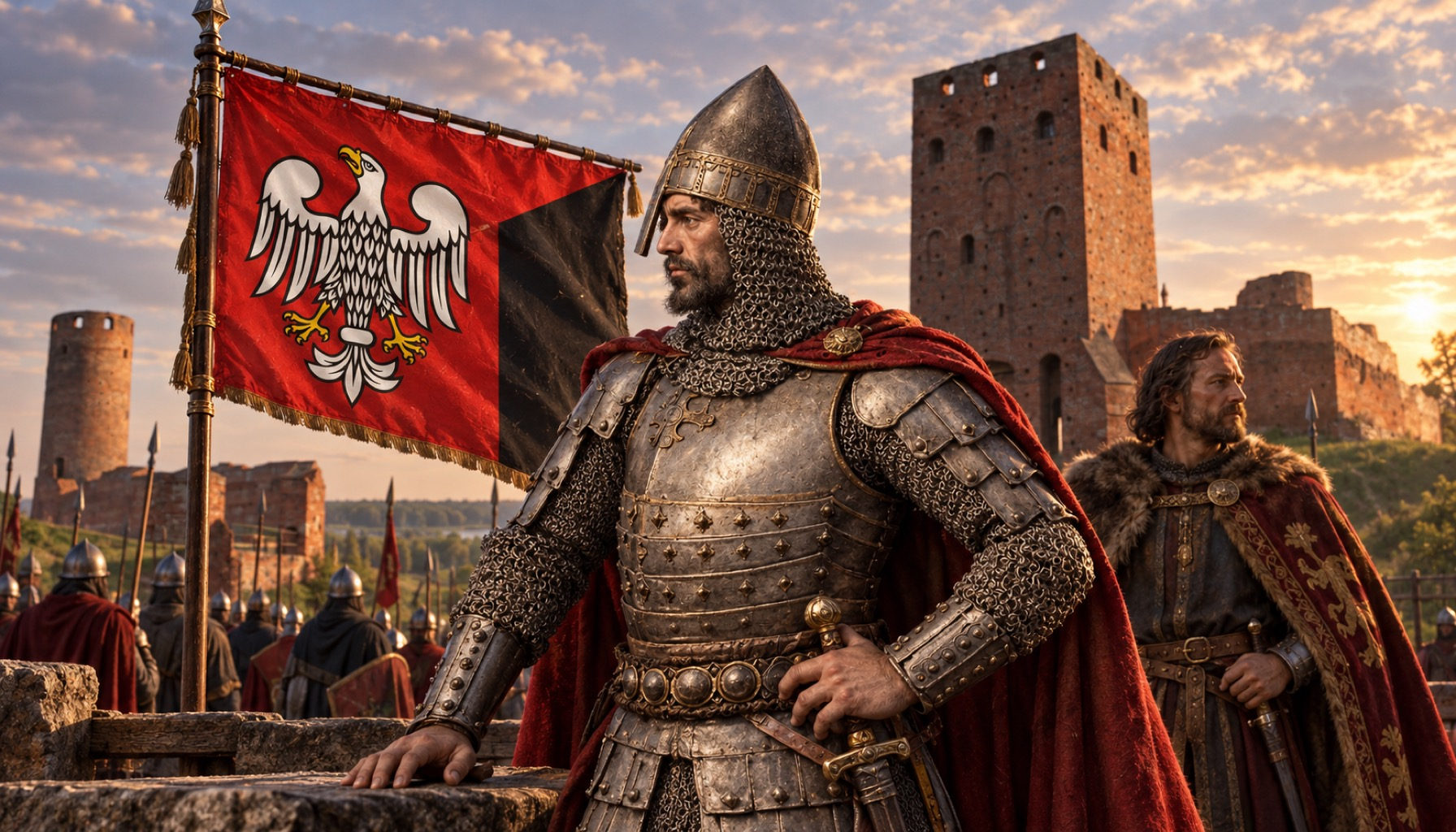
Konrad I of Masovia was one of the most consequential Piast princes of the fractured Polish Middle Ages, a ruler whose career stretched from the late twelfth century into the troubled first half of the thirteenth. Born around 1187 or 1188, the son of Casimir II the Just, he inherited lands in Masovia and Kuyavia and spent much of his life in the exhausting contest among rival Piast dukes for control of Krakow and the senior dignity of Poland.
He is historically important not simply because he twice held Krakow and the title of High Duke, but because of a decision made on Poland’s exposed northern frontier. Faced with resistance from pagan Prussian groups and the weakness of local military solutions, Konrad invited the Teutonic Knights into the region. It was a practical political move in the moment; in the long term, it helped create one of the most formidable territorial powers in the Baltic world.
To understand Konrad, one must picture Poland not as a neat kingdom but as a family inheritance repeatedly cut into pieces. The Piast realm had splintered into competing duchies, and ambitious princes spent decades manoeuvring for Krakow, whose possession carried prestige and a claim to senior authority. Konrad was a vigorous participant in this political game. He seized opportunities, built alliances, fought rivals, and twice gained control of Krakow, though never securely enough to restore lasting unity. His power base lay in Masovia and Kuyavia, lands important in their own right and strategically placed between the Polish heartlands and the forested, contested north.
That northern frontier mattered enormously. There the Christian principalities of the Piasts met the still unconquered Prussian peoples. Raiding, counter-raiding, missionary ambition, and territorial expansion all collided. Konrad’s invitation to the Teutonic Order, intended to strengthen the border and advance conquest and conversion, had consequences beyond anything a single duke could easily contain. The Order did not remain a mere auxiliary force. It built its own political and military state in Prussia, reshaping the history of Poland, the Baltic, and eastern Europe for centuries. Konrad’s descendants remained important among the Masovian Piasts, and through his son Casimir I of Kuyavia he became grandfather, in dynastic terms, to the line that led to King Wladyslaw I the Elbow-high.
The biological sample associated with him is listed as Piast Prince Konrad I, with an approximate sample date of 1247 AD, the year of his death. That places the remains squarely in the world of the historical Konrad rather than in some distant ancestral horizon. In practical terms, this is precisely what makes such a sample interesting: it potentially connects a named medieval ruler, known from chronicles and dynastic history, to a genomic dataset.
That said, identification needs careful wording. The supplied material links sample PCA0665 to Konrad I of Masovia, but it does not provide the full chain of archaeological and historical reasoning by which the remains were matched to the duke. So the responsible position is this: the sample is presented as belonging to Konrad I, but without the underlying identification details reproduced here, one should avoid overstating certainty about the mechanism of attribution. Ancient DNA is at its best when paired with documented burial context, osteology, chronology, and, where possible, kinship analysis with related burials.
The broader research context, including the study published in Nature Communications at https://www.nature.com/articles/s41467-026-71457-1, is important because work on medieval elite burials can illuminate dynastic relationships, lineage continuity, and the biological history of ruling houses. Such studies do not replace written history, but they can test, support, or complicate it in fascinating ways.
The reported Y-DNA haplogroup for this sample is R1b1a1b1a1, while the mitochondrial DNA haplogroup is T2b2b1. These two results describe very different inheritance paths. Y-DNA follows the direct paternal line, passed from father to son, while mtDNA follows the direct maternal line, passed from mother to children. So in Konrad’s case, the Y-line speaks only to one narrow chain of fathers, and the mtDNA speaks only to one narrow chain of mothers. Neither represents his whole ancestry, which was of course far broader.
R1b1a1b1a1 belongs to a wider paternal lineage that appears across much of western and central Eurasia in both ancient and modern populations. On its own, it does not label Konrad as “Celtic,” “Germanic,” “Polish,” or anything similarly simplistic. Haplogroups are lineages, not ethnic badges. What matters historically is that the paternal line reported for this Piast prince can now be discussed in relation to other ancient individuals and dynastic samples rather than guessed from later legend or modern surname lore.
T2b2b1, his reported mitochondrial lineage, is a maternal branch within a broader mtDNA family with deep roots in West Eurasian prehistory. Again, this does not reveal the identity of a named medieval ancestress. It tells us only about one maternal thread among many. Still, maternal lineages are often neglected in dynastic storytelling, so it is rather pleasing when they can be recovered at all.
A short ancient-DNA comparison is worthwhile here. Among R1b1a1b1a1-linked ancient samples, the most immediately relevant parallel is another Piast-context individual, Piast Dynasty Poland Santok Lubusz Province Gorzw Wielkopolski (PCA0503), because it belongs to the same broad medieval Polish dynastic world. Beyond that, the same wider paternal lineage also appears in a strikingly mixed set of earlier and later individuals, including Elite Celtic Germany Eberdingen-Hochdorf Biegel (HOC001), Bronze Age Unetice Thuringia Leubingen Sommerda Germany (LEU064), Lombard Warrior Elite Collegno Northern Italy (COL_150), Prince Andras Arpad Dynasty (HU52), and Vendel Age Elite Boat Burial Uppsala Sweden (ven001). The point is not that Konrad was closely related to all these people; plainly he was not. Rather, his Y-line sits within a very old and geographically widespread paternal network seen in elite, ordinary, prehistoric, and medieval burials across Europe.
For the maternal side, the supplied T2b2b1-linked comparison is more focused: Piast Prince Konrad I (PCA0665) itself. That means the mtDNA result is presently most useful here as an identifying feature of this individual sample, rather than as part of a longer list of directly comparable maternal matches in the material provided.
Konrad I of Masovia is a wonderful example of what ancient DNA can and cannot do. It can give us biological data from a man already famous in the written record, potentially helping scholars examine dynastic continuity, paternal and maternal lineages, and the authenticity of elite burials. It cannot, by itself, explain his politics, his ambitions, or the fateful calculation behind bringing in the Teutonic Knights. Those remain the business of history. But when genetics and history meet in a figure like Konrad, they give us something rare: not an abstract medieval nobleman, but a documented ruler whose life changed the map and whose lineage can now be studied at the molecular level.
At MyTrueAncestry, you can compare your DNA with ancient populations and archaeological samples from the worlds that shaped medieval Europe, including dynastic, frontier, and Baltic-era contexts like those surrounding Konrad I of Masovia. It is a chance to explore deep genetic connections to the past without pretending that a shared lineage alone can prove direct descent from any one ruler.



Comments