Kazimierz I

– 5 min read


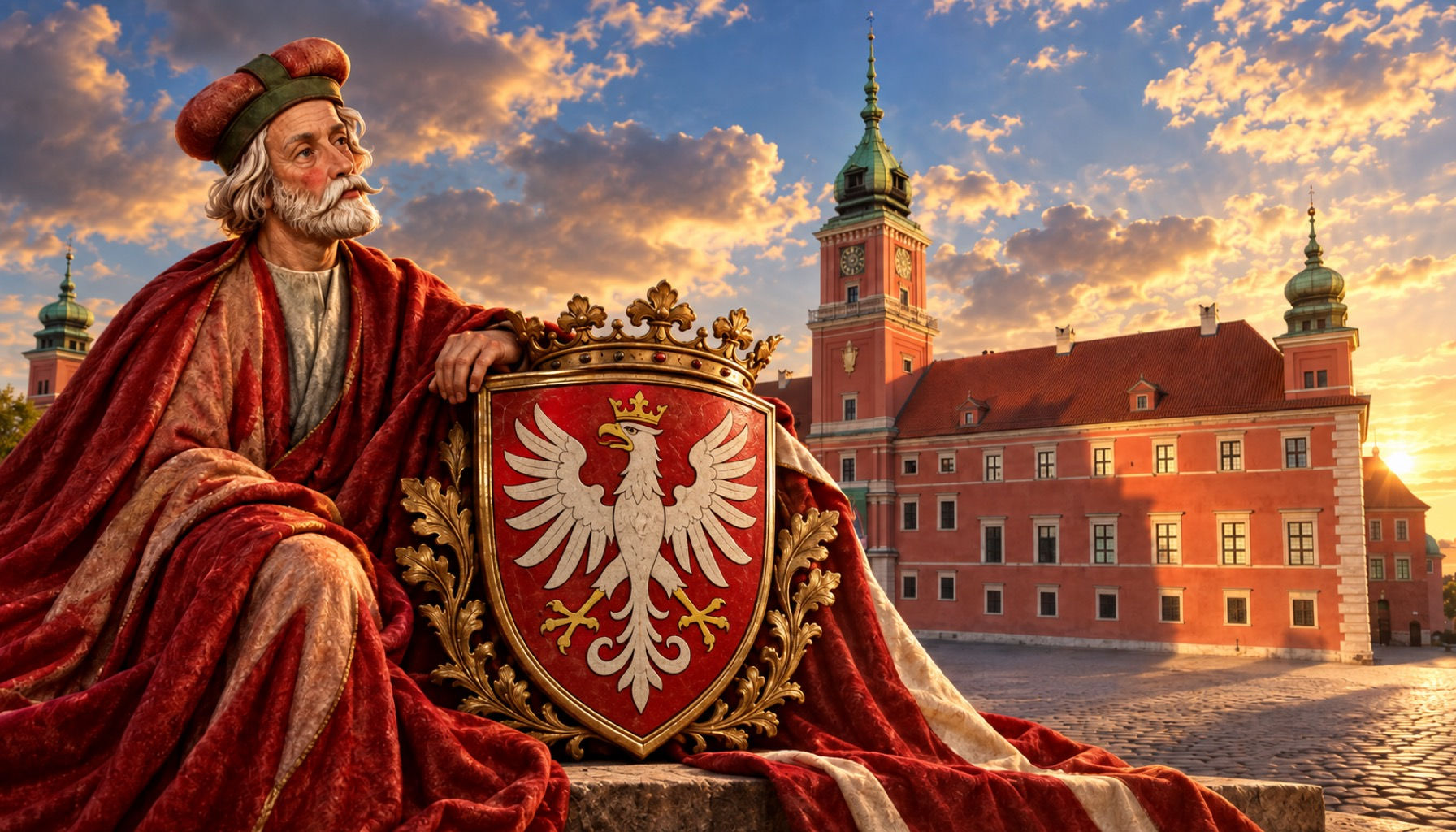
Kazimierz I of Warsaw belongs to that fascinating moment when medieval Poland was still a mosaic of Piast-ruled duchies rather than a neat block on a modern map. He lived in the 14th century and ruled in Masovia, a frontier-minded region shaped by dynastic bargaining, pressure from Lithuania, and the long afterlife of Piast family politics. Historically, he matters above all because he was the first Masovian prince to make Warsaw the main center of an independent Piast duchy and to style himself Lord of Warsaw.
That may sound like a technical shift in titulature, but it was much more than that. It marked a political reorientation toward Warsaw itself, a place that would, in the centuries ahead, become one of the great urban and political centers of Poland. Kazimierz stands at an early stage of that story: not the founder of the city, of course, but one of the rulers who helped turn it from a regional stronghold into the heart of princely power in Masovia.
Traditionally, Kazimierz I is regarded as a son of Trojden I of Czersk and Maria of Galicia-Volhynia, which places him squarely in the Masovian branch of the Piast dynasty and also in a wider network stretching eastward into Ruthenian political circles. He initially ruled jointly with his brother Siemowit III, as so often happened in Piast politics, where inheritance was less a clean transfer than an ongoing negotiation among brothers, cousins, and local power bases. After the division of their territories, Kazimierz took control of Warsaw and the surrounding lands.
This was not a quiet inheritance. Masovia sat in a world of unstable frontiers, and warfare with Lithuania formed part of Kazimierz’s political reality. In the aftermath of conflict, he took part in rebuilding and strengthening Warsaw and its ducal defenses. That detail matters. Medieval rulership was not just a matter of seals and charters; it was timber, earthworks, walls, markets, and the hard business of making a town defensible and governable. Kazimierz later received Sochaczew and acknowledged the overlordship of King Casimir III the Great of Poland, a reminder that even assertive regional princes still operated within larger hierarchies of power. He died childless in 1355 and was buried at Płock Cathedral, one of the great dynastic burial places of Masovia.
The biological sample associated with him is listed as Kazimierz I Piast Masovian Dynasty, dated approximately to 1355 AD. The supplied historical context also notes that modern archaeogenetic research has associated one of the studied Piast skeletons with Kazimierz. That wording is important. It suggests a research-based attribution rather than a casual label, but it does not by itself tell us every step by which the identification was established.
What can be said securely is that Kazimierz was historically buried at Płock Cathedral, and that one of the Piast remains studied in the recent research has been associated with him. Without further identification details in the supplied material, the most careful way to describe this is as a strongly supported research attribution, rather than an absolutely certain identification beyond all dispute. Ancient DNA work is often at its best when paired with burial context, chronology, dynastic expectations, and kinship patterns across several individuals, and that is precisely why royal and princely cemeteries are so historically valuable.
In other words, the interest here is not simply that “a skeleton was tested,” but that a member of the Masovian Piasts appears within a broader dynastic genetic dataset. For medieval historians, that is gold dust: the bones in the cathedral begin to speak not only through chronicles and tomb tradition, but through genomes.
The reported Y-DNA haplogroup for this sample is R1a1a1b1a2b3a3a2g2. Y-DNA follows the direct paternal line, from father to son, and so it is especially relevant in a patrilineal dynasty like the Piasts, where questions of male-line continuity are historically central. The reported mtDNA haplogroup, which tracks the direct maternal line, is unknown or not determined here, so we should simply say that the maternal-line haplogroup has not been established in the supplied data.
Now, a haplogroup is not an ethnicity badge, and it certainly is not a shortcut to saying “this proves someone was Polish” or “this proves Piast identity.” That would be far too crude. What it does provide is a lineage marker along one single line of descent. In Kazimierz’s case, that paternal marker is historically useful because it can be compared with other tested Piast males to examine whether the expected male-line continuity holds up genetically. That is one of the genuinely exciting contributions of the recent Piast archaeogenetic work discussed in the Nature article at https://www.nature.com/articles/s41467-026-71457-1.
A short ancient-DNA note is worth adding here. The same R1a1a1b1a2b3a3a2g2-linked cluster includes not only Kazimierz I Piast Masovian Dynasty (PCA0575) but also other Piast-related individuals such as Piast Masovian Dynasty Prince (PCA0618), Wenceslaus of Płock Piast Masovian Dynasty (PCA0654), and several other Piast males in the dataset. More distantly, the same broader paternal lineage also appears in a strikingly wide range of ancient and medieval contexts across Eurasia, from samples such as Hungarian Royal House of Aba Samuel Aba Benedictine Monastary (HUASper55A) to Iron Age, Roman, medieval, and even much older prehistoric individuals. That breadth does not make them close relatives of Kazimierz; quite the reverse, it shows how deep and time-layered such paternal lineages are.
As for the maternal side, the mtDNA haplogroup remains unspecified, so the only ?-linked sample we can mention with confidence is Kazimierz I Piast Masovian Dynasty (PCA0575) itself. This is a useful reminder that ancient DNA datasets are often uneven: sometimes the paternal line is clear while the direct maternal-line label is absent, uncertain, or unpublished in summary form.
Kazimierz I’s DNA is historically interesting not because it magically reveals his personality or politics, but because it anchors a documented medieval ruler inside a biological family history. He was a prince known from written sources, connected to named relatives, tied to a known burial tradition, and active at a decisive stage in Warsaw’s early rise. When a genome can be associated with such a figure, historians gain a new way to test dynastic continuity, compare branches of the Piast house, and refine the genealogy of the Masovian line.
Still, there are limits. A Y-DNA haplogroup cannot tell us whether Kazimierz felt more Masovian than Polish, how he understood his own rulership, or what language he used at court on a given day. It cannot, by itself, settle every contested genealogical detail either. What it can do is add an independent line of evidence to the old work of chronicles, seals, tombs, and charters. That is the real pleasure of archaeogenetics: not replacing history, but making it more exact.
Compare another medieval dynasty
MyTrueAncestry lets you compare your DNA with ancient populations and archaeological samples from the worlds that shaped medieval Europe, including dynastic and regional contexts like those of the Piasts and Masovia. It cannot prove direct descent from Kazimierz I, but it can help you explore whether your ancestry shows genetic connections to the deeper populations and lineages behind this historical landscape.



Comments