Haplogroup T1a2b1

– 6 min read


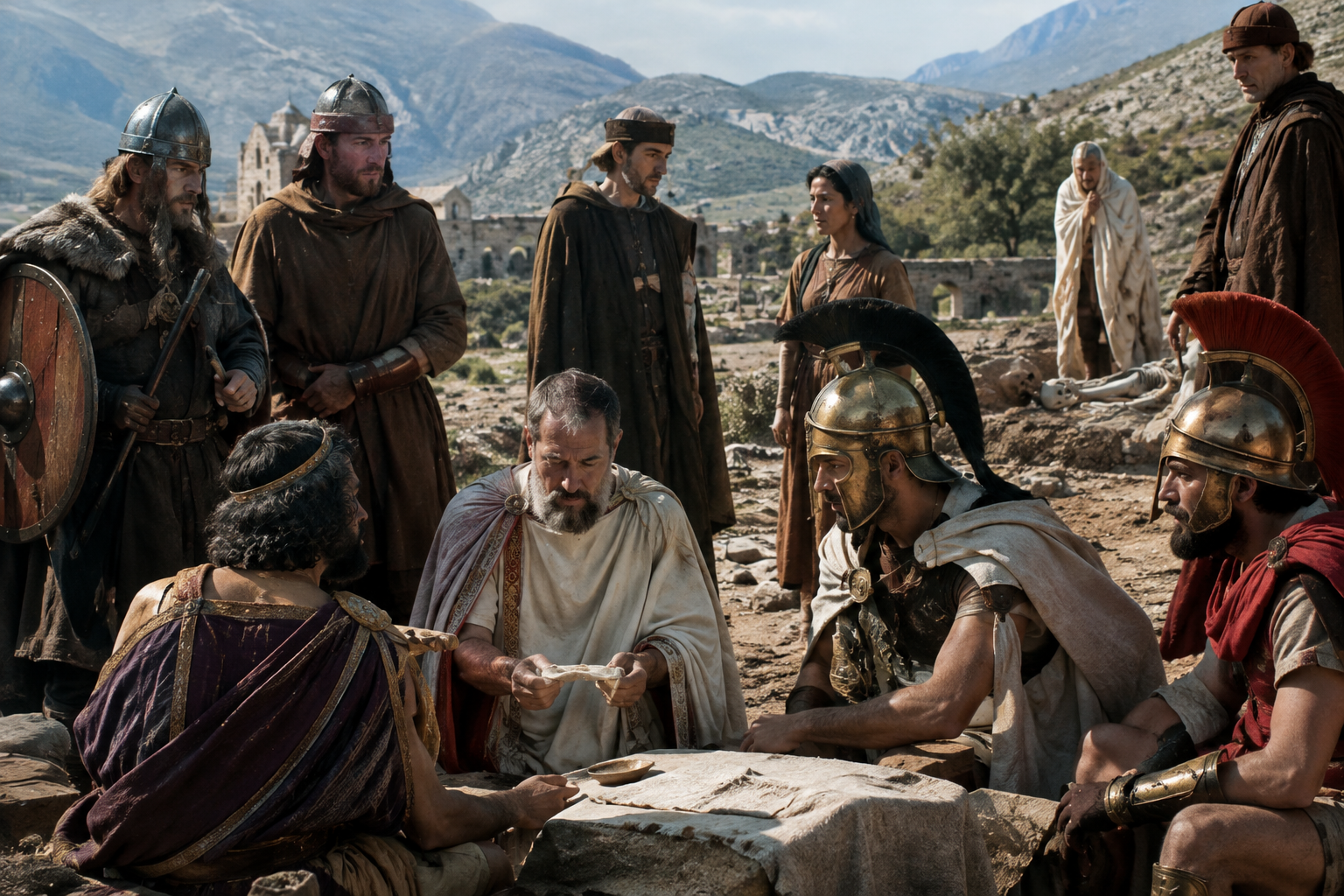
Some Y-DNA haplogroups turn up where you expect them. Others appear like a historian's nuisance in the best possible sense: in places that force you to rethink tidy maps. T1a2b1 belongs very much to that second category. It is a paternal lineage within haplogroup T, a branch of the human Y-chromosome tree that has long been associated, in broad terms, with parts of the Near East, northeast Africa, and the Mediterranean world. But the story becomes more interesting when we look at ancient DNA. Suddenly this lineage appears among Greek warriors in Sicily, a Phoenician-connected individual at Delphi, a Late Roman man in Spain, a medieval burial in Albania, a Lombard-period grave in Italy, and even a Viking Age individual in Sweden.
That does not mean one simple "people" marched across history carrying T1a2b1 like a flag. Y-DNA does not work like that. It traces only one direct paternal line out of the thousands that make up a person's ancestry. Still, paternal lineages can be remarkably useful. They let us track strands of male-line continuity, mobility, and mixture that written sources only partly capture. In the case of T1a2b1, the evidence points not to one ethnic label, but to movement through the interconnected worlds of the eastern Mediterranean, the central Mediterranean, the Balkans, and parts of Europe beyond.
Haplogroup T is a relatively uncommon but historically widespread Y-chromosome lineage. Its deeper origins are usually discussed in connection with western Asia and neighboring regions, though the exact pathways by which its many branches spread are still the subject of active research. A narrow subclade such as T1a2b1 should not simply inherit the whole biography of haplogroup T. What matters is where this specific branch appears in securely dated ancient remains.
That is where the picture becomes rather Mediterranean. The current sample set suggests a lineage at home in zones shaped by seafaring, trade, colonization, war, and empire. Greek, Phoenician, Roman, Illyrian, Lombard, Balkan, and even Scandinavian contexts all appear. Not because T1a2b1 "belongs" to all those identities in any simplistic way, but because men carrying related paternal lines moved through those historical worlds.
Explore How Ancient DNA Rewrites History
Some of the most striking evidence comes from the ancient Mediterranean at war. At Himera in Sicily, three individuals linked to the great conflicts between Greeks and Carthaginians carry this lineage: I7218, an Ancient Greek Warrior First Sicilian War Himera Sicily Year:480 BC; and I7224 and I7224x, both listed as Ancient Greek Warrior Second Sicilian War Himera Sicily Year:409 BC. Himera was one of those frontier places where Greek colonial ambition, local Sicilian politics, and Carthaginian power collided violently.
What makes these men so interesting is not that they prove all Greek soldiers shared one paternal origin; plainly they did not. Instead, they show that T1a2b1 was present in the military and settlement networks of classical Sicily. That fits a broader archaeological truth about the island: Sicily was never a sealed box. It was a place where lineages from different shores met, fought, settled, and intermarried.
Another revealing sample is I17962, recorded as Carthago-Phoenician Phokis Delphi Greece Year:663 BC. Delphi is usually imagined as the great Greek sanctuary, which it was. But sanctuaries were also crossroads. Pilgrims, merchants, envoys, and foreigners came through constantly. A Phoenician-connected individual in that setting is a reminder that the Mediterranean was knitted together by movement long before Rome made it a political unit.
So when T1a2b1 appears in both Greek and Phoenician-associated settings, the sensible conclusion is not direct kinship between these specific men. It is that this paternal branch was circulating in the same maritime world that linked the Aegean, Sicily, southern Italy, and beyond.
Discover the DNA of Ancient Greek Armies
By Late Antiquity, the Roman Empire had turned mobility into a daily fact of life. Soldiers, officials, merchants, clergy, slaves, and settlers crossed enormous distances. In that context, I35899, the Late Roman Spain Cordoba Lucena Cortijo Basilica del Coracho Year:450 AD sample, matters a great deal. Here T1a2b1 turns up in southern Iberia, one of the empire's most cosmopolitan provinces. Late Roman Spain was not merely "local Iberian" in genetic terms, and ancient DNA keeps showing just how connected it remained.
Further east, we find CL23, listed as Roman-Illyrian Lombard Grave Year:580 AD. That description alone hints at the untidiness of post-Roman Europe. "Roman," "Illyrian," and "Lombard" are not neat biological categories; they are overlapping political, cultural, and regional identities. A single grave can sit at the meeting point of imperial legacies and new migrating elites. T1a2b1 here suggests continuity and mixture in the Adriatic and Italian worlds after the collapse of western Roman rule.
Then there is I14622, Medieval Albania Cinamak Kukes District Year:830 AD. This is especially valuable because it places the lineage in the medieval Balkans, where questions of continuity, migration, and local survival are often debated with more heat than evidence. One sample does not settle those arguments. But it does show that a T1a2b1 paternal line was present in northern Albania in the early medieval period, adding a useful data point for the region's complex demographic history.
Readers interested in that wider Balkan background may want to follow the recent work on Albanian population history, which helps frame why a lineage like this can appear in both ancient and medieval regional contexts.
Read About Ancient DNA and Albanian Origins
If you thought this was purely a Mediterranean story, VK398 complicates it nicely. This sample, Viking Age Skara Varnhem Sweden Year:1050 AD, places T1a2b1 in Viking Age Scandinavia. That does not make it a "Viking haplogroup" in any exclusive sense. It does, however, show that by the 11th century this paternal line had reached, or persisted in, northern Europe as well.
How? Several possibilities exist: long-distance trade, earlier Roman-era movement, migration through continental Europe, or the ordinary fact that medieval populations were less isolated than modern nationalist histories sometimes imagine. Scandinavia in the Viking Age was connected to the Baltic, the North Sea, the rivers of eastern Europe, Byzantium, and the Islamic world. A southern-associated Y-line turning up there is surprising only if we assume the medieval world was parochial. It was not.
That broader Scandinavian context is worth exploring alongside new work on Viking and post-Viking burials, which often reveals just how varied these communities could be.
Explore Viking Age DNA Diversity
Two entries in this set deserve especially careful handling. CD12, described as Turin Shroud Foot Region Linen Fragment Turin Italy Year:1978 AD, is not a straightforward ancient human burial at all, but a tested linen fragment associated with the Shroud. Any DNA result from such material raises obvious questions about contamination, handling history, and interpretation. It is historically fascinating, but not comparable in evidential weight to a securely excavated skeleton.
Likewise, I3403, Skeleton Lake Traveller - Hellenic Year:1805 AD, belongs to a much later context and reflects the extraordinary mobility of more recent centuries. It reminds us that paternal lineages do not stop moving once the medieval period ends. Merchants, soldiers, pilgrims, laborers, and wanderers continued to carry them across continents.
The main lesson of T1a2b1 is not pedigree romance. It is connectivity. This lineage appears, in the evidence supplied here, in places shaped by exchange: Greek Sicily, Phoenician-linked Delphi, Roman Spain, Lombard Italy, medieval Albania, Viking Age Sweden. That is a map of contact zones.
Ancient DNA gives us a different kind of history from castles, chronicles, and family trees. Written genealogy can tell us who claimed descent from whom. Archaeogenetics can show that paternal lines often crossed political and cultural boundaries with startling ease. Sharing a haplogroup with an ancient warrior or a medieval burial does not prove direct descent, still less membership in any noble house. But it can place your paternal line in the same broad human story: one of movement, adaptation, and survival across many centuries.
If your own Y-DNA falls near T1a2b1, the most responsible way to think about it is not "I am descended from that exact man," but "my paternal line may belong to one of the historical streams that moved through these worlds." That, in truth, is interesting enough.
Upload your DNA to MyTrueAncestry to explore whether your results show connections to ancient individuals, archaeological cultures, and historical populations like those discussed here. These comparisons can open a remarkable window onto your deep ancestry, while still respecting the difference between genetic similarity and proven family descent.
Comments