Haplogroup T1a2a

– 5 min read


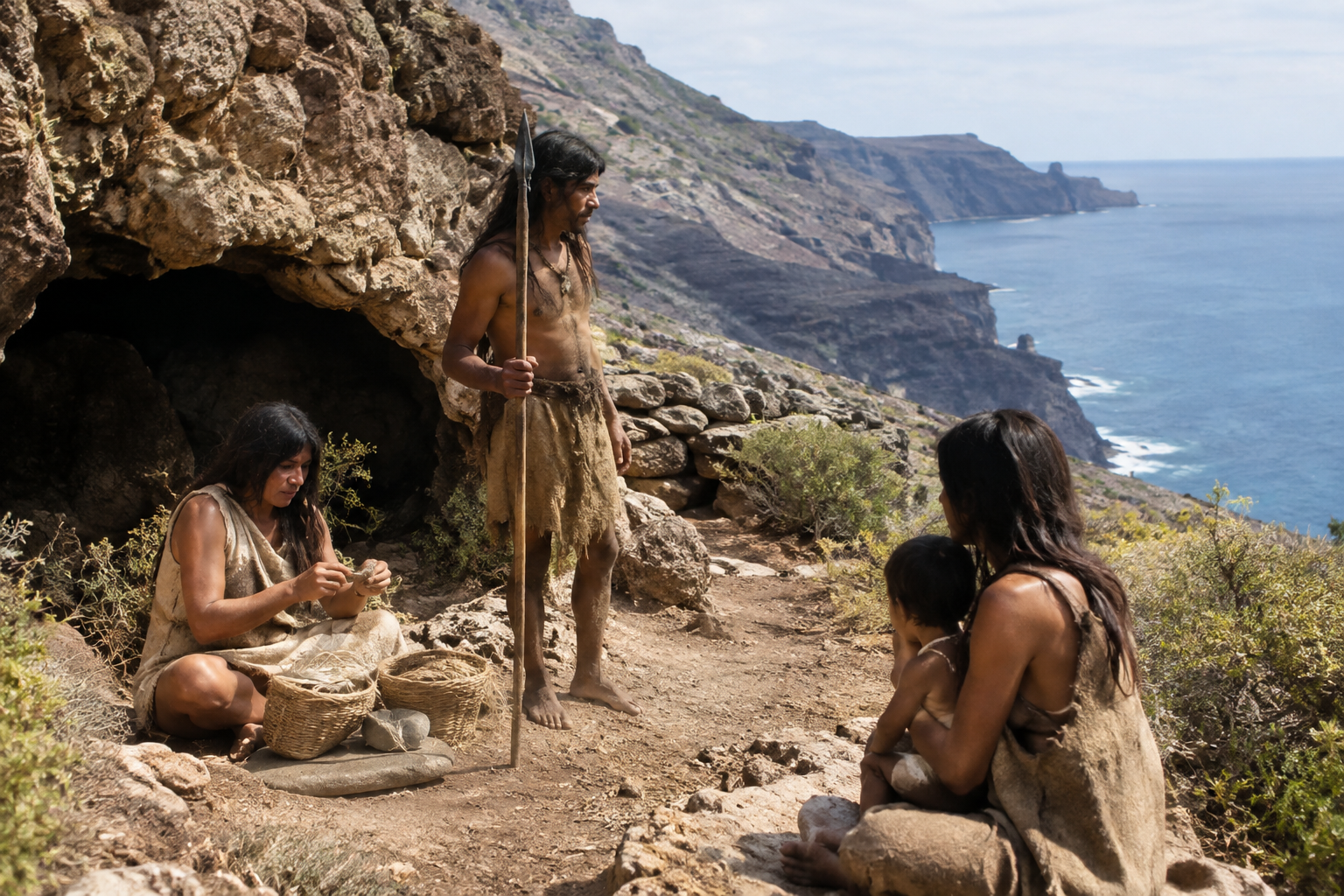
At El Agujero on Gran Canaria, one late pre-Hispanic individual dated to about AD 1424, sample CAN.008, gives us a rare and rather pointed glimpse of Y-DNA haplogroup T1a2a in the Canary Islands. That matters because the Guanche and related indigenous island communities are often discussed in broad terms - North African roots, island isolation, later conquest - but ancient DNA lets us look at one paternal line at a time, in one actual person, from one actual burial landscape.
For men researching T1a2a today, this is the useful starting point: not a grand theory about all migrations everywhere, but a documented case showing that this lineage, or a reported assignment associated with it, was present in the late indigenous population of Gran Canaria just before the full consolidation of Castilian rule. Y-DNA traces a direct paternal line only, not a person's whole ancestry, yet that single line can still illuminate how populations were assembled and maintained on the Atlantic edge of the Old World.
El Agujero sits on the coast of Gran Canaria, one of the islands whose indigenous population was still living under its own social structures in the fifteenth century, even as European expansion pressed ever closer. Sample CAN.008, dated to AD 1424, belongs to that final indigenous era: late enough to stand on the threshold of colonial upheaval, but still part of the pre-conquest island world.
That timing is crucial. A paternal lineage found in this setting is not evidence for some vague prehistoric presence somewhere in the Mediterranean; it is evidence that the lineage survived into the very last generations of indigenous life on Gran Canaria. In other words, T1a2a here is tied not merely to remote origin stories, but to continuity inside a real island community at a historically charged moment.
A genetic study of ancient Canary Islanders published in Nature Communications has helped clarify just how informative these island burials can be. The broader picture emerging from such work is one of North African-derived populations shaped by founder effects, inter-island differences, and long periods of relative isolation after settlement.
Haplogroup T is an old and widely dispersed Y-chromosome family with branches found across parts of the Near East, northeast Africa, the Mediterranean, and beyond. But the article haplogroup here is not the whole of T. It is T1a2a, a narrower branch, and responsible writing means keeping that distinction clear.
With a single late Guanche-era sample, we should not pretend to map the entire early history of T1a2a in the Canaries. What we can say is more modest and more solid: a man associated with this paternal branch was part of the indigenous population of Gran Canaria in the early fifteenth century. That places T1a2a within the mosaic of lineages carried into, preserved within, and perhaps reshaped by the island world long before modern genealogy began to notice it.
This matters especially because the Canary Islands often tempt people into neat stories: one source region, one migration, one genetic signature. Ancient DNA keeps spoiling that simplicity. Even populations with strong overall North African affinity can contain a variety of paternal lines, each with its own deeper history.
The islands are a historian's dream and a geneticist's headache. They were settled from North Africa, but once communities were established on different islands, geography did much of the editing. Isolation, bottlenecks, and local marriage patterns could magnify some lineages and reduce others, so a lineage's presence on one island and in one period need not mirror its frequency everywhere else.
That is why CAN.008 is more than a curiosity. Gran Canaria was one of the major centers of indigenous life in the archipelago, and a late date like AD 1424 places the sample close to the violent transition between indigenous and colonial regimes. A paternal lineage preserved in this context may reflect older North African ancestry brought by the islands' settlers, but it also reflects centuries of island-specific demographic history.
In practical terms, this makes T1a2a in the Canaries a clue to persistence rather than spectacle. The striking thing is not that one branch turned up in an exotic place; it is that it endured in a bounded island society right up to the eve of conquest.
Iberian-North African Connection
The indigenous peoples of the Canaries are generally understood to derive much of their ancestry from North Africa, often discussed in connection with Amazigh-related populations. That background makes the appearance of a T-lineage entirely plausible, but plausibility is not the same as precision. The sample from El Agujero does not, on its own, identify a precise mainland homeland, tribe, or migration route for this paternal line.
What it does show is that the paternal landscape of the islands was not limited to the lineages most commonly invoked in popular summaries. The ancient Canaries were part of a wider Afro-Mediterranean story, even if they sat far out in the Atlantic. Their inhabitants were not frozen relics of a single event, but descendants of settlers whose lineages had already travelled through older North African worlds before crossing to the islands.
That wider framing fits well with the growing archaeological-genetic picture of North Africa itself: deep regional continuity mixed with movement, contact, and repeated reshaping over millennia. If your paternal line is T1a2a, the Canary evidence does not prove island ancestry, but it does place your branch within a documented historical setting connected to that broader North African sphere.
North Africa's Genetic History
There is another reason the date of CAN.008 is so evocative. The early fifteenth century was not some quiet epilogue. It was the period when indigenous island societies were increasingly entangled with raiding, slaving, missionary efforts, and military expansion from Europe. To find T1a2a in a man from this era is to see the lineage still embedded in an indigenous setting just before that world was fundamentally altered.
That does not make CAN.008 a symbol of an entire people, and it certainly does not allow us to read ethnicity straight off a Y chromosome. But it does give the lineage historical texture. T1a2a was not only somewhere in prehistory; it was present in a coastal Gran Canarian community at a moment when old island lineages were about to be absorbed into a new Atlantic order.
The same broad lesson appears again and again in Iberian and island archaeogenetics: conquest does not instantly erase local ancestry, and local ancestry was never as uniform as later categories imply. Readers who want a wider Iberian comparison may find it useful to look at how post-Roman and later genetic change unfolded in nearby regions as well.
Roman Hispania's Genetic Legacy
For T1a2a, the most distinctive point here is not a sweeping origin myth but a firmly placed ancient witness: CAN.008 from El Agujero, Gran Canaria, around AD 1424. That single man anchors the haplogroup in the late indigenous Canary Islands, linking this paternal branch to a North African-derived island population living through the last phase before conquest. If you carry T1a2a today, this does not tell you your whole story, but it does place your direct paternal line inside one of the Atlantic world's most fascinating archaeological chapters.
Comments