Haplogroup T1a2
– 5 min read


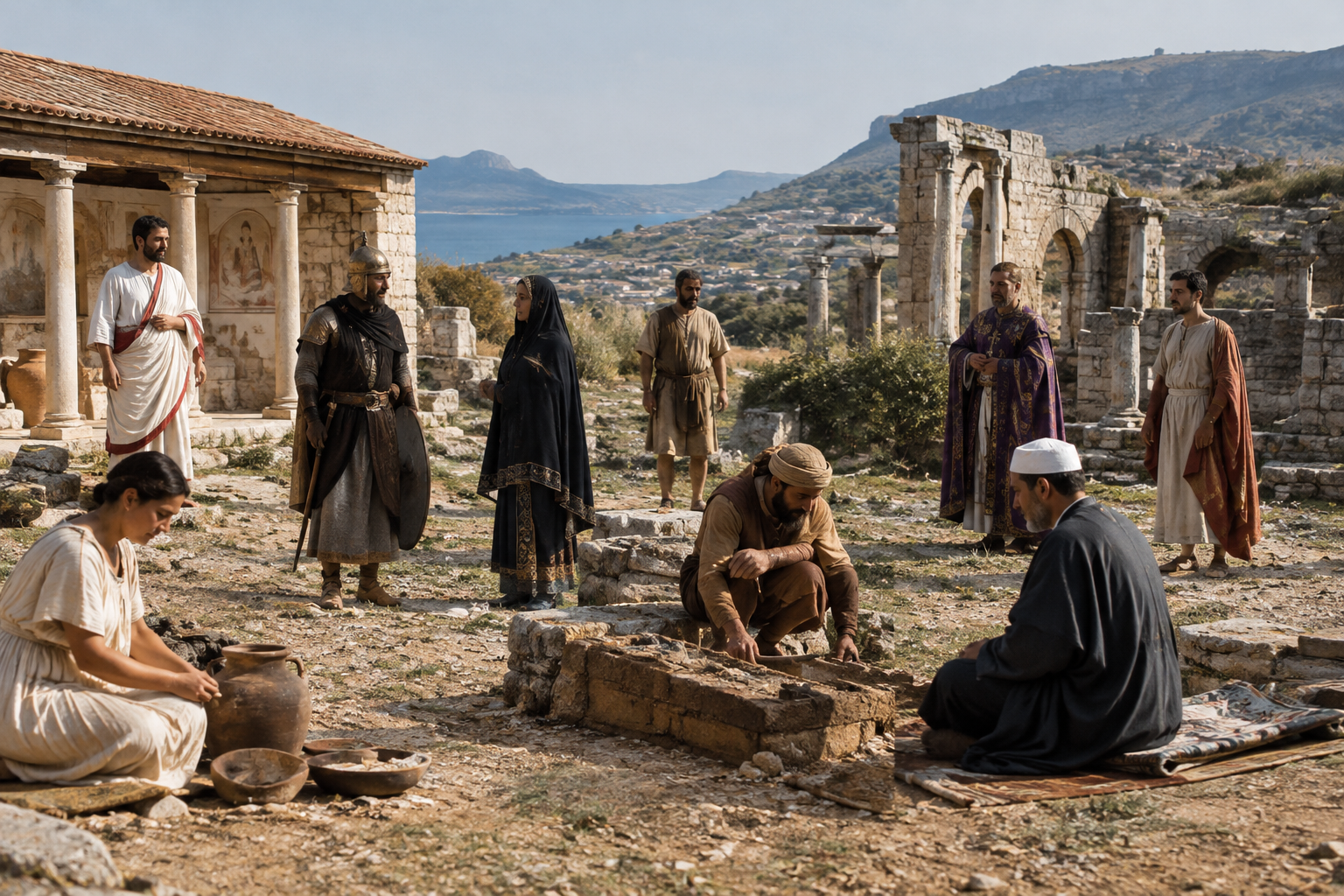
Some Y-chromosome lineages seem to sit quietly in the background of history until ancient DNA brings them abruptly into view. Haplogroup T1a2 is one of those cases. It is not one of the big headline paternal branches that dominate popular discussions of European prehistory, yet when ancient samples begin to appear, T1a2 turns up in places that tell a particularly Mediterranean story: Neolithic Anatolia, Bronze Age southeast Anatolia, Punic North Africa, Roman Serbia, Roman Spain, Byzantine western Anatolia, and medieval Muslim Sicily.
That spread is historically interesting because it does not point to a single empire, ethnicity, or language. Instead, it hints at movement through farming, trade, colonization, military service, and religion across the eastern and central Mediterranean. As ever with Y-DNA, a caution comes first: a haplogroup traces just one direct paternal line out of the many thousands in a person's family tree. It can illuminate one strand of ancestry with remarkable clarity, but it does not define a whole people, still less a whole identity.
Haplogroup T belongs to a wider Y-chromosome branch with long-standing associations in western Asia, the Near East, and parts of northeast Africa and the Mediterranean. For a narrower lineage such as T1a2, we have to be careful not to pour the entire history of the parent haplogroup into this one sub-branch. Still, the ancient evidence supplied here strongly suggests that T1a2, or closely related paternal lines, were present in Anatolia quite early and later moved through the connected worlds of the Mediterranean.
The earliest sample in this set is especially striking: cch205 from Neolithic Anatolia Catalhoyuk, dated to 6000 BC. Catalhoyuk has long occupied a special place in archaeological imagination, with its dense settlement, plastered houses, and extraordinary early farming community. A T1a2-linked paternal line in that setting places this haplogroup in one of the great early centers of village life in southwest Asia. That does not prove Catalhoyuk was the birthplace of T1a2, but it does make Anatolia an important part of the story.
Another useful waypoint is I4615 from Early Bronze Age Southeast Anatolia Tatika, dated to 2100 BC. By this time, the world had changed dramatically. Villages had become more entangled in wider systems of exchange, metallurgy, and emerging states. The appearance of this paternal line again in Anatolia suggests either local continuity, repeated movement within the region, or both.
If you want a wider look at how early farming populations spread and transformed the ancient world, this related article adds useful context.
Explore the Neolithic Expansion
From Anatolia, the record then opens outward into the sea-lanes and imperial corridors of later antiquity. One of the most evocative samples is I24200 from Punic Era Tunisia Kerkouane, dated to 550 BC. Kerkouane belongs to the Punic world of North Africa, a Carthaginian maritime sphere tied to Phoenician colonization, trade, and cultural exchange. A T1a2-related paternal lineage here fits well with a Mediterranean pattern in which people, goods, and family lines moved between the Levant, North Africa, Sicily, Sardinia, and Iberia.
Then there is I4055 from Roman Villa Granada Spain, dated to 300 AD. Roman Spain was no isolated western fringe. It was deeply connected to the wider empire, drawing in soldiers, merchants, administrators, enslaved people, and migrants from many provinces. A T1a2 line in Roman Granada does not tell us exactly where that man's paternal ancestors came from, but it does remind us that Roman Iberia was full of long-distance human movement.
The same is true of I15532 from Imperial Roman Viminacium Serbia Pecine Necropolis, dated to 250 AD. Viminacium was a major city and military center on the Danubian frontier. Frontier zones in the Roman Empire were rarely ethnically neat. They were populated by soldiers from elsewhere, camp followers, local families, traders, and officials. A T1a2 paternal line in this context is less a surprise than a lesson in how imperial networks redistributed ancestry.
For readers interested in that western end of the Roman story, especially Iberia, this article makes an excellent companion.
Discover Roman Hispania's DNA Legacy
The medieval evidence is where T1a2 becomes especially vivid. I20143 from Byzantine Era Stratonikeia Church Anatolia, dated to 975 AD, shows this paternal line still present in western Anatolia under Byzantine rule. That continuity matters. It suggests that the eastern Mediterranean was not simply a sequence of total population replacements. Dynasties changed, faiths changed, languages shifted, but some paternal lines remained in circulation across many centuries.
And then we reach Sicily, that most gloriously complicated of Mediterranean islands. Two samples are crucial here: SGBN7b from Medieval Sicily Segesta Muslim Grave, dated to 1140 AD, and SGBN1 from the same site, dated to 1200 AD. These are not abstract data points. They come from a medieval island shaped by Greek, Arab, Berber, Latin, Norman, and Jewish histories, where conquest never erased the older layers completely.
T1a2 in Muslim-period Segesta is exactly the sort of finding that makes Sicily so revealing for population history. It shows how paternal ancestry linked to wider Mediterranean and Near Eastern worlds could persist or arrive within an Islamic Sicilian context. But we should be precise: these samples do not prove direct descent from Punic settlers, from Byzantine Anatolians, or from Neolithic villagers at Catalhoyuk. What they show is that related paternal branches appeared repeatedly across the connected Mediterranean over a very long timespan.
Sicily in this period is worth exploring in its own right, because the island often preserves in microcosm what happened across the sea as a whole.
Explore Medieval Sicily's Multi-Faith DNA
No associated noble family or castle details were supplied here, and that absence is actually a useful reminder about method. In popular genealogy it is tempting to leap from an ancient Y-lineage to a medieval house, a coat of arms, or a ruined fortress on a hilltop. But genetics does not work like heraldry. A broad haplogroup match, even an intriguing one, cannot by itself identify a noble dynasty, confirm aristocratic descent, or assign a man from antiquity to a later documented family.
What ancient DNA can do is provide the background against which noble histories unfolded. Medieval families in Sicily, Iberia, the Balkans, or Anatolia did not emerge in empty landscapes. They arose in regions already shaped by millennia of migration, survival, intermarriage, conquest, and continuity. A lineage like T1a2 offers one way of seeing that deep background: not as a neat pedigree, but as a long human presence moving through towns, farms, ports, garrisons, and places of worship.
That distinction between genetic context and documented genealogy is central to responsible historical storytelling. If you are interested in how MyTrueAncestry handles named families when evidence is stronger and the documentary record is fuller, this article is a useful example.
Read About the House of Branciforte
T1a2 is a good reminder that paternal history is often about connections rather than borders. In this sample set, its story runs from cch205 at Catalhoyuk in 6000 BC, through I4615 in Bronze Age southeast Anatolia, to I24200 in Punic Tunisia, I15532 in Roman Serbia, I4055 in Roman Spain, I20143 in Byzantine Anatolia, and finally SGBN7b and SGBN1 in medieval Muslim Sicily. That is not the history of one people marching under one banner. It is the history of a paternal lineage participating in many different societies.
For family historians, this is the exciting part. If you carry T1a2 today, ancient DNA cannot hand you a tidy biography of your direct paternal ancestors. It can, however, place your lineage within a historical landscape that includes some of the earliest farmers of Anatolia, the maritime world of the Punic Mediterranean, the cosmopolitan machinery of Rome, the endurance of Byzantine Anatolia, and the multi-faith complexity of medieval Sicily.
Upload your DNA to MyTrueAncestry to explore whether your results show connections to ancient individuals, archaeological cultures, and historical populations like those discussed here. These matches do not prove direct descent from a specific ancient person or noble house, but they can open an extraordinary window onto the deep past of your paternal line.






Comments