Haplogroup T

– 5 min read


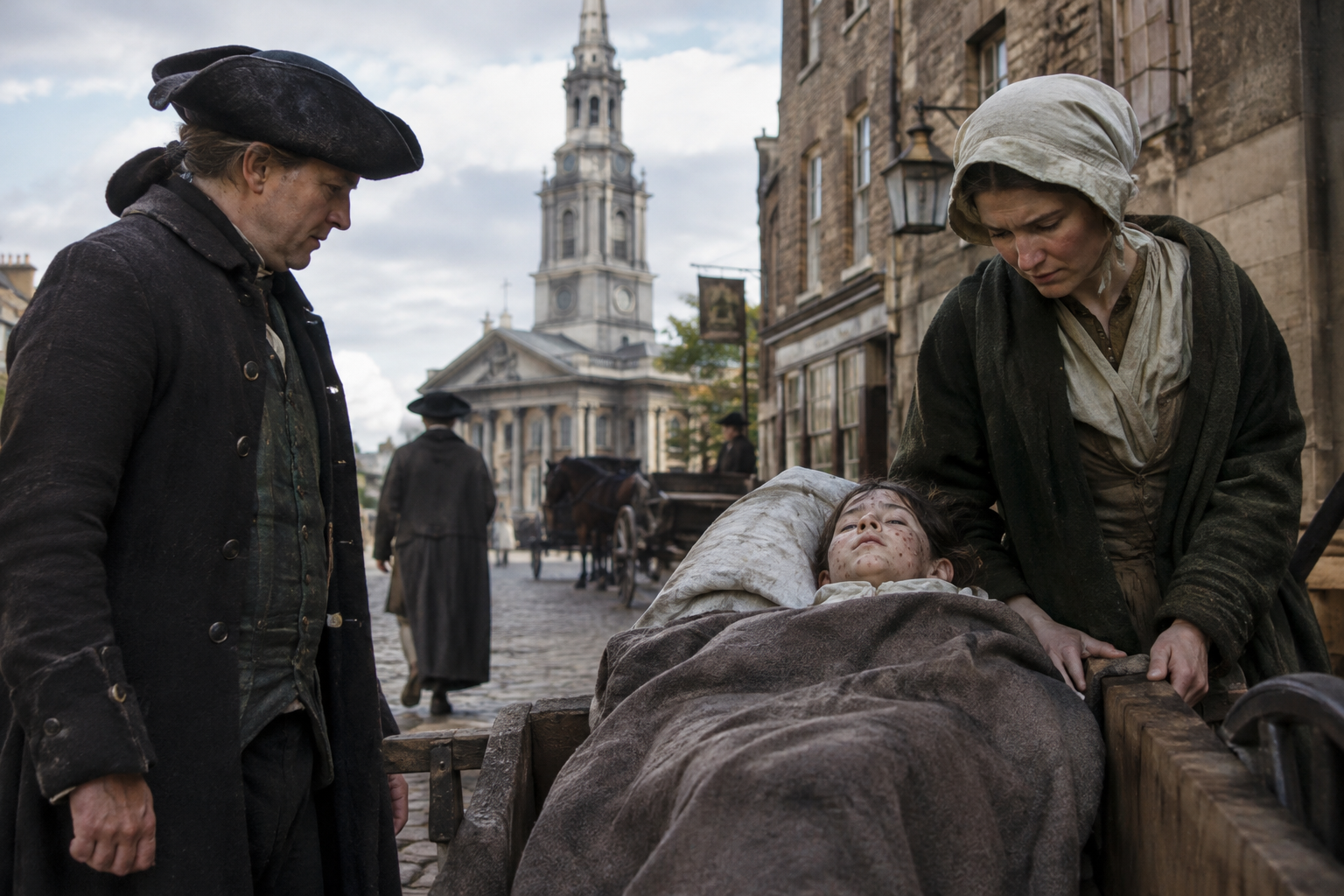
In 1760 AD, at St Martin-in-the-Fields in London, one man was buried in the middle of a smallpox epidemic and later entered the genetic record as sample P328d. It is a strikingly specific anchor for haplogroup T: not a Bronze Age warrior, not a king in a stone tomb, but an ordinary late medieval or early modern Londoner caught up in one of the great urban diseases of the 18th century.
That matters because haplogroup T is one of those paternal lines that often appears in discussions of long-distance population history, trade, and movement across western Eurasia, the Near East, northeast Africa, and the Mediterranean. Yet here it turns up in a documented London burial context. Y-DNA traces one direct paternal line only, but even a single case like P328d is a useful reminder that the male histories behind British burials were not always locally predictable.
The St Martin-in-the-Fields cemetery is one of the most evocative bioarchaeological sites in London because it captures city life at scale: crowding, disease, burial management, and the sheer demographic churn of a great capital. Sample P328d comes from a smallpox victim dated to 1760 AD, placing him in a world of parish burials, intense mobility, and expanding imperial London.
For a haplogroup article, this is a useful kind of evidence. It does not tell us that haplogroup T was common in London, nor does it let us assign this man a neatly bounded ethnic identity. What it does show is that the paternal branch T was present in the city during a well-documented historical moment, embedded in an urban population shaped by migration from within Britain and from much farther afield.
A broader ancient DNA framework for Britain and its changing population structure can be seen in research on the island's past, including genetic work on ancient and historical populations from Britain and beyond. In that wider setting, a lineage like T is best understood not as an exotic curiosity but as one of many paternal threads that appear when archaeogenetics begins to sample real communities rather than idealized national ancestries.
Roman and Early Medieval Britain DNA
Haplogroup T is a rare but widespread Y-chromosome lineage. In modern populations it is found in scattered frequencies from the Horn of Africa and the Near East into the Mediterranean and parts of Europe, with additional branches further east. That distribution has made it historically interesting, but also easy to oversimplify.
The important caution is that T is a broad parent haplogroup. Without a securely reported downstream subclade, we should not pretend to know which branch P328d belonged to within T, still less when or how his paternal line reached Britain. A man buried in London in 1760 could reflect family movement in the medieval period, the early modern period, or much earlier episodes of contact that had long since been absorbed into the population.
And that, really, is where the archaeology is more useful than romantic speculation. London was a receiving place. It drew people from provincial England, from Scotland and Ireland, from continental Europe, and through trade and empire from much wider networks. A T-lineage in that setting is historically plausible without requiring a dramatic one-step migration story.
If this same haplogroup had turned up in a port cemetery in the eastern Mediterranean, nobody would be terribly surprised. In London, by contrast, it catches the eye because later British Y-DNA is more often discussed in relation to haplogroups such as R1b, I, or E. But cities have a way of exposing what tidy national summaries hide.
By the 18th century, London was one of the great aggregation points of the Atlantic and European worlds. Servants, artisans, soldiers, merchants, sailors, apprentices, laborers, and parish poor all passed through its neighborhoods and burial grounds. A lineage like T could have arrived through any number of family histories: Roman-era movement, medieval trade, post-medieval immigration, or older Mediterranean connections diluted across generations. The sample does not decide between those possibilities, but it makes them historically concrete.
This is also why single burials from urban cemeteries deserve attention. They are not merely isolated data points. They belong to social landscapes where surnames, accents, occupations, and origins were constantly mixing. A paternal lineage can persist through that change even when language, status, and local identity alter completely.
Although P328d is our only named ancient sample here, haplogroup T makes most historical sense when placed against the backdrop of regions linked for millennia by trade, seafaring, farming dispersals, and imperial expansion. Its modern distribution has often encouraged discussion of the Near East, eastern Mediterranean, northeast Africa, and southern Europe as important zones in its deeper history.
That does not mean every European T-lineage must be traced to one named migration or one famous civilization. Archaeology is rarely that obliging. Still, the broad pattern fits what we know of the ancient world: people, goods, and marriage networks moved repeatedly across seas and frontiers. The Roman Empire, medieval Mediterranean commerce, and early modern port traffic all created conditions in which rarer paternal lines could travel far and then become locally rooted.
For readers interested in how mixed and mobile ancient communities could be, especially in Mediterranean settings, there is a helpful comparison in MyTrueAncestry's post on medieval Sicily's genetic diversity. Sicily is not London, of course, but it shows the same larger lesson: lineages move through real places with layered histories, not through neat textbook boxes.
There is something wonderfully corrective about P328d. Haplogroup articles can easily drift toward heroic founders and sweeping arrows on maps. But this case begins with a burial linked to disease in a London churchyard. It brings the discussion back to what ancient DNA is often best at: recovering overlooked individuals and showing that population history lives inside ordinary lives.
It also underlines a central point for anyone researching haplogroup T today. A T result does not by itself identify a single homeland, ethnicity, or noble pedigree. What it can do is point toward a paternal line with deep roots in the interconnected histories of western Eurasia and adjacent regions, and one that had clearly found its way into Britain by the 18th century.
With the evidence here, the most responsible conclusion is also the most interesting one. Haplogroup T appears in sample P328d, a smallpox victim buried at St Martin-in-the-Fields in 1760 AD, showing that this paternal branch was part of the human mixture of historic London. For descendants or testers today, that does not promise a simple origin story. It suggests a paternal line that may connect, somewhere in its deeper past, to the older movement of men around the Mediterranean, Near East, and Europe before becoming fully woven into later local histories.





Comments