Haplogroup S1a1

– 5 min read


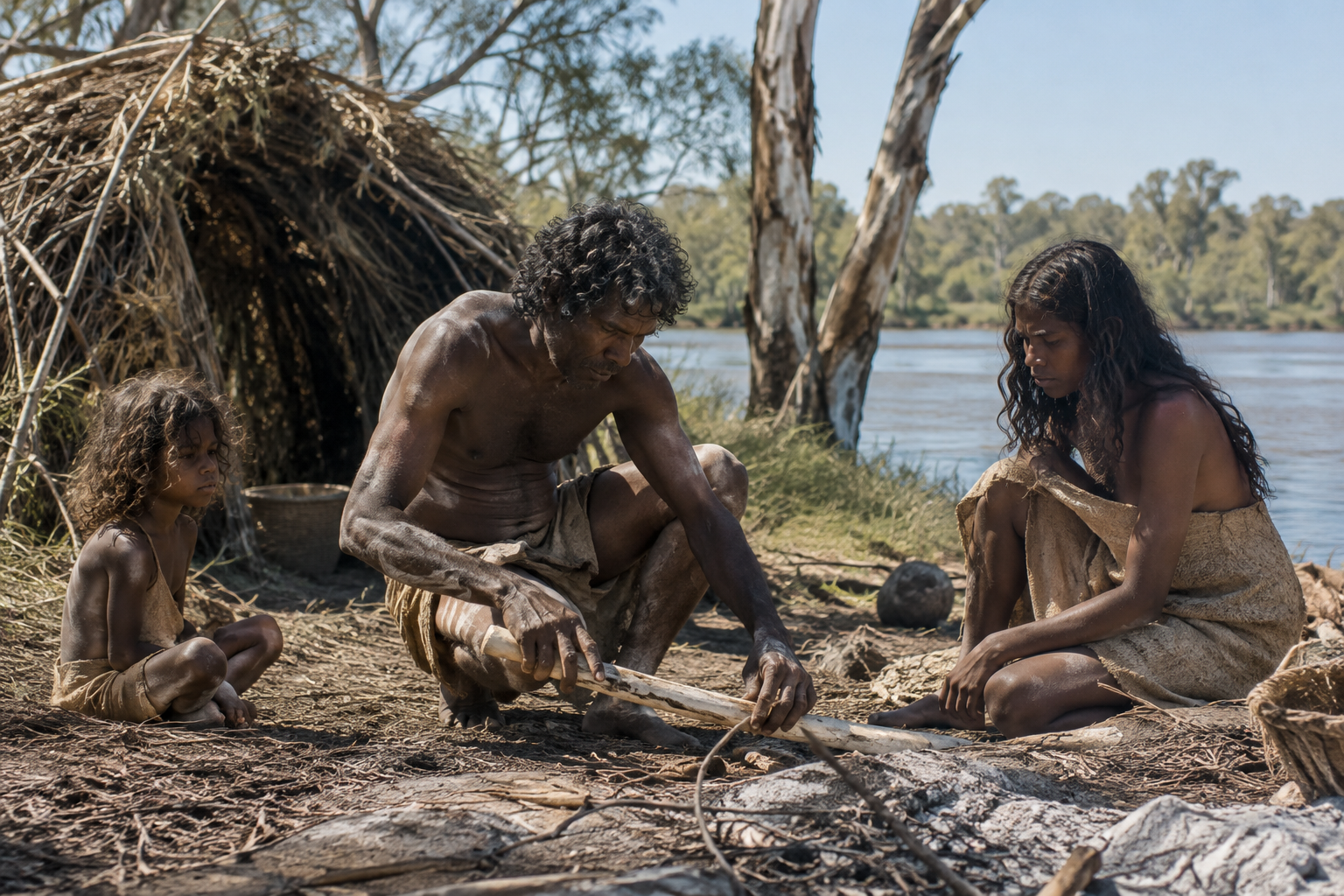
At Koondrook-Perricoota in southeastern Australia, one ancient man known as KP1 has become an unexpectedly important reference point for the Y-DNA haplogroup S1a1. Dated here to around AD 550, he belongs to a world that sits well outside the usual Eurasian storylines that dominate popular discussions of ancient DNA. That alone makes S1a1 worth pausing over, because this is a paternal lineage rooted in Aboriginal Australian history rather than in the better-publicised migrations of farmers, steppe herders, or medieval dynasties.
What gives KP1 his importance is not royal glamour or a crowded cemetery of named relatives, but rarity of evidence. Ancient Y-chromosome data from Australia are still limited, so every securely placed individual matters disproportionately. In this case, S1a1 appears not as an abstract label on a modern testing chart, but in a real person from the Murray River region, living in late Holocene Australia and anchoring a paternal line in a documented archaeological landscape.
Koondrook-Perricoota lies in the riverine country of northern Victoria and southern New South Wales, a place shaped by wetlands, floodplains, and long Aboriginal occupation. For archaeologists, this is not an empty backdrop. River systems like the Murray were corridors of movement, exchange, subsistence, and ceremony over very long stretches of time, and they preserve evidence for communities whose histories are far deeper than the colonial period that usually frames public memory.
Within that setting, KP1 gives us one direct paternal snapshot. Y-DNA traces one narrow line of descent, father to son, not the whole ancestry of an individual. But narrow does not mean trivial. In places where ancient genomes are sparse, a paternal lineage can still show that a branch such as S1a1 was present in a particular region by the mid first millennium AD, among Aboriginal Australians whose ancestors had already been on the continent for tens of thousands of years.
A major ancient DNA study on Aboriginal Australians and Papuans helped establish the broader significance of these deep regional histories and the long-term structure of Sahul-related populations: research published on ancient genomes from Australia and nearby regions pushed discussion well beyond crude ideas of timeless isolation or simple uniformity. That matters here, because a haplogroup like S1a1 needs to be understood in the context of deep local continuity alongside regional diversity, not as a stray curiosity.
The label S1a1 identifies a specific branch within the wider Y-chromosome haplogroup S, a lineage strongly associated with populations of Sahul, especially New Guinea and Aboriginal Australia. It is important not to inflate that statement. The larger haplogroup S has a deep and complicated history, and one cannot simply pour the whole history of the parent branch into the narrower subclade S1a1 without direct evidence for every step.
Even so, the appearance of S1a1 in KP1 is historically meaningful. It shows that this paternal branch was part of Aboriginal Australian population history in southeastern Australia in late antiquity, if one may use that Eurasian period label very cautiously here. That is useful because modern Y-DNA results often leave people staring at a code and wondering whether it connects to something genuinely ancient. In this case, the answer is yes: S1a1 is not merely modern administrative taxonomy but a lineage with archaeological depth in Australia.
It is also a reminder that ancient DNA has changed the scale of Australian archaeology. Once, many arguments about population structure relied heavily on stone tools, regional styles, and linguistics. Those remain essential. But genetics now adds another line of evidence, helping to test whether communities were highly local over long periods, broadly connected, or both at different levels.
Readers sometimes expect dozens of ancient samples for every haplogroup article, preferably spread across neat chronological stages. Australia often refuses that convenience. Preservation is difficult, destructive testing requires ethical care and community engagement, and the number of published ancient Y-chromosome assignments remains modest. That means KP1 is significant not because he founded a dynasty we can name, but because he is one of the few ancient anchors available for this particular paternal branch.
There is a useful archaeological lesson in that. Sparse evidence does not mean empty history. On the contrary, in regions where ancient DNA sampling is still developing, each result must be handled carefully and in context. KP1 should not be turned into "the" representative of all Aboriginal men in southeastern Australia, still less into proof of a single migration event. What he does provide is a fixed point: by around AD 550, S1a1 was present in the Koondrook-Perricoota population landscape.
This is precisely the sort of finding that makes ancient DNA most valuable when used modestly. Rather than sweeping claims, it gives us a real person in a real place, and that helps tether modern paternal ancestry to country, chronology, and archaeology.
Placing KP1 in the first millennium AD also matters historically. Aboriginal Australia at this time was not a static remnant of some distant prehistory. Communities across the continent maintained complex social worlds, regional exchange systems, ecological knowledge, and long-settled relationships to land and water. The Murray-Darling basin in particular supported substantial and enduring populations, with lifeways adapted to seasonal abundance and environmental variation.
That is why a lineage like S1a1 should be read against Indigenous continuity rather than against imported Old World templates. There is no need to force parallels with European clan founders or steppe expansions. The better historical frame is Aboriginal persistence: paternal lines continuing through local communities over many generations, while social identity itself was shaped by kinship, language, law, and country, not by Y-DNA alone.
Ancient DNA work in Australia has increasingly supported this broader picture of deep time combined with regional structure. Genetic evidence does not replace oral tradition or archaeology, but it can strengthen the case that many present-day lineages reach far back into particular landscapes. For descendants and for public history alike, that is a powerful corrective to narratives that once treated Australian history as beginning only with written colonial records.
The deeper background to S1a1 lies in Sahul, the ancient landmass that once joined Australia and New Guinea during lower sea levels. Human settlement in this region reaches back astonishingly far, and the paternal lineages found there reflect that antiquity. Haplogroup S belongs to that deeper story of populations whose histories unfolded largely outside the later demographic turnovers that transformed much of Eurasia.
That does not make Sahul a sealed capsule. Archaeology and genetics both show movement, adaptation, and regional differentiation across long spans of time. But it does mean that lineages such as S1a1 may preserve especially deep local histories. For a modern tester, that is perhaps the most distinctive feature of this branch: it points toward one of the world's oldest continuous human regional histories, not toward a recent imperial or medieval expansion.
Ancient Y-chromosome migrations
The ancient evidence for S1a1 is still slender, but it is real and historically important. KP1 from Koondrook-Perricoota shows this paternal branch in Aboriginal Australia around AD 550, tying the lineage to the long Indigenous history of southeastern Australia and to the deeper population story of Sahul. For someone researching a modern S1a1 result, the responsible conclusion is not a fantasy pedigree but something better grounded: your direct paternal line belongs to an ancient regional history with remarkable time depth, and archaeology is only just beginning to map it clearly.
Comments