Haplogroup R1b1a2a1a2b1

– 5 min read


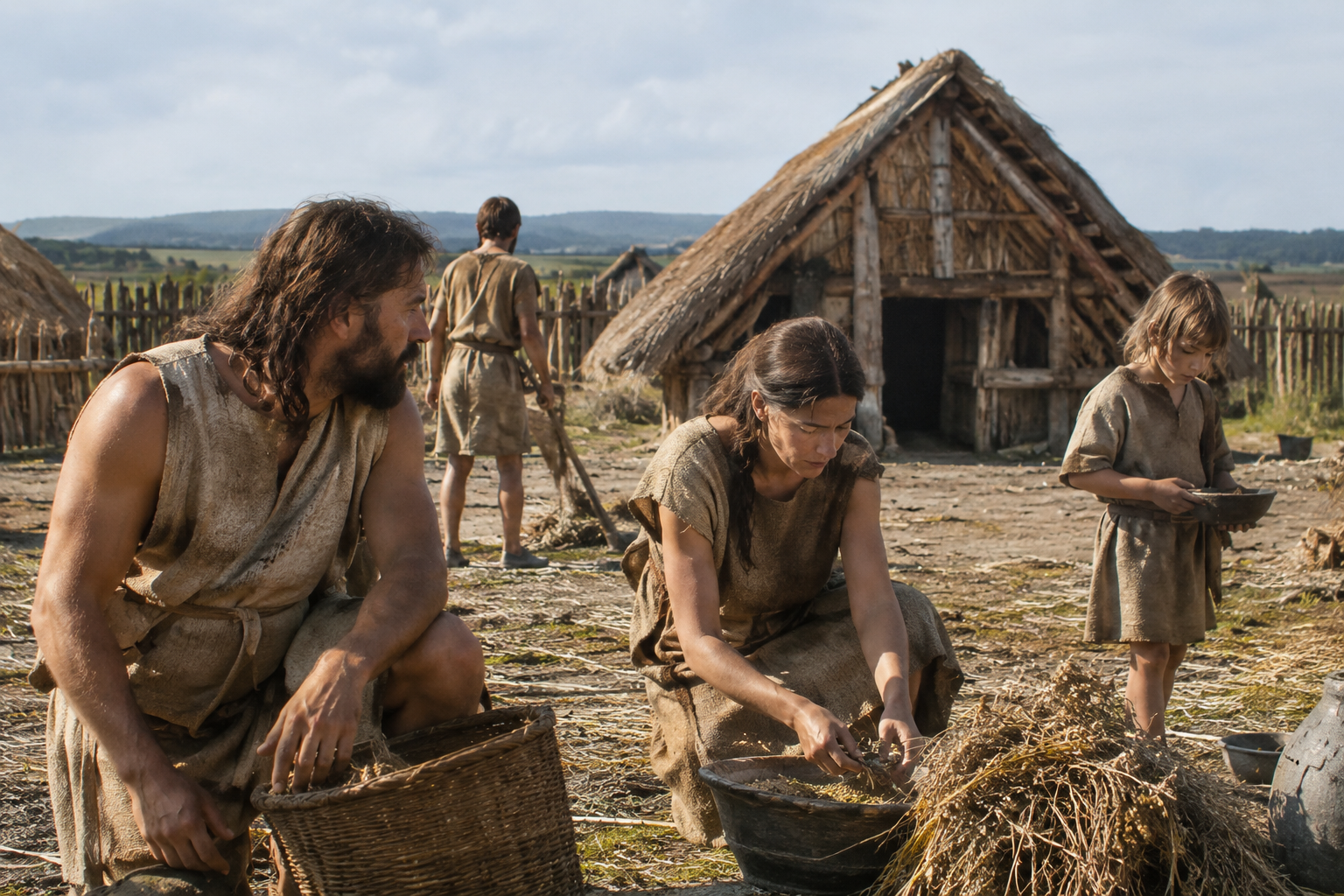
At Zwingendorf in Lower Austria, two men buried around 1900 BC, catalogued as ZWD001 and ZWD002, offer a useful starting point for thinking about the Y-DNA branch R1b1a2a1a2b1. They are not famous rulers or named warriors from a text. They matter for a simpler and, in some ways, more interesting reason: they show this paternal line in an Early Bronze Age farming landscape north of the Danube, in a region where ancient DNA is beginning to put real human detail back into broad historical models.
That matters because R1b1a2a1a2b1 is a very specific paternal marker within the wider R1b family, one of the major Y-chromosome lineages of later prehistoric western and central Europe. Y-DNA tracks one direct male line only - father to son to son - so it does not describe a person's whole ancestry. But when the same branch appears in several burials from closely related places and dates, it can help anchor a lineage in a real archaeological world rather than an abstract map.
The strongest feature of the evidence here is not one spectacular grave but a cluster. Alongside the two Zwingendorf men, the same haplogroup is reported in SLB045 from Schleinbach, dated around 1875 BC, and ULK012 from Ulrichskirchen, dated around 1800 BC. These are all sites in what is now Lower Austria, and all belong broadly to the Early Bronze Age world of central Europe.
That pattern is worth pausing over. A single Y-line in one burial can always be treated as an isolated occurrence. Four men from nearby places, within roughly a century, make a stronger historical point. They suggest that this branch was not passing through as a curiosity. It had some local presence in communities occupying the northeastern Austrian landscape during the centuries after the great demographic transformations associated with the Bell Beaker and post-Beaker Bronze Age world.
We should still keep our footing. Shared haplogroup does not prove these four men were close relatives, belonged to one ruling house, or represented every family in the region. But it does show that R1b1a2a1a2b1 belonged to the living paternal fabric of Bronze Age Lower Austria.
These place-names may sound modest, but that is often where the real substance of archaeogenetics lies. Lower Austria sits in a corridor connecting the Danube basin, Moravia, western Slovakia, and the wider Carpathian world. In the Early Bronze Age, this was no remote edge. It was a landscape of villages, burial grounds, exchange networks, and shifting regional traditions.
The samples listed here fall in the centuries when central Europe was reorganising itself after the end of the Bell Beaker horizon. New burial customs, changing metal use, and regional identities were taking shape, yet there was also biological continuity. A lineage like R1b1a2a1a2b1 appearing at several nearby Austrian sites fits that larger picture rather well: not a sudden flash of strangers, but a durable male line carried through local communities during a period of cultural change.
One reason this region has become so valuable is that it lets archaeologists compare genetics with fine-grained local evidence. Lower Austrian cemeteries are not just dots on a continental map. They sit within a dense archaeological zone where kinship, mobility, and social ties can sometimes be studied together. That is precisely why these otherwise unglamorous sample codes matter.
Lower Austrian kinship networks
The wider R1b family became especially important in many parts of Bronze Age and later Europe, but that broad success should not be lazily projected onto every downstream branch. R1b1a2a1a2b1 is a narrower limb within that much larger tree. The evidence here does not license grand claims about where this exact subclade first formed, nor does it let us assign it neatly to a single language, tribe, or archaeological culture.
What it does support is more concrete. By about 1900 to 1800 BC, this branch was present in multiple men buried in northeastern Austria. In other words, if someone today belongs to R1b1a2a1a2b1, one historically grounded way to imagine part of that paternal past is through settled Bronze Age communities in the Danubian zone of central Europe, not just through later medieval surnames or modern national borders.
That is a useful corrective to how people often read haplogroups. The most revealing question is not "Which modern nation owns this lineage?" but "In what ancient communities do we actually see it?" Here, the answer points firmly toward the Early Bronze Age communities of Lower Austria.
Ancient DNA can seduce us into chasing the oldest sample or the most dramatic migration. Yet repeated regional finds are often more informative than a single earlier appearance somewhere else. ZWD001, ZWD002, SLB045, and ULK012 together show persistence across neighbouring communities and over several generations. That kind of repetition is how population history begins to look less like a legend of heroic arrivals and more like ordinary human continuity.
It also helps explain why central Europe matters so much in Bronze Age debates. This was a zone where ancestry linked to earlier steppe-derived populations had already become deeply established, but where local developments shaped how those ancestries were lived out. Paternal lines could persist while material culture, exchange systems, and burial traditions changed around them. The men carrying R1b1a2a1a2b1 in Lower Austria were part of that historical process.
A related strand of research in the region has also examined the broader cultural context of Early Bronze Age Austrian cemeteries, including work touching on disease history and burial grounds in northeastern Austria. One such study can be found here. Even when a paper is not centered on this exact haplogroup, it helps situate these burials in the lived realities of the time: communities exposed not only to cultural change, but also to biological shocks.
There is a larger implication here as well. When several men from Bronze Age Austria carry the same narrow paternal branch, they become part of the evidence for how some R1b lines consolidated in central Europe after earlier prehistoric population shifts. That does not mean one lineage "caused" a culture. It means the people buried in these cemeteries were participants in the formation of later European gene pools.
This is especially relevant because central Europe has increasingly been discussed as a key arena for the spread and reshaping of Bronze Age populations, and perhaps for later language histories too. Any attempt to connect genetics and language must be cautious. Still, the concentration of related paternal lines in this zone makes it easier to understand why central Europe looms so large in debates about later Indo-European-speaking populations and the ancestry of many western Europeans.
Central Europe and Celtic origins
The distinctive thing about R1b1a2a1a2b1 in this case is not a royal pedigree or a legendary founder. It is the quiet strength of a regional cluster: Zwingendorf, Schleinbach, and Ulrichskirchen, all in Bronze Age Austria, all pointing to a paternal line established in central European communities around 1900 to 1800 BC. For someone researching this haplogroup today, that is a solid historical foothold - a reminder that one direct male line can sometimes be traced, not to myth, but to real cemeteries in a real Bronze Age landscape.






Comments