Haplogroup R1b1a1b1a2

– 4 min read


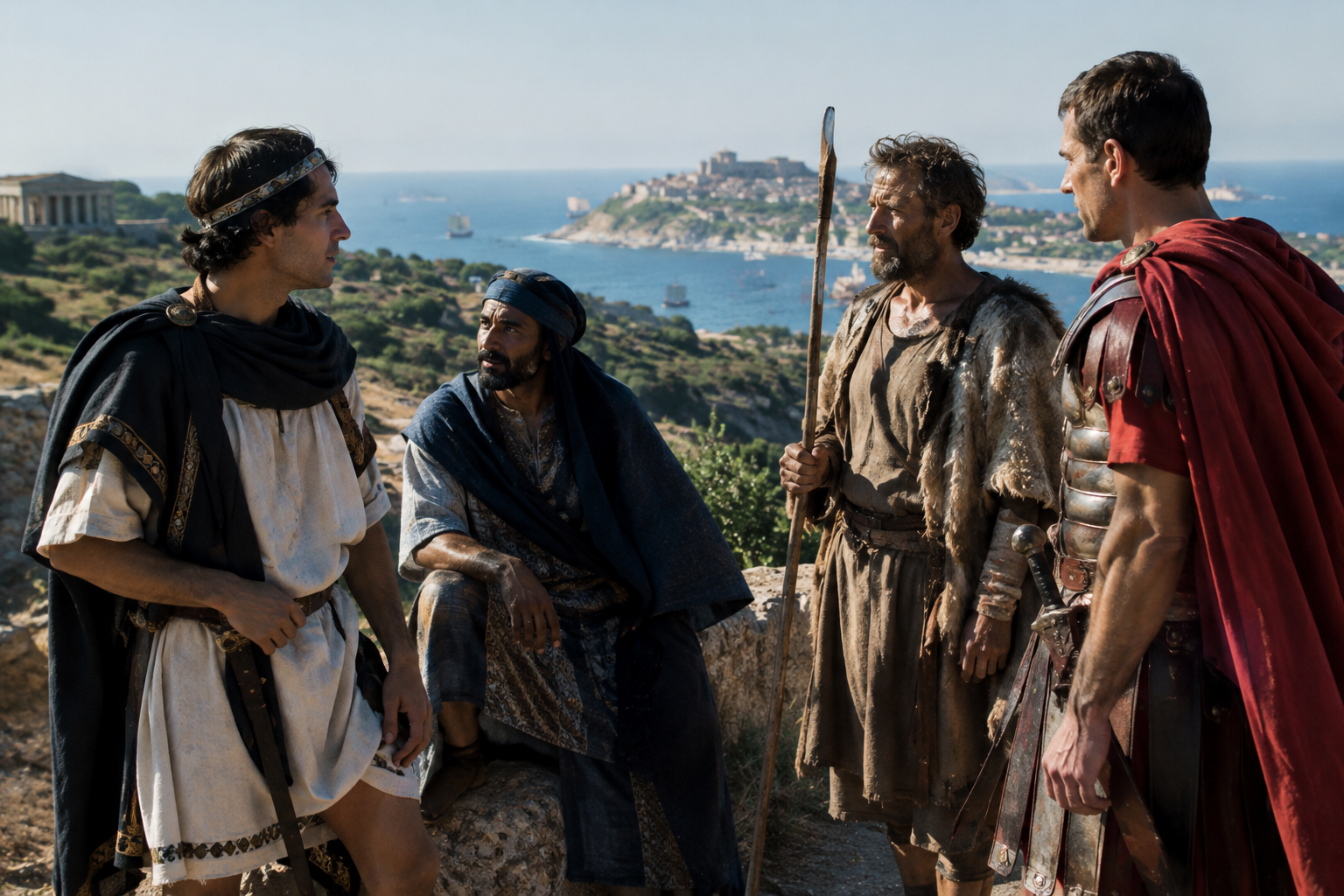
At Tarquinii in Etruria, one of the more striking late finds is an individual dated to around 226 BC, catalogued as TAQ024. By that date the great age of independent Etruscan city-states was already giving way to a Roman world, yet the cemetery record still preserves people living through that transition. For anyone interested in Y-DNA haplogroup R1b1a1b1a2, TAQ024 matters because he places this paternal line in a recognisably Etruscan setting at the very moment when central Italy was being politically and culturally reorganised.
That is a useful reminder of what a Y-chromosome result can and cannot say. It tracks one direct paternal line only, not a person's whole ancestry, language, or identity. Even so, when the same broad branch appears in late Etruscan, Latin, and Punic-connected contexts, it begins to tell a properly historical story: not of a single people, but of men moving through the intensely connected Mediterranean of the first millennium BC and the early Roman Empire.
Tarquinii was one of the major cities of ancient Etruria, famous for its long urban life and for the cemetery landscapes that have done so much to shape modern ideas of the Etruscans. A late individual such as TAQ024 belongs to a period when Etruscan communities were no longer isolated political powers, if they ever had been, but participants in a wider Italian world dominated by Rome.
That wider setting matters. Ancient DNA research on Iron Age and Roman Italy has repeatedly shown that central Italy was neither genetically sealed nor reducible to a simple outsider-versus-native scheme. A study of ancient Italian populations and their transformations across time can be found in this major ancient DNA publication, which helped frame the now-familiar picture of deep local continuity combined with substantial mobility and mixture.
In that context, the association of TAQ024 with R1b1a1b1a2 should not be read as "the Etruscan haplogroup." That would be far too crude. What it does show is that this paternal branch was present among men buried in an Etruscan city during its late historical phase, when identities in Italy were being reshaped not by replacement alone, but by long contact, intermarriage, and political absorption.
An earlier clue comes from R1021, identified here as a Latin tribe inland individual dated to around 650 BC. This is a very different historical moment from TAQ024. We are now in the early Iron Age of central Italy, before Rome's imperial phase, in a landscape of neighbouring peoples, emerging city-states, and shifting alliances.
The significance of R1021 is not simply that he is older. It is that he suggests the branch linked here to R1b1a1b1a2 was present in the inland Latin sphere centuries before the Roman Empire. That makes the Tarquinii evidence more interesting, because it hints that this paternal line belonged to the shared human background of central Italy rather than to one narrowly bounded ethnic group.
Archaeologists are often wary, rightly, of converting ancient labels into biological boxes. "Latin," "Etruscan," and later "Roman" are historical categories with political and cultural meanings, not fixed genetic tribes. But when R1021 and TAQ024 are set side by side, they suggest a paternal continuity of presence across neighbouring societies that were distinct in culture yet deeply entangled in daily life.
The sample VIL011, from Villamar in Sardinia and dated to around 250 BC, widens the map considerably. Sardinia in this period had long experience of contact, colonisation, and competition, especially involving Phoenician and then Carthaginian power. By the third century BC, during and around the Punic Wars, the island was one of the western Mediterranean's crucial frontier zones.
Finding a branch associated here with R1b1a1b1a2 in a Carthaginian Sardinian context is important because it resists lazy assumptions about neat east-west or coloniser-native divisions. Punic communities were themselves mixed, shaped by North African, Levantine, local island, and wider Mediterranean inputs. A preprint focused on Punic-era genetic diversity in the central Mediterranean is available at this research link, and its broader value lies in showing how connected these societies really were.
For the haplogroup story, VIL011 does not prove that R1b1a1b1a2 was "Carthaginian" in any exclusive sense. Rather, it demonstrates that this paternal line could be carried by a man living within a Punic political and cultural environment in Sardinia. In historical terms, that is exactly what one might expect from an island that sat amid sailors, traders, soldiers, farmers, and administrators moving between Africa, Iberia, Sicily, and Italy.
The latest of the listed individuals, R111, is described as a Carthago outlier from the Roman Empire, dated to around AD 100. By then Carthage was no longer the rival city destroyed by Rome in 146 BC, but a major Roman centre in North Africa, rebuilt and integrated into imperial systems of trade, administration, and migration.
The word "outlier" is often the most interesting part of a genetic description, because it usually signals that someone does not fit the dominant local pattern. That does not automatically make R111 a recent migrant, still less does it tell us from where he or his paternal ancestors came. But in a Roman imperial context, the very existence of such outliers is historically unsurprising. Ports, colonies, army postings, slave networks, merchants, and family strategies all moved people around the Mediterranean on a large scale.
Set beside VIL011 from Punic Sardinia, R111 helps show continuity not of empire, but of circulation. The political masters changed from Carthaginian to Roman; the sea lanes and human movements did not stop. For a lineage like R1b1a1b1a2, the evidence fits a Mediterranean world in which paternal lines could appear in multiple cultural settings without belonging exclusively to any one of them.
With this set of samples, the most defensible point is also the most interesting one. R1b1a1b1a2 appears here not in one isolated homeland story, but across late Etruscan Italy, an earlier Latin context, Carthaginian Sardinia, and Roman North Africa. That is not evidence of a single dynasty or tribe. It is evidence of participation in a web of central and western Mediterranean populations during the Iron Age and early imperial centuries.
For someone researching this paternal line today, that makes the branch historically suggestive rather than narrowly diagnostic. It may connect your direct male line to the same broad human networks that linked inland Latium, Etruria, Sardinia, and Carthage under successive political worlds. The real value lies in the pattern: men carrying this lineage were present in places where identities were made through contact, not isolation.






Comments