Haplogroup R1b1a1b1a1a3b1a

– 5 min read


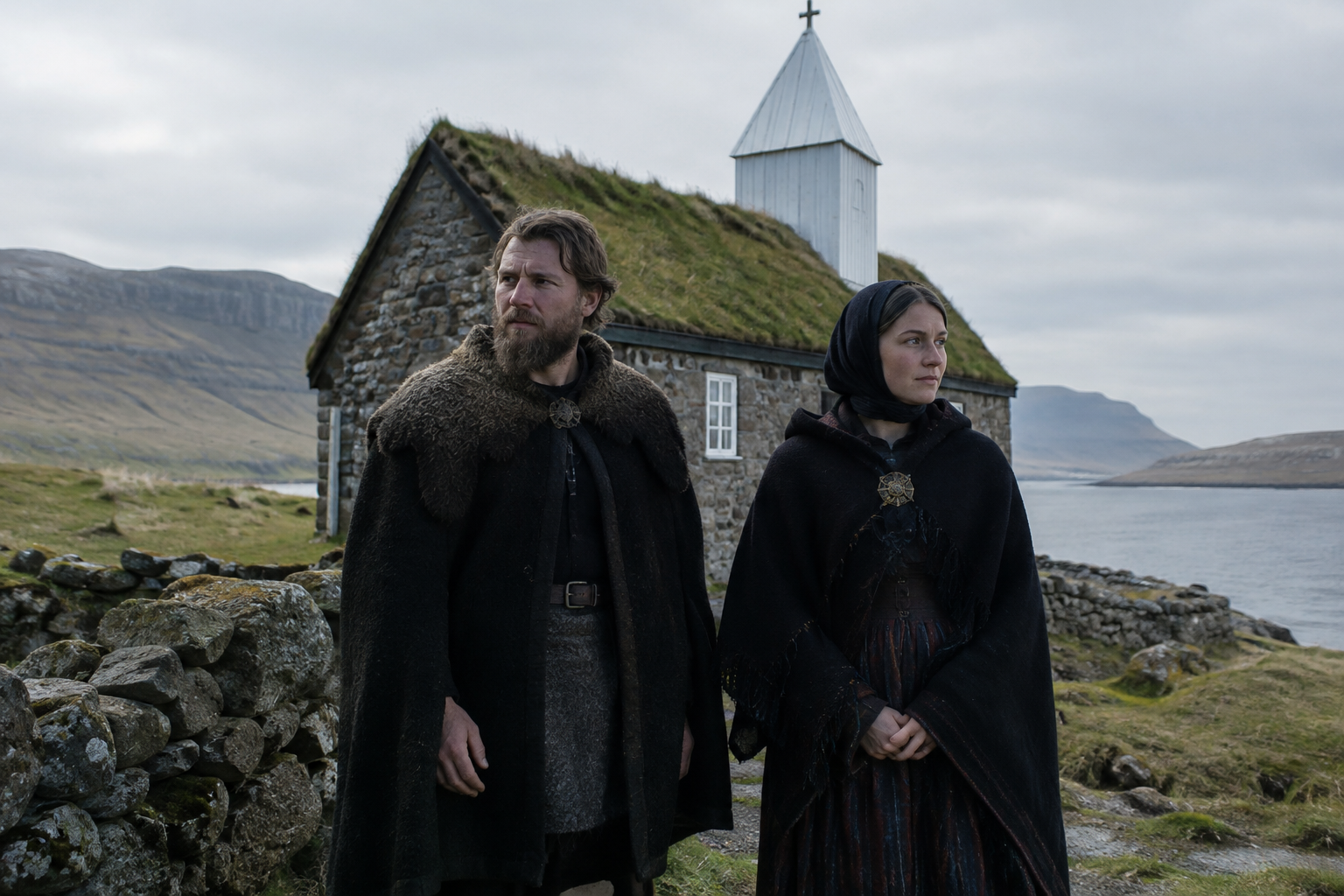
At Sandoy Church in the Faroe Islands, two men buried around AD 1600, identified as VK234 and VK25, offer a surprisingly precise glimpse into one paternal line at the edge of the North Atlantic. Their Y-DNA is reported here under the branch R1b1a1b1a1a3b1a, a very narrow twig within the much larger R1b family that is widespread across western Europe. That matters because the Faroe Islands are often described in broad terms - Viking, Norse, North Atlantic - but these two burials remind us that even in a small island society, paternal history can be tracked at a much finer scale.
The setting is important. By about AD 1600, the Faroes were not a newly settled frontier but a long-established island community shaped by centuries of seafaring links with Norway, the British Isles, and the wider North Atlantic world. Y-DNA traces only one direct male line, not the whole ancestry of a person or population, yet when the same branch appears in more than one individual at the same church site, it becomes an archaeological clue to continuity, kin connections, or simply the survival of a local paternal lineage across generations.
Sandoy is one of the larger Faroese islands, and a churchyard there is exactly the sort of place where genetics and history meet in an unusually intimate way. Church burials from the late medieval and early modern period belong to settled Christian communities, not to the dramatic age of first landfall. That changes the question. Instead of asking who first reached the islands, we are looking at who was still there centuries later, and which paternal lines had become rooted in local society.
VK234 and VK25 do not come to us with saga-style biographies, and it is better not to invent them. What we can say is that they belong to a historical Faroese population living in a period when the islands were tied into Scandinavian political and ecclesiastical structures, while also preserving the distinctiveness that island life tends to foster. Their shared association with R1b1a1b1a1a3b1a places that paternal branch in a documented Faroese burial context rather than leaving it floating as an abstract modern test result.
A genetic study of the Faroese and their population history, available as a research preprint on bioRxiv, has helped bring this broader setting into focus. Even without pressing beyond what these two sample labels securely tell us, the larger point is clear enough: ancient and historical DNA from the Faroes is invaluable because island populations preserve both signals of migration and signals of persistence.
The full label R1b1a1b1a1a3b1a is not the same thing as saying simply "R1b." That longer name indicates a much more specific paternal sub-branch nested inside a huge lineage with deep roots and many later expansions in Europe. One of the common mistakes in public discussions of DNA is to take the fame of a parent haplogroup and simply pour all of it into a much narrower descendant branch. Archaeologically, that is far too crude.
For these Faroese burials, the safest reading is modest and useful. This branch was present among men buried at Sandoy Church around AD 1600. It does not, by itself, identify language, status, occupation, or ethnic identity. But it does show that one particular paternal line, within a lineage often found around the North Atlantic world, formed part of the male ancestry of this settled island community.
Modern imagination tends to freeze the Faroes in the Viking Age, all boats and bravado. But by the time of VK234 and VK25, the islands had lived through conversion to Christianity, integration into medieval Scandinavian kingdoms, and the routines of parish life. A churchyard burial from about AD 1600 belongs to that later story: one of continuity, inheritance, and community memory.
That is why these samples are so valuable. They help bridge the gap between the celebrated age of settlement and the quieter centuries that followed. If a paternal line such as R1b1a1b1a1a3b1a appears in multiple men from the same church context, it suggests that this was not a passing maritime trace but part of the lived demographic fabric of the islands.
The Faroes are especially interesting because their history sits between movement and isolation. Ships connected them to Norway, Iceland, Shetland, Orkney, and beyond, yet everyday life happened in small, relatively bounded communities. DNA from church burials therefore has unusual power: it can reveal not just where ancestors may once have come from, but which lineages endured locally long enough to enter the historical cemetery record.
Two samples are not a dynasty, and they are not the whole population of Sandoy. Still, two men from the same site and period are more informative than a single isolated result. They show recurrence. In archaeology, recurrence is often where a pattern begins to emerge.
That pattern need not mean close kinship; without explicit kinship results, one should not assume father and son, brothers, or a single household. Yet repeated presence in one burial ground does point toward a branch established within the local male population. In small island societies, that sort of persistence is historically meaningful, because it speaks to settlement history not as a one-off event but as a chain of generations.
It is also a reminder that churchyards are archives. They preserve more than faith and funerary custom; they preserve population structure. When ancient DNA is recovered from such places, we gain access to the kind of history that written records often blur - not grand political history, but the slow survival of families and lineages in one place.
The Faroes do not stand alone. They belong to a larger North Atlantic zone that included Viking and post-Viking movement between Scandinavia and the British Isles. That makes any western European paternal branch found in Faroese burials historically plausible, but plausibility is not the same thing as a proven route. We should resist the temptation to draw a single neat arrow on a map and declare the matter settled.
What the Sandoy evidence does support is a more grounded historical picture. By the early modern period, the Faroese population had already been shaped by centuries of contact, settlement, marriage, and local reproduction. A branch like R1b1a1b1a1a3b1a fits that history well: not as a badge of one dramatic migration, but as part of the accumulated inheritance of the islands.
For readers interested in how post-Viking burial evidence can illuminate Scandinavian communities after conversion, there is a useful parallel in early Christian contexts elsewhere in the north.
If your paternal line falls under R1b1a1b1a1a3b1a, these Sandoy Church burials offer something rare and concrete: evidence that this branch existed in the historical Faroe Islands by around AD 1600. That does not make every modern carrier Faroese, nor does it reduce a whole family story to one island cemetery. But it does place the branch in a real North Atlantic community, in a real churchyard, among men who lived long after first settlement and formed part of the islands' continuing population.
That is the distinctive value of VK234 and VK25. They do not tell a mythic origin story. They tell a sturdier and, in its way, more interesting one: that a precise paternal line survived in the Faroes as part of an established community whose history was shaped by both sea routes and local continuity.
Comments