Haplogroup R1b1a1b1a1a2c1a6a1

– 5 min read


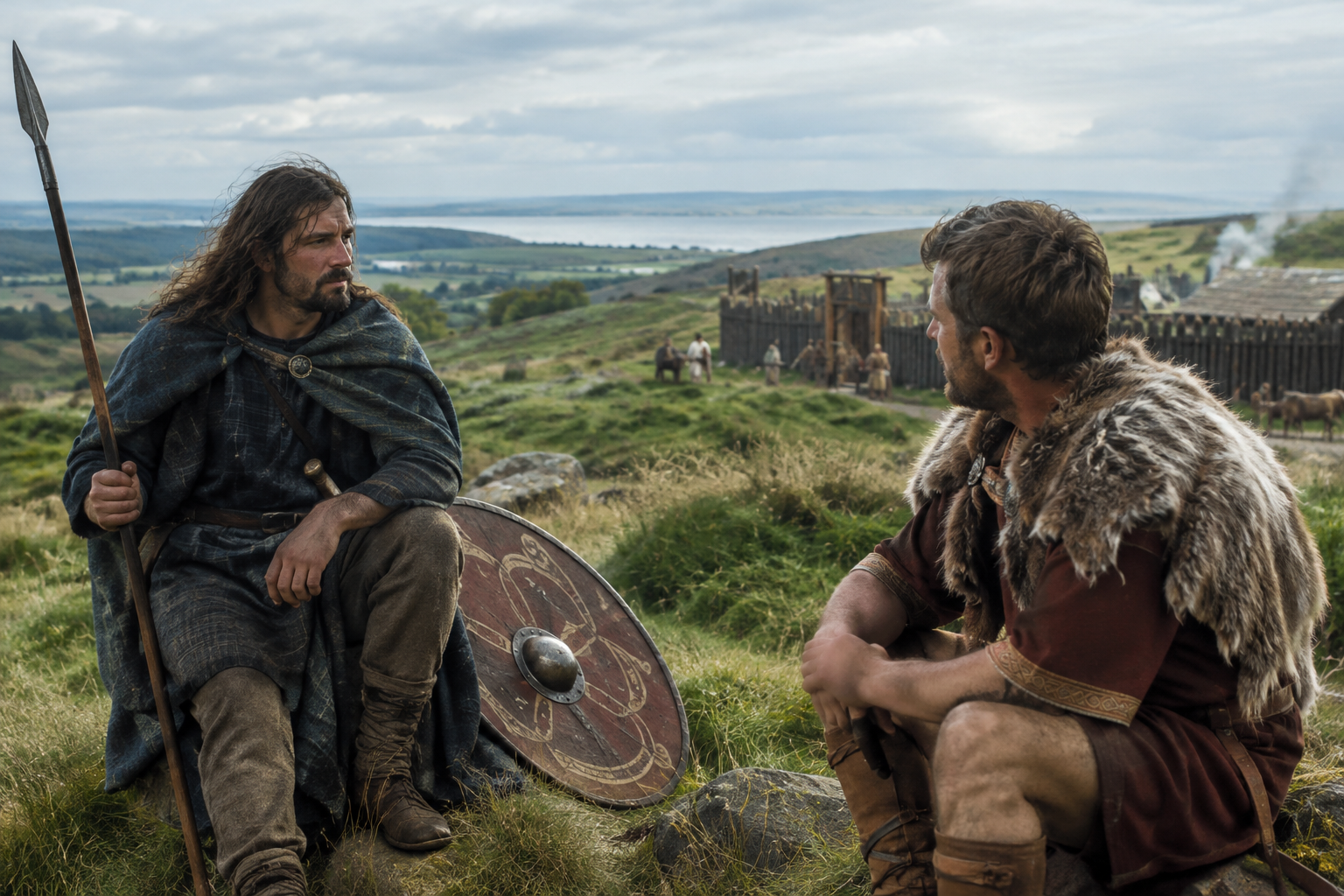
At Worlebury Camp in Somerset, an Iron Age hillfort overlooking the Bristol Channel, one ancient man dated to around 115 BC appears in the record as sample I11142. He is not a king with a name, nor a saga hero, but in some ways he is more interesting than either. He gives us a direct glimpse of one paternal line, the Y-DNA haplogroup R1b1a1b1a1a2c1a6a1, inside a real late prehistoric community in southwestern Britain.
That matters because Y-DNA traces one narrow line of descent from father to son. It is not a person's whole ancestry, still less a ready-made ethnic label. But when the same branch turns up in securely dated ancient individuals from Iron Age and Roman-period Britain, it begins to tell a very grounded story: not of abstract maps, but of men living in defended settlements, farming familiar landscapes, and passing one paternal lineage through centuries of local change.
Worlebury Camp is one of those sites that reminds us how physical Iron Age society could be. Hillforts were not just symbols on a distribution map. They were built places, with banks, ditches, entrances, and routines of life worked out on high ground. The presence of sample I11142 at this Somerset site places the haplogroup R1b1a1b1a1a2c1a6a1 in a setting shaped by local defence, stock management, exchange, and long-settled agricultural life.
We should be careful here. One male burial or skeleton from a hillfort does not mean the entire community shared his paternal line, and it certainly does not let us name his tribe from classical texts. But it does show that this branch belonged to the human fabric of Iron Age western Britain, not merely to later medieval pedigrees or modern surname clusters.
A broader ancient DNA study of Britain published in Nature has helped place Iron Age and Roman-period individuals into a much clearer genetic landscape. One of its larger lessons is that Britain was neither frozen in place nor endlessly replaced. Local continuity and incoming connections could coexist, and paternal lines such as this one have to be read within that more nuanced picture.
The second ancient individual linked here is I12927, dated to around AD 125 from Gloucestershire in Britain. That date places him in the early Roman imperial period, when the political world of southern Britain had been transformed. Roads, forts, towns, taxation, military service, and new forms of status had all arrived. Yet a paternal line associated with R1b1a1b1a1a2c1a6a1 was still present in the region.
This is precisely the sort of evidence that stops us telling lazy before-and-after stories. Rome did not wipe the slate clean. Roman rule changed institutions, economies, and mobility, but many local families remained where they were, or near enough, carrying older lineages into a new imperial setting. A man buried in Gloucestershire in the second century AD might have lived in a world of Roman administration while still belonging, in paternal terms, to a line already rooted in Britain generations earlier.
That does not prove direct descent from the man at Worlebury Camp, of course. Somerset and Gloucestershire are neighboring regions, not a documented father-to-son chain across two centuries. What it does show is recurrence in a meaningful geographical zone: southwestern Britain, from the later Iron Age into Roman times.
The long form R1b1a1b1a1a2c1a6a1 sits inside the very large R1b family, one of the major Y-chromosome groupings in western Europe. But that broad fact can mislead if it is handled too casually. A huge parent haplogroup can spread across many regions and periods, while a far narrower descendant branch may have a much more local or historically specific pattern.
So the right way to read this article's branch is modestly. The evidence here does not license grand claims about where this exact subclade first arose, nor does it let us attach it neatly to a single named people. What it does support is something more useful: this branch was present among men in southwestern Britain around the late Iron Age and remained represented there into the Roman period.
For family historians, that is often the more valuable point. Deep ancestry becomes historically tangible when a branch is found in dated archaeological individuals from recognisable places. Instead of an anonymous code on a testing screen, you are looking at a lineage that turns up in actual ancient Britons.
Southwestern Britain is especially interesting because it was never an empty edge of the map. Long before Rome, this was a landscape of hillforts, enclosed farms, coastal movement, and regional identities. Somerset and Gloucestershire sat within a busy zone linked by river valleys, uplands, and access to the Severn estuary and Bristol Channel. People, animals, goods, and marriages moved through it.
That is one reason the two samples matter together. They do not merely represent two isolated dots. They sit in a region where continuity across the Roman conquest is historically plausible and archaeologically visible, even though the political order changed dramatically. In other words, this haplogroup's appearance in both periods fits a wider pattern in which parts of the local population persisted through conquest rather than vanishing beneath it.
Recent work on Britain has repeatedly shown that Roman-period communities could be genetically mixed in some places and strongly local in others. The old stereotype of "native" versus "Roman" simply does not survive contact with the data. A paternal lineage like R1b1a1b1a1a2c1a6a1 may therefore belong to men living through cultural change without requiring a clean ethnic label for either period.
It is easy to dismiss a pair of samples as too small to matter. Archaeology, though, often works by accumulation. One securely placed Iron Age man from Worlebury Camp and one man from Roman Gloucestershire do not define the whole history of the branch, but they do anchor it. They place it among ancient individuals with dates, places, and historical contexts rather than leaving it entirely to modern distribution patterns.
That is especially important in Britain, where paternal histories have been argued over for years in terms of Celts, Romans, Anglo-Saxons, Vikings, and Normans, as though each period simply overwrote the last. Ancient DNA has made the picture less theatrical and more human. Some lineages arrived, some expanded, some dwindled, and many endured locally through multiple historical phases.
For this branch, the present evidence points to endurance in one part of Britain. Not eternal continuity, not tribal purity, not a dynastic secret - just the solid and rather fascinating fact that a paternal line represented by R1b1a1b1a1a2c1a6a1 was living in the west of Britain before Rome and still there after Rome had remade the political landscape.
The clearest insight from R1b1a1b1a1a2c1a6a1 is not a grand origin myth but a regional historical foothold. This branch is linked here to two ancient males from Somerset and Gloucestershire, spanning the later Iron Age and the Roman period. For someone researching a paternal line today, that makes the haplogroup historically vivid: it was part of the male population of southwestern Britain at a moment when local traditions endured even as empires arrived.
Comments