Haplogroup R1b1a1b1a1a2c1a4b2b
– 5 min read


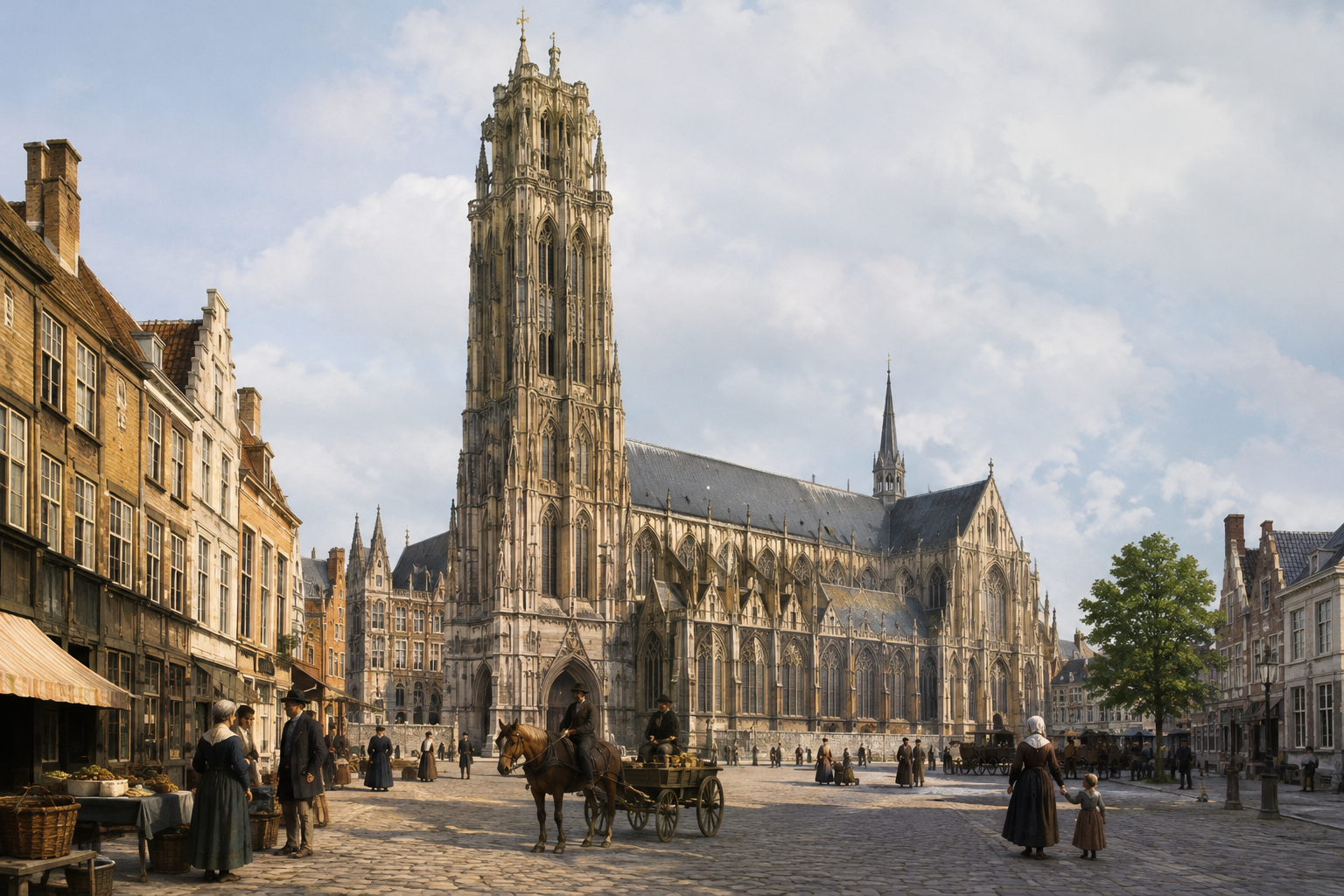
In 1821, at St. Rombouts in Mechelen, Belgium, an early modern man now catalogued as STR016b entered the scientific record in an unexpected way. He is not a Bronze Age warlord or a richly furnished prince, but that is precisely what makes him interesting. For the very specific Y-DNA lineage R1b1a1b1a1a2c1a4b2b, the clearest ancient anchor here is a man from a historic church setting in the Low Countries, dated to the early nineteenth century.
That matters because Y-DNA is a record of one direct paternal line only: father to son, and so on, through time. It does not define a whole person's ancestry, language, or identity. But when a lineage turns up in an excavated and dated individual, even a relatively recent one like STR016b, it gives us something solid: a real man in a real place, standing at the end of a very long paternal chain.
At first glance, a date like 1821 AD may seem almost too recent for archaeogenetics. Yet church and cemetery burials from the early modern and modern transition are often enormously useful. They sit close enough to documented history to illuminate the population structure of towns and regions we know well from archives, while still belonging to the world of excavated human remains rather than living genealogy.
In the case of STR016b, the importance lies less in dramatic archaeology than in context. Mechelen was no isolated hamlet. St. Rombouts belonged to one of the major ecclesiastical and urban landscapes of the southern Low Countries, a region shaped for centuries by trade, war, mobility, and dense local continuity. A paternal line found there in 1821 is part of that layered history: medieval towns, Habsburg rule, Spanish and Austrian phases, French revolutionary disruption, and the new post-Napoleonic kingdom that followed.
An ancient DNA study of people from the Low Countries and nearby regions has shown just how informative such burials can be for reconstructing mobility and continuity in historic populations. Research on this wider landscape, including material relevant to Belgium, can be found in this Nature study, which helps place individuals like STR016b into the broader story of regional population history.
The long string of letters and numbers tells you immediately that this is not a broad umbrella haplogroup but a highly specific downstream branch. Its deeper ancestry lies within the vast R1b family, one of the major paternal lineages in western Europe. But that broad fact is only the beginning, not the conclusion.
It would be careless to project the entire prehistoric history of R1b onto R1b1a1b1a1a2c1a4b2b. A narrow subclade may have a much more recent, regional story than its distant parent branch. What the St. Rombouts sample shows is that this particular paternal line was present in Belgium by the early nineteenth century, in an urban religious setting. That is a firmer statement than any romantic tale of tribal founders or medieval knights.
For readers tracing this haplogroup today, that distinction is crucial. Your branch belongs to a great western European paternal tree, yes, but the evidence supplied here speaks most clearly to a later historical presence in the Low Countries rather than to a single named prehistoric culture.
Mechelen is a good place to think historically about paternal continuity because it has so often sat at a crossroads. In the late medieval and early modern centuries it was an important administrative, ecclesiastical, and commercial centre. That does not mean every man buried there was a newcomer; quite the opposite. Towns like Mechelen often combined deep local family roots with a steady trickle of migrants from nearby villages, provinces, and neighboring states.
So a lineage like R1b1a1b1a1a2c1a4b2b turning up at St. Rombouts could represent several overlapping histories at once: longstanding local descent, movement within Brabant and Flanders, or the wider circulation of families through the political patchwork of the Low Countries. Archaeogenetics cannot choose among those options from Y-DNA alone, but it can show that this paternal branch belonged to the human fabric of historic Belgium.
That is one reason later burials are worth taking seriously. They connect grand population history to the scale at which most family researchers actually work: towns, parishes, regions, and surnames. A man like STR016b is close enough in time to feel familiar, yet distant enough to remind us how many generations can disappear into the ordinary silence of the archive.
There is a temptation in ancient DNA writing to privilege only the spectacular: kings, mounted warriors, mass migrations. But much of Europe's real paternal history lies in less glamorous contexts. Parish churches, cathedral precincts, and urban cemeteries preserve the men who actually sustained continuity across centuries.
STR016b belongs to that category. His value is not that he single-handedly explains the origin of the haplogroup, but that he fixes it in a documented historical landscape. If your own paternal ancestry points toward Belgium, northern France, the Netherlands, or the adjoining Rhineland, a sample like this becomes especially resonant. It suggests that the branch participated in the dense, local, and often surprisingly stable male lineages of northwestern Europe.
This also fits with a broader lesson from European archaeogenetics: major migrations matter, but so do long stretches of regional persistence. Studies of the Rhine-Meuse and adjacent North Sea world repeatedly show that later populations were formed not by one event but by repeated episodes of movement layered onto established communities.
Lower Rhine-Meuse Deep History
Anyone carrying R1b1a1b1a1a2c1a4b2b naturally wants to know how far back the line goes. In the broadest sense, the parent R1b family is heavily implicated in later prehistoric changes across western Europe, including the Bronze Age reshaping of paternal lineages. But the further down the tree one travels, the more caution is needed.
The evidence here does not justify assigning this exact subclade to a named Bronze Age people, a Celtic tribe, a Frankish clan, or a medieval dynasty. What it does justify is a more modest, and in some ways more useful, historical picture: by the early modern period, this branch was part of the paternal landscape of Belgium, in one of the most historically interconnected parts of Europe.
That kind of result can be more illuminating for genealogists than a sweeping origin myth. It narrows attention toward regional documentary history, surname studies, parish records, and neighboring populations in the Low Countries, rather than toward unsupported claims of descent from a famous house.
Bell Beaker and the Rhine-Meuse
The most distinctive thing about R1b1a1b1a1a2c1a4b2b in the evidence provided is not royal glamour but grounded historical presence. Sample STR016b places this paternal line in early nineteenth-century Mechelen, at St. Rombouts, within the urban and ecclesiastical world of Belgium. That makes the branch a small but tangible part of Low Countries history: not abstract, not legendary, but human and local.
For someone researching this haplogroup today, the sensible takeaway is that your direct paternal line may have meaningful roots in the historic populations of northwestern Europe, and perhaps particularly in the Belgian-Dutch-Rhineland zone where towns, churches, and families preserved continuity through centuries of political change. That is a quieter story than the usual dynastic fantasies, but it is also the more believable one.
Comments