Haplogroup R1b1a1b1a1a2c1a3a2a1a1a
– 4 min read


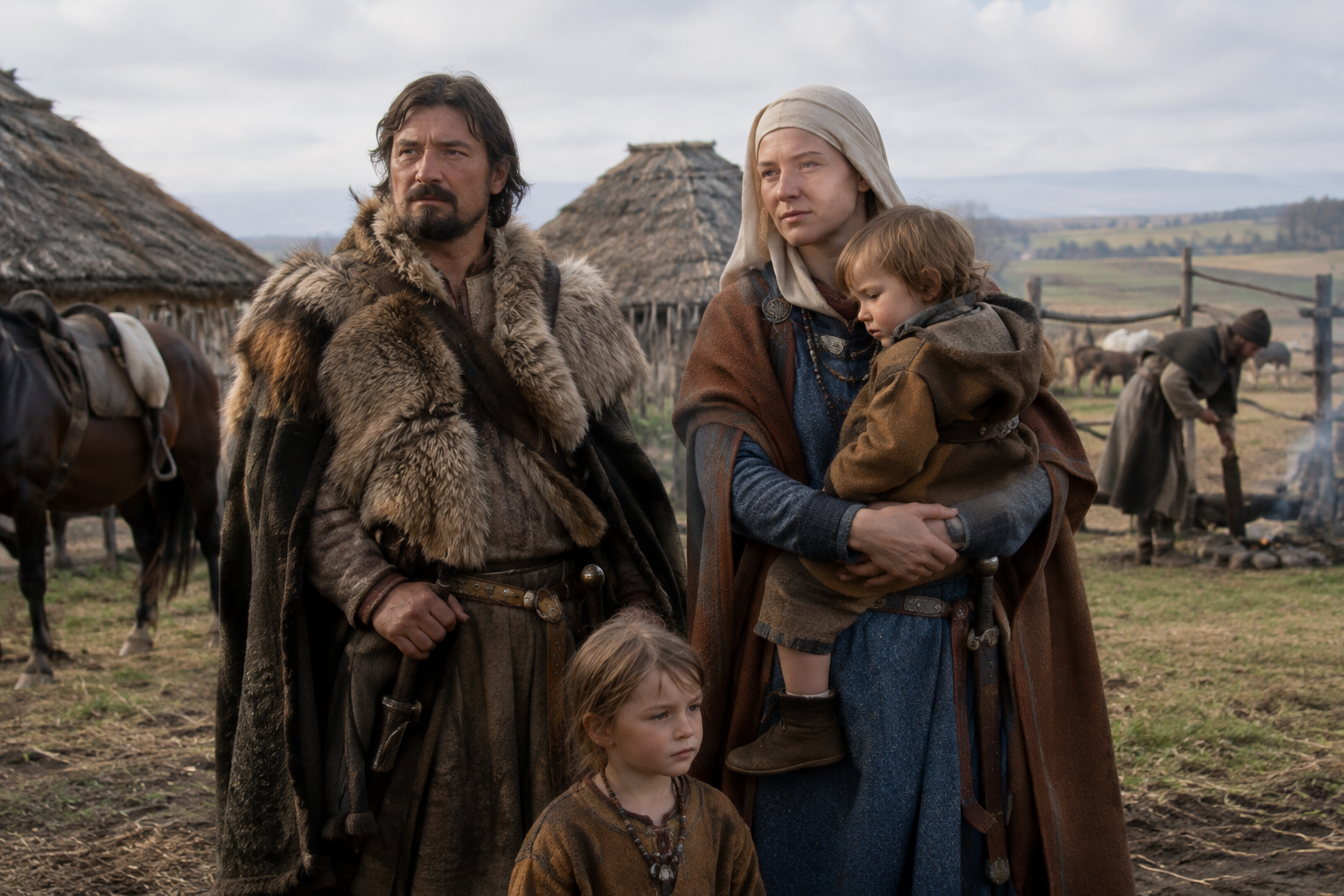
At Rakoczifalva in Migration Period Hungary, one excavated man, catalogued as RKF217 and dated to around AD 650, offers a small but revealing window onto a much larger paternal story. He is associated here with the very narrow Y-DNA branch R1b1a1b1a1a2c1a3a2a1a1a - an imposing string of letters and numbers, certainly, but behind it stands something very human: one direct male line carried through the unsettled centuries after Roman power in the Carpathian Basin had collapsed.
The important point is not that a single grave can explain an entire people. It cannot. But RKF217 matters because he comes from a place and time when the middle Danube was full of movement, reassembled communities, and new political worlds. A Y-chromosome lineage traces only one paternal line, not a person's whole ancestry or identity, yet in the archaeological setting of seventh-century Hungary it can still help anchor a family thread within a famously mixed landscape.
Rakoczifalva lies in the Great Hungarian Plain, one of those landscapes that archaeology repeatedly shows to have been less of a quiet frontier than a zone of constant human traffic. By the seventh century, this region had already seen Roman-era influence at its margins, the movements of Sarmatians, Huns, Gepids, and others, and then the rise of the Avar Khaganate. Any burial from this period belongs, therefore, to a world in which local continuity and long-distance mobility sat side by side.
That is why RKF217 is more interesting than his short record might first suggest. His date places him squarely within the Migration Period's aftermath, when communities in the Carpathian Basin were being reorganized under new authorities and new social alliances. A paternal lineage such as R1b1a1b1a1a2c1a3a2a1a1a does not tell us his spoken language, legal status, or ethnic label, but it does show that one branch of the broad and widespread R1b family was present in this seventh-century Hungarian setting.
A major ancient DNA study of the region and its neighboring populations, published in Cell, helped underline just how varied the post-Roman and early medieval Carpathian Basin could be. That broader context matters here: rather than expecting a single "Avar," "Gepid," or "local" genetic signature, the archaeology and genomics of the period increasingly point toward mixed communities with different paternal and maternal histories intersecting in the same cemeteries.
The haplogroup in this article, R1b1a1b1a1a2c1a3a2a1a1a, is not a grand civilizational label. It is a finely split twig on the much larger R1b tree. That distinction is crucial. Broad R1b lineages are common across much of Europe and have deep prehistoric histories, but one cannot simply pour all of that vast background into a tiny terminal branch and pretend the work is done.
For someone tracing paternal ancestry today, the narrowness of this branch is precisely what makes it useful. The wider R1b family may tell you that your direct male line belongs to a lineage with a long European history; a specific branch such as R1b1a1b1a1a2c1a3a2a1a1a can place that line in a much tighter genealogical neighborhood. Ancient evidence like RKF217 does not prove descent from him or from his immediate kin, but it does show that this paternal line, or a line very close to it, had reached the middle Danube by around AD 650.
It is tempting to read every early medieval burial through the old language of tribes marching neatly across maps. Archaeology has spent years dismantling that picture. Cemeteries in the Carpathian Basin often contain people with differing biological backgrounds, different funerary habits, and different ties to the surrounding world. The result is not confusion so much as realism: early medieval society was assembled, not pure.
That larger lesson gives RKF217 his proper scale. He should not be turned into a mascot for a single migrating nation. Instead, he stands as evidence that one direct paternal line within the R1b complex was part of the human mixture that made up Migration Period Hungary. In practical terms, that means this haplogroup sits comfortably inside a region known for contact between steppe-linked groups, long-established local populations, and people whose family histories likely stretched into several parts of Europe.
By AD 650, Hungary was not merely inheriting the Roman past; it was living through the consequences of its disappearance. Roads, river routes, and abandoned imperial structures still shaped the land, but power now rested in new hands. Burial grounds from this period are often our clearest witnesses because written sources are patchy and usually written by outsiders with their own agendas.
In that setting, a Y-line like R1b1a1b1a1a2c1a3a2a1a1a is best understood as one thread in the remaking of the Danube world. Some paternal lines in these centuries may reflect deep local roots; others may mark recent arrivals; many likely represent family histories already blended over generations before they ever entered the archaeological record. RKF217 belongs to that middle ground where genetics is most valuable: not as a badge of certainty, but as evidence of how real communities were put together.
This is one reason comparative reading across nearby regions is so useful. Work on mixed early medieval populations elsewhere in Europe has repeatedly shown that material culture, burial custom, language, and Y-DNA do not map onto one another in any simple way. The Carpathian Basin, if anything, makes that point more strongly than most.
One ancient sample can never carry the whole argument, but neither is it trivial. Ancient DNA advances not only through spectacular royal identifications or mass cemetery studies, but also through securely dated individuals whose lineages can be placed in time and space. RKF217 gives this branch exactly that: a documented appearance in seventh-century Hungary, in a historically important crossroads region.
That matters especially for very specific haplogroups. Modern testers often know their terminal branch in extraordinary detail, yet without ancient comparators the historical picture can remain frustratingly abstract. A man like RKF217 does not solve the entire puzzle, but he gives the branch archaeological ground under its feet.
The strongest insight from this haplogroup, on present evidence, is not a claim of famous descent or a dramatic migration tale. It is the quieter and more useful fact that this direct paternal line appears in the archaeological record of Migration Period Hungary, represented by RKF217 at Rakoczifalva around AD 650. For modern researchers, that places the branch within the dense human traffic of the Carpathian Basin - a region where empires had fallen, new powers were rising, and family lines endured through the change.

Comments