Haplogroup R1b1a1b1a1a2b1c2

– 5 min read


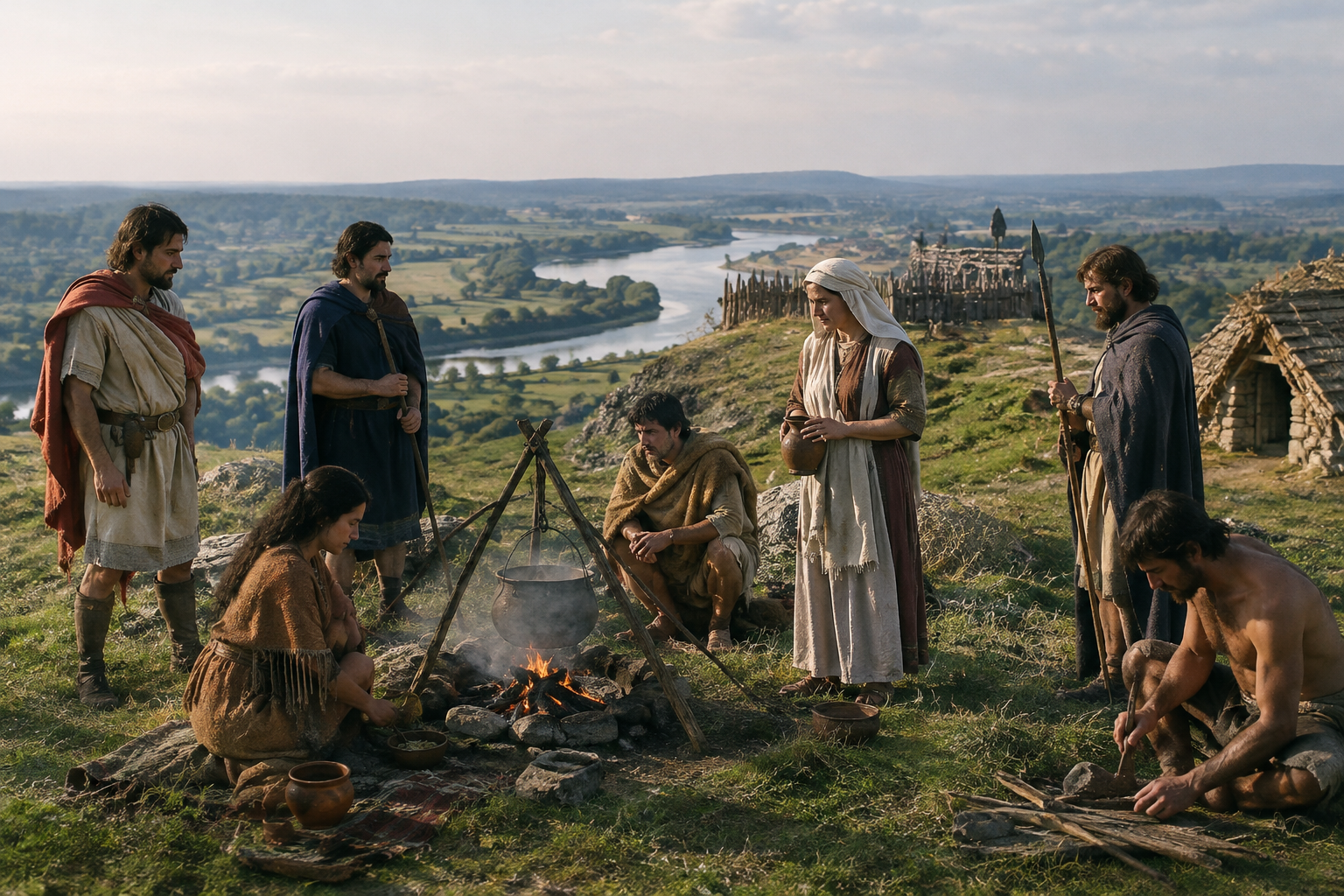
At Felsina, the Etruscan city beneath modern Bologna, one ancient male dated to around 600 BC was assigned sample ID I29157. He matters here not because he can stand in for all Etruscans - he cannot - but because he places the Y-DNA branch R1b1a1b1a1a2b1c2 in a very particular Iron Age world: urbanizing northern Italy, where local traditions, wider Mediterranean contacts, and older continental lineages were meeting in the same cemeteries.
That is the first useful thing to say about this haplogroup. On MyTrueAncestry, a branch name as specific as R1b1a1b1a1a2b1c2 points to one direct paternal line only. It is not a person's full ancestry, and it is certainly not a shortcut for language or ethnicity. But when that same line appears in Iron Age Italy, Iron Age Slovenia, and Bronze and Iron Age Croatia, it begins to sketch a believable regional story across the northern Adriatic and the southeast Alpine world.
Felsina was no marginal outpost. Before the Roman colony of Bononia, it was one of the major Etruscan centers of the Po Valley, tied into exchange networks running across Italy and beyond. A sample like I29157 therefore sits in a historically important setting: not the stereotyped Etruria of southern Tuscany alone, but the northern Etruscan sphere, where archaeology has long shown both continuity and change.
A recent MyTrueAncestry article on Etruscan Origins and Change in Bologna explores precisely that larger setting - how Bologna's population history looks more complex and more local than older origin myths once suggested.
What makes this relevant to R1b1a1b1a1a2b1c2 is not an argument that the branch was uniquely "Etruscan." Rather, it shows that a lineage associated today with a very fine-grained paternal label was present among people living in an Etruscan political and cultural environment in the Po Valley by the 6th century BC. That fits a broader picture in which Iron Age Italy preserved substantial ancestry from earlier European populations even while cities, trade, and identities were changing rapidly.
Research on ancient Italy has increasingly emphasized that cultural labels and biological descent do not map neatly onto one another. The ancient DNA picture from the peninsula has made that plain again and again, including in studies of central and northern Italian populations.
If Bologna gives us an urban Etruscan setting, Dolge Njive in Slovenia gives us something rather different: an Early Iron Age burial landscape in the Dolenjska region. Two men from this context, I5685 and I5687, dated around 600 BC, are associated here with the same haplogroup branch. That repetition is worth noticing. It does not prove a ruling dynasty, but it does suggest that this paternal line was established in the region rather than appearing as a one-off anomaly.
Dolenjska in the Early Iron Age belonged to a zone of hill forts, barrows, and shifting local elites, positioned between the Adriatic, the Alps, and the Pannonian basin. This was a corridor of contact, not a sealed cultural box. An ancient DNA study examining burials from Dolge njive has helped place these graves into a richer discussion about kinship practices and community structure in southeast Europe.
For readers tracing R1b1a1b1a1a2b1c2, this is an especially useful piece of evidence because it moves the story away from a single named civilization and into a regional social landscape. The branch appears not only in the Po Valley but also in the southeastern Alpine world at roughly the same time. That makes the northern Adriatic and its hinterlands a more plausible frame than any narrow ethnic label.
There is a wider regional context too. MyTrueAncestry's piece on shifting paternal lineages in Croatia is useful background for understanding how male-line patterns could change or persist unevenly across the eastern Adriatic world.
The Croatian evidence pushes the line deeper in time. Sample I18072 comes from Bezdanjaca Cave and is described here as Pre-Illyrian Bronze Age Croatia, around 1500 BC. Much later in date but still part of the same broad eastern Adriatic sphere is I5725 from the Iron Age hillfort at Križ Brdovecki in the Sava valley, dated around 580 BC.
Those are very different archaeological contexts. A cave burial in the Bronze Age is not the same thing as an Iron Age fortified settlement zone, and the term "Pre-Illyrian" should be handled carefully as a cultural shorthand, not as a firm ethnic identity. But taken together, the samples do suggest a long male-line presence in the western Balkans before and during the period when historically attested Iron Age groups emerged.
This is exactly where genetics is at its most interesting and most awkward. Ancient texts tempt us to label everything too quickly: Illyrian, Venetic, Etruscan, Celtic. Yet the paternal evidence here looks more like a durable regional thread moving through changing cultural worlds. Bronze Age burial traditions, Early Iron Age hill-fort communities, and urbanizing Po Valley centers are all different chapters, but this branch appears in each.
For a broader population-scale frame, the major Eurasian ancient DNA synthesis published in Science is often important for understanding how later European Iron Age populations inherited ancestry from earlier Bronze Age transformations, even though no single synthesis can by itself explain a fine-scale subclade like this one.
One listed individual stands far from the Adriatic world in both time and place: I15299 from the St. Mary City Chapel Field Cemetery in Maryland, dated to 1667 AD. That sample should not be forced into the prehistoric story as if it were evidence for an unbroken documented genealogy from Iron Age Italy or Croatia to colonial North America. It is not that.
What it does show is something both simpler and more human: by the 17th century, this paternal branch was present among people buried in England's first enduring colonial capital in Maryland. That fits what we already know about the mobility of European male lines in the early modern Atlantic world, where migration carried old regional lineages into entirely new settings.
The cemetery has already been discussed in MyTrueAncestry's article on the genetic legacy of 17th-century St. Mary's City, which gives helpful historical context for the population living there.
Put the ancient evidence together and a pattern emerges with unusual clarity for such a specific branch. R1b1a1b1a1a2b1c2 appears in an Etruscan-period context at Bologna, in multiple Early Iron Age males at Dolge Njive in Slovenia, and in Bronze and Iron Age Croatia. That is not a random scatter across the whole map. It concentrates around the northern Adriatic, the Po Valley, the southeast Alpine zone, and the western Balkans.
This does not mean the branch "belongs" to Etruscans, Illyrians, or any other named people. It means the best current ancient matches point toward a paternal history rooted in populations living around those connected regions during later prehistory and the Iron Age. Readers interested in the deeper Balkan backdrop may also want to see MyTrueAncestry's discussion of Balkan hunter-gatherers and Europe's deep past.
For someone carrying R1b1a1b1a1a2b1c2 today, the most distinctive supported insight is not a glamorous royal claim or a single ethnic badge. It is the repeated appearance of this direct paternal line in the northern Adriatic world and its neighboring inland corridors, from Bronze Age Croatia to Early Iron Age Slovenia and Etruscan Bologna. That is a serious archaeological footprint: regional, old, and tied to communities living through some of Europe's great transformations in settlement, identity, and exchange.






Comments