Haplogroup R1b1a1b1a1a2b1b

– 4 min read


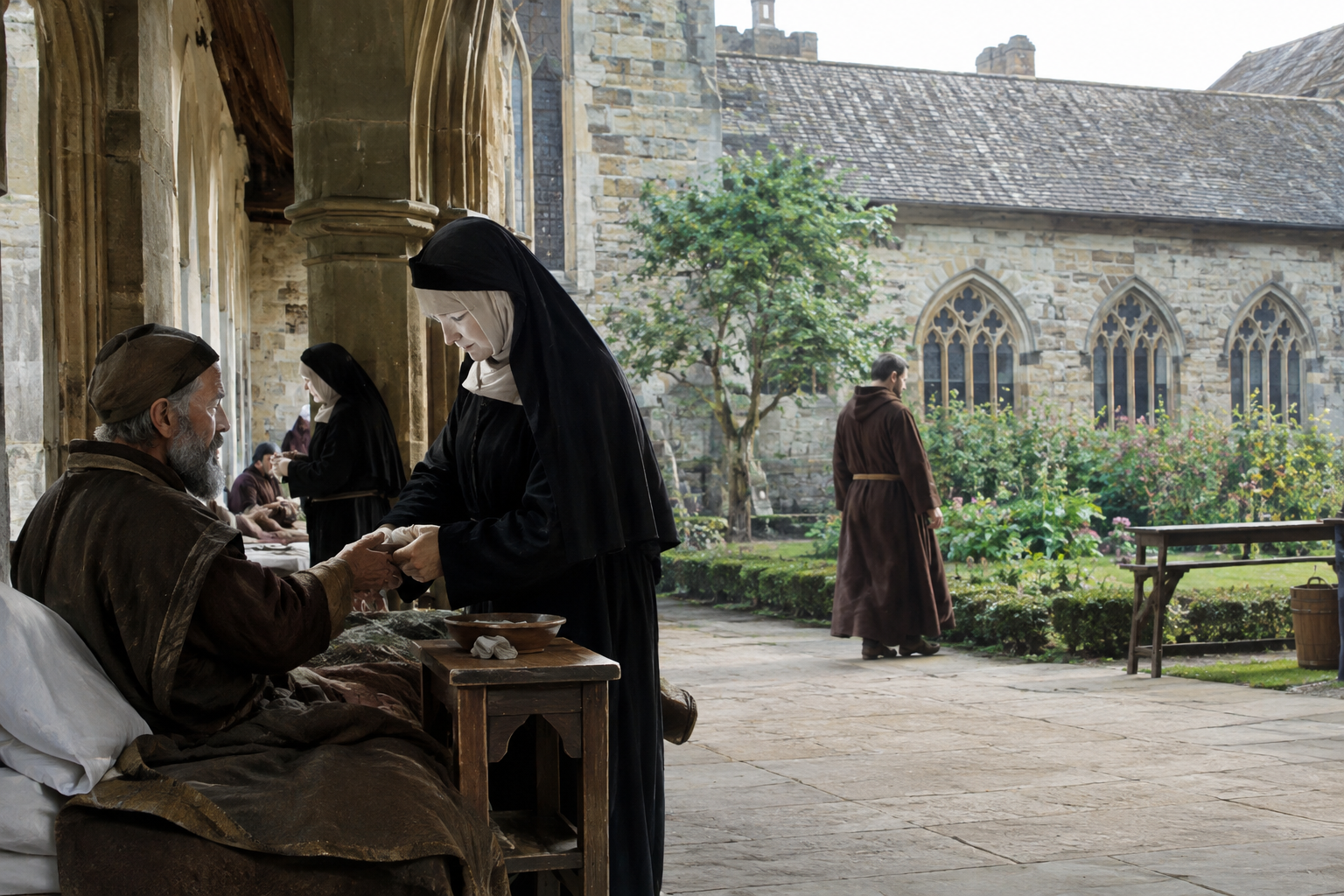
In about AD 1209, a man was buried at St John's Hospital in Cambridge. Today he appears in the ancient DNA record as ATP_PSN_116, a medieval English individual whose Y-chromosome has been associated with the haplogroup R1b1a1b1a1a2b1b. It is a very narrow paternal line, tucked deep inside the much larger R1b family tree, and that makes this one burial especially useful: not because it can stand for all medieval England, but because it gives us one firmly dated glimpse of this lineage in a real urban setting.
That setting matters. A hospital in the early 13th century was not a modern medical institution, but a religious and charitable foundation serving the sick, poor, elderly, and travellers. So ATP_PSN_116 does not lead us straight into the world of kings or battlefields. Instead, he places this paternal branch in the crowded, practical, and deeply unequal society of medieval Cambridge, where people lived among churches, bridges, markets, scholars, and the institutions that tried, however imperfectly, to care for the vulnerable.
St John's Hospital stood just outside the old core of Cambridge, in a landscape shaped by the River Cam, roads, and ecclesiastical property. By the early 1200s the town was already an important regional centre, and its population was being pulled in different directions by trade, religion, and the growing scholarly community that would soon define Cambridge's later fame.
The significance of ATP_PSN_116 is not that he was elite, but that he was ordinary enough to be historically precious. Ancient DNA often illuminates palaces, richly furnished graves, or dramatic migration horizons. Here, by contrast, we have a paternal lineage represented in a working medieval institution. That helps anchor R1b1a1b1a1a2b1b in the everyday human landscape of England rather than in later surname traditions or modern distribution maps alone.
A broader ancient DNA study of Britain and nearby regions has explored how populations changed from Roman into early medieval times, and how those changes were still visible centuries later in local communities. For readers interested in that wider background, see this research preprint on ancient population history in Britain, which forms part of the scientific setting in which medieval individuals like those from Cambridge are being interpreted.
Roman and Early Medieval Britain
The exact label R1b1a1b1a1a2b1b is a fine-grained branch of a much older paternal tree. The parent haplogroup R1b is widespread in western Europe and especially common in parts of Britain, but that broad fact should not be lazily projected onto every one of its tiny descendant branches. A terminal or near-terminal subclade records one direct male line only: father to son to son, across many generations. It does not describe a person's whole ancestry, language, social rank, or ethnic identity.
That distinction is worth making because medieval England was already the product of many overlapping histories. Prehistoric population shifts, Roman rule, post-Roman migrations, Scandinavian settlement, and Norman political takeover all helped shape the people living there. A man carrying R1b1a1b1a1a2b1b in 13th-century Cambridge could belong to a lineage that had been in Britain for a very long time, or one that had moved within the British Isles or across the Channel at some earlier point. The sample itself proves presence, not the full route by which that presence came about.
There is something salutary about finding a Y-DNA branch not in a royal tomb but in a hospital cemetery. Medieval hospitals were social crossroads. Their burial grounds could contain people from the immediate neighbourhood, dependants of the institution, and sometimes individuals whose lives had been marked by illness, poverty, age, or displacement. That makes ATP_PSN_116 part of an institutional history as much as a genetic one.
Cambridge in this period was not isolated. It was tied into eastern England's road network and river traffic, and eastern England itself had long been one of the regions most exposed to North Sea movement. That does not let us assign one neat origin story to a single Y-line, but it does remind us that even a local medieval burial may sit within centuries of mobility and mixing. A paternal lineage found here belonged to a town shaped by far more than its parish boundaries.
In Britain, many paternal lines under the vast R1b umbrella ultimately trace back to prehistoric and later historic processes that cannot be reduced to a single migration event. Some branches expanded dramatically in later prehistory; others became regionally common through founder effects, local survival, and the churn of medieval demography. By the 13th century, lineages like the one carried by ATP_PSN_116 were part of a thoroughly historical society: feudal, urbanising, Christian, and literate.
That is an important corrective to the temptation to treat Y-DNA as a tribal badge. The man from St John's Hospital was not simply a carrier of an ancient western European branch. He was a medieval English person living after the Norman Conquest, after Scandinavian settlement, after the formation of English kingdoms, and within a world of hospitals, guilds, church patronage, and expanding towns. His haplogroup belonged to that layered history too.
Recent work on the genetic impact of the Norman era has shown just how complicated local communities could be in the centuries after 1066, with ancestry components linked to earlier Anglo-Saxon, Scandinavian, and continental influences appearing in varying proportions. That larger context helps make sense of why a Cambridge hospital burial can be so revealing without needing to be spectacular.
For someone researching this haplogroup today, the real value of ATP_PSN_116 lies in scale. Broad ancestry studies can tell us that many western European men fall somewhere under R1b. A medieval sample linked to R1b1a1b1a1a2b1b tells us something more focused: that this particular paternal thread was present in England by the early 13th century, in a documented settlement context, and among the ordinary dead rather than only among celebrated dynasties.
That sort of evidence is modest, but it is sturdy. It does not promise descent from a famous house. It does something better. It places a narrow paternal line inside a real historical community, among the people who made medieval towns function day by day and whose names usually vanished even when their bones did not.
The clearest supported insight for R1b1a1b1a1a2b1b is not one of grandeur but of placement. Through ATP_PSN_116 at St John's Hospital, Cambridge, this paternal line is visible in medieval England within an institutional burial ground around AD 1209. That makes it a lineage with documentary-era footing in a busy English town, shaped by the long population history of Britain but preserved in the remains of one man whose life unfolded far from the chronicles of kings.




Comments