Haplogroup R1b1a1b1a1a2b1a2a

– 4 min read


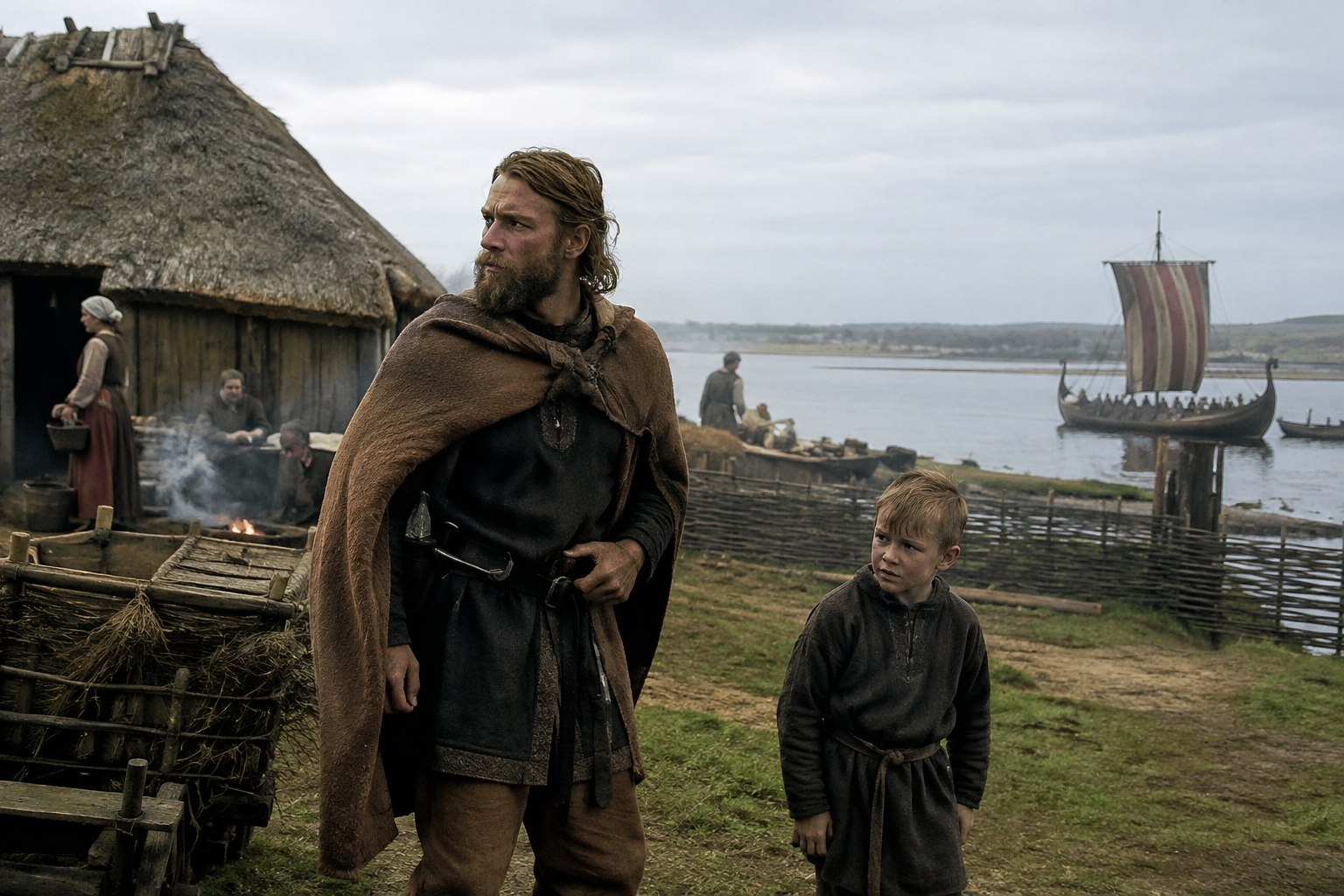
In around AD 1050, in Jutland at Tjaerby near Randers, one man now known to us simply as CGG100686 was buried in Viking Age Denmark. He is a small but telling piece of evidence for the Y-DNA haplogroup R1b1a1b1a1a2b1a2a: not a saga hero, not a king, and not a ready-made dynasty, but an excavated individual from a society that was changing fast.
That is precisely what makes him interesting. By the mid-11th century, Denmark stood at the far end of the Viking Age, when older Scandinavian patterns of mobility, raiding, trade, and settlement were giving way to a more consolidated Christian kingdom. A direct paternal lineage like this one tracks only one narrow male line, not a person's whole ancestry, but in an archaeological setting it can still illuminate how particular lineages were present within that larger social transformation.
The known ancient anchor for this article's haplogroup is modest but concrete: CGG100686 from Tjaerby, Randers, dated around AD 1050. That places him in eastern Jutland at a moment when Denmark was no longer merely the homeland of Viking expeditions. It was becoming a medieval kingdom with churches, reorganized local power, and stronger ties across the North Sea and Baltic worlds.
When we talk about haplogroup R1b1a1b1a1a2b1a2a here, we should be careful. The long label refers to a very specific branch nested inside the much broader R1b family, a paternal lineage found across large parts of Europe. It would be a mistake to load the entire prehistory of R1b onto this narrower branch without direct evidence. What the Tjaerby individual shows, more securely, is that one man associated with this reported branch was living in Viking Age Denmark at the close of that era.
That may sound cautious, but caution is how archaeology stays interesting. A single grave does not tell us that this lineage was uniquely "Viking," nor that every later bearer descends from Denmark. What it does offer is a fixed point in time and place: this paternal line was present in Jutland during a historically important century.
AD 1050 is not just a date near the end of the Viking Age; it is a date right inside a period of institutional change. Denmark in the 10th and 11th centuries was shaped by royal consolidation, Christianization, and intense contact with England, Norway, the southern Baltic, and the wider North Sea zone. A lineage found in Jutland at this point sits in a historical landscape of movement and mixture rather than isolation.
That broader context has been explored in major ancient DNA research on Viking Age Scandinavia, including a large genetic study of the Viking world. Even without forcing every detail of that research onto CGG100686 specifically, the wider picture is clear enough: Viking Age populations were not simple, sealed ethnic blocks. They were regional communities linked by travel, kinship, warfare, marriage, and trade.
So the significance of this haplogroup in Denmark lies less in any romantic notion of a "pure Viking line" and more in its placement within that networked world. A paternal branch recorded at Tjaerby belongs to a society where people, goods, languages, and identities circulated widely across northern Europe.
Modern maps can make Jutland look peripheral. Archaeology suggests the opposite. It was a hinge region: facing the North Sea, connected to the Baltic, and tied overland into the rest of the Danish peninsula and beyond. Any male lineage found there in the 11th century must be understood against that geography.
That matters especially for a narrow subclade such as R1b1a1b1a1a2b1a2a. With only one explicitly supplied ancient sample here, the sensible historical reading is not to assign a grand migration story to the branch itself, but to place its attested bearer in a zone of heavy interaction. Jutland lineages could be local over many generations, recently arrived from elsewhere around the North Sea, or part of older population continuities reshaped by new political realities. The archaeology does not allow us to collapse those possibilities into one tidy slogan.
In other words, the value of CGG100686 is that he is a real man from a real place at a real turning point. He reminds us that haplogroups are most useful when pinned to excavated people, not when left floating as abstract labels on internet maps.
There is another reason this single Danish sample deserves attention. Late Viking-Age and early medieval Scandinavian cemeteries increasingly let us compare genetics with changing burial customs, settlement patterns, and religious practice. In that sense, a paternal lineage is not just a marker of descent; it is part of the social history of communities adapting to a new order.
Across Scandinavia, the move from older Viking Age worlds into Christian medieval ones did not erase the population and start afresh. Instead, it involved continuity mixed with reorganization. Men carrying different paternal lines could be absorbed into the same language community, the same kingdom, and eventually the same parish structure. That is why no single Y-DNA branch can stand in for "the Danes" or "the Vikings" as a whole.
Yet these lineages still matter. Over time, enough securely dated ancient samples let us see which paternal branches appear in particular regions and periods, and how those patterns overlap with archaeology. For R1b1a1b1a1a2b1a2a, the Tjaerby individual is currently that kind of fixed point: a documented Scandinavian appearance in the final Viking centuries.
If you belong to R1b1a1b1a1a2b1a2a today, the most responsible historical takeaway is not a claim to one famous people or one neatly bounded ethnic identity. It is something more archaeological, and in its way more substantial: your direct paternal line belongs to a branch with at least one attested presence in late Viking Age Denmark, in Jutland, around AD 1050.
That does not prove a recent Danish origin for every modern bearer, and it does not turn the branch into a synonym for Viking identity. But it does place the lineage inside a documented historical landscape of Scandinavian mobility, kingdom-building, and North Sea connection. The point is not prestige; it is context. A haplogroup becomes historically meaningful when it can be tied, however cautiously, to excavated people such as CGG100686.
So the distinctive insight of R1b1a1b1a1a2b1a2a is a precise one. At least one bearer stood in 11th-century Jutland, at the edge of the Viking Age and the beginning of medieval Denmark. For anyone tracing a paternal line, that is a genuine archaeological foothold: one man, one place, one period where genetics and history briefly meet.
Comments