Haplogroup R1b1a1b1a1a1c2b2b

– 6 min read


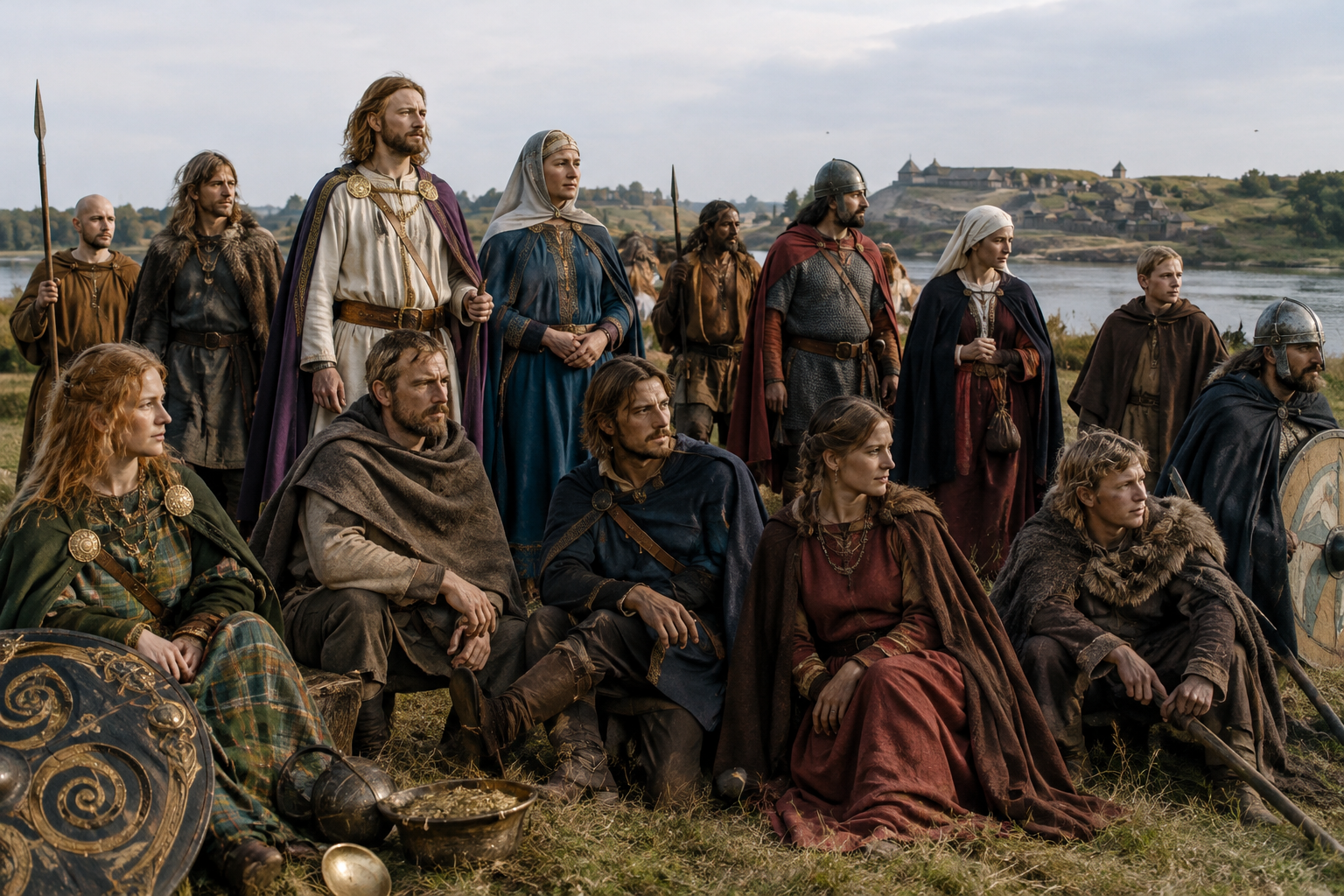
Some Y-DNA lineages appear in the record like sudden flashes: one burial, one region, one century. Others keep turning up in ways that make historians pause. The paternal lineage R1b1a1b1a1a1c2b2b is interesting for exactly that reason. In the material supplied here, it appears in an Iron Age elite Celtic burial in southern Germany, reappears among Migration Period and Merovingian-era men in central Europe, and turns up again in medieval England and Viking Age Scandinavia. That does not mean all these men were close kin. It does mean this paternal branch belonged to a very mobile and historically important part of Europe.
Y-DNA traces a direct paternal line: father to son, back through many generations. It is powerful, but it is also narrow. A Y-DNA haplogroup does not describe a person's full ancestry, culture, language, or identity. Still, when a lineage like R1b1a1b1a1a1c2b2b appears across Celtic, Frankish, Longobard, English, and Scandinavian contexts, it offers a remarkable way to think about continuity and movement across more than 1,500 years of European history.
This lineage sits within the broad R1b family, one of the major Y-chromosome groupings in western Eurasia. That broad parent branch has a deep and complicated history, and it would be misleading to dump all of that history directly onto a much narrower descendant like R1b1a1b1a1a1c2b2b. What we can say more safely is that this subclade belongs to a paternal world long established in Europe by later prehistory and well represented in the historic heartlands of central and western Europe.
The sample pattern here points especially toward central Europe, above all the zone stretching from southern and central Germany into neighboring regions. That matters because central Europe was not some quiet backwater. It was a meeting ground of Iron Age Celtic societies, Roman frontier politics, post-Roman kingdoms, Germanic migrations, and later Viking-era exchange. A paternal lineage present there could easily become part of several different cultural stories over time without needing to belong exclusively to any one of them.
Explore Central European Celtic Origins
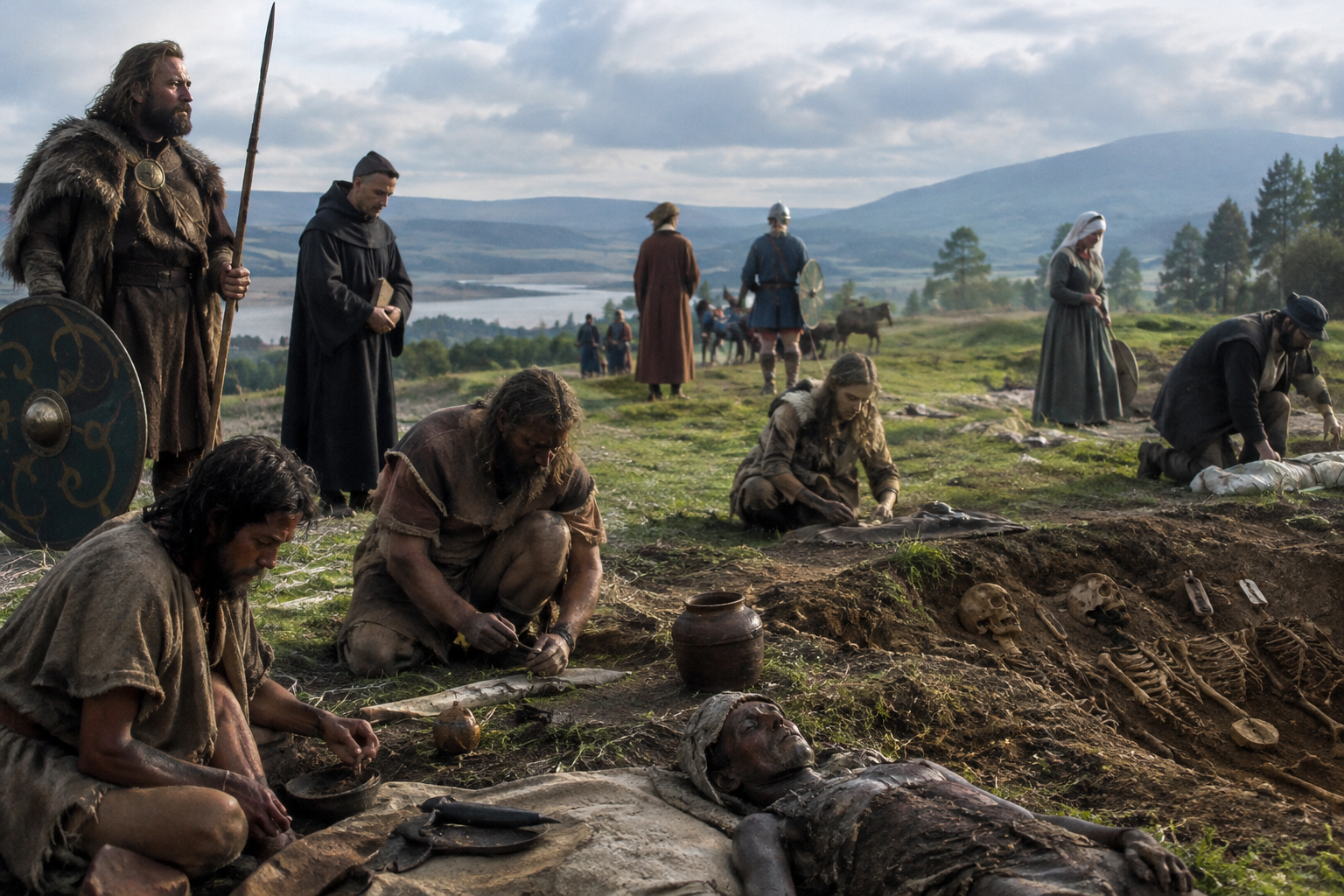
The earliest supplied individual is especially striking: MBG002, from an Elite Celtic Burial Germany Magdalenenberg Villingen-Schweningen, dated to 530 BC. Magdalenenberg is one of those sites that instantly evokes status, ceremony, and the political life of Iron Age Europe. An elite Celtic burial is not just a skeleton with a label. It is evidence that this paternal branch was present among people important enough to be marked out in death. That does not prove dynastic continuity to later centuries, but it firmly places this lineage in the social landscape of Iron Age central Europe.
Then the record picks up again in the unsettled centuries after Rome. At Bruecken in Saxony-Anhalt, both BRC025x and BRC004x are assigned to the Germanic Tribe Migration Period, dated to 500 AD. Nearby in the same broad era is RTW017, a Migration Period Germany Rathewitz Saxony-Anhalt individual, also dated to 500 AD. These are valuable because they place the lineage in a zone deeply involved in the reshaping of Europe after imperial Rome. This was a world of federates, warbands, local communities, and shifting loyalties rather than neat ethnic blocks.
The Merovingian evidence strengthens that impression. We have Btb100 from Merovingian Period Frankish Buettelborn Germany, dated to 600 AD, and Mln28a from Merovingian Period Frankish Moemlingen Germany, dated to 650 AD. Alongside them stands NS6, identified simply as a Young Merovingian Noble, dated to 605 AD. Here the story is not merely one of survival, but of presence within the Frankish world that dominated much of early medieval western and central Europe.
Another revealing sample is CGG021981, a Longobard Migration Period Czech Holubice burial dated to 562 AD. The Longobards are a gift to anyone interested in archaeology because they force us to think about migration not as a single mass movement but as a complicated social process. A lineage found in a Longobard-era context in Czechia reminds us that central Europe was both corridor and destination.
Read About the German Frontier 400-700 CE
By the early medieval period, this paternal line is no longer confined to the continent. I17272, from Early Medieval Yorkshire England Norton Bishops East Mill, dated to 550 AD, places it in northern England at a formative moment in post-Roman British history. Later still, ATP_PSN_190 from Medieval England Cambridge St Johns Hospital, dated to 1209 AD, shows the lineage in a fully medieval English setting.
There is also a Scandinavian and Viking dimension. VK178, from the Viking St. Brice Massacre Oxford, dated to 1002 AD, links this paternal branch to one of the most dramatic episodes of Anglo-Scandinavian conflict. And VK425, from Viking Age Skara Varnhem Sweden, dated to 1050 AD, places it firmly in Sweden as the Viking Age gave way to a more Christian and politically consolidated Scandinavian world.
None of this proves one tidy migration line from Iron Age Germany to Viking Sweden to medieval England. Ancient DNA is rarely so obliging. What it does show is a paternal branch embedded across the North Sea zone, in exactly the centuries when movement between continental Europe, England, and Scandinavia was intense.
If we stand back from the individual graves, a pattern emerges. This lineage appears first in an elite Celtic context, then among Migration Period and Merovingian populations in central Europe, then in England and Scandinavia in the early and high Middle Ages. That is not proof of one family saga carried unbroken through written history. It is, however, a good example of how paternal lines can persist while cultures, political labels, and languages change around them.
That is one of the most useful correctives offered by archaeogenetics. Written sources may call people Celtic, Frankish, Longobard, English, or Viking. Y-DNA reminds us that paternal ancestry does not obey those labels neatly. The same branch can be absorbed into different kingdoms and communities over centuries. Equally, men from the same named people could belong to very different Y lineages. Genetics complicates history in the best possible way.
It is also worth stressing that sharing a broad or even fairly specific haplogroup is not proof of direct descent. A medieval English man and an Iron Age Celtic burial may belong to the same paternal branch while being separated by many hundreds of years and countless collateral lines. The value lies in context, not fantasy genealogy.
Explore Ancient DNA in Post-Roman Britain
In the supplied material, no associated noble families or castles were actually provided alongside this haplogroup. That absence is important, and it would be bad history to fill it with guesses. We therefore cannot responsibly attach R1b1a1b1a1a1c2b2b to a named dynasty, ancestral seat, or medieval castle on the basis of the current input alone.
Still, the lack of a named castle does not make the story less historical. Quite the opposite. It reminds us that most paternal history happened long before heraldry, coat armor, and stone keeps. By the time castles rose over England, France, and the German lands, lineages like this had already been moving through Europe for many centuries. Ancient DNA gives us a view beneath the later noble facade, into the older human realities from which medieval lordship eventually emerged.
For readers interested in how that later world of dynasties can sometimes intersect with genetics, MyTrueAncestry has many house and clan studies. But in this case, caution is the honest path: broad geographic overlap with later noble regions is only that, overlap, not proof of dynastic connection.
R1b1a1b1a1a1c2b2b matters because it shows how a paternal line can be visible in several of Europe's biggest historical transitions: Iron Age Celtic society, the post-Roman reshaping of central Europe, the Merovingian world, the Viking Age, and medieval England. Few forms of evidence let us watch that kind of long duration so directly.
For anyone who carries this lineage today, the lesson is not "you are a Celt" or "you descend from Vikings" or "you belong to a noble house." The lesson is subtler and more interesting. Your direct paternal line may belong to an old European branch that moved through, and was reshaped by, some of the most important societies in the continent's history. That is a historical clue, not a complete identity card.
If you want to see whether your own DNA shows connections to ancient individuals like MBG002, Btb100, Mln28a, VK178, or VK425, MyTrueAncestry can help you compare your results with archaeological samples from across the ancient world. Those matches can open fascinating windows onto your past, even when they do not prove direct descent from any one ancient person or later noble family.
Comments