Haplogroup R1b1a1b1a1a1c2b2a1b1a4

– 5 min read


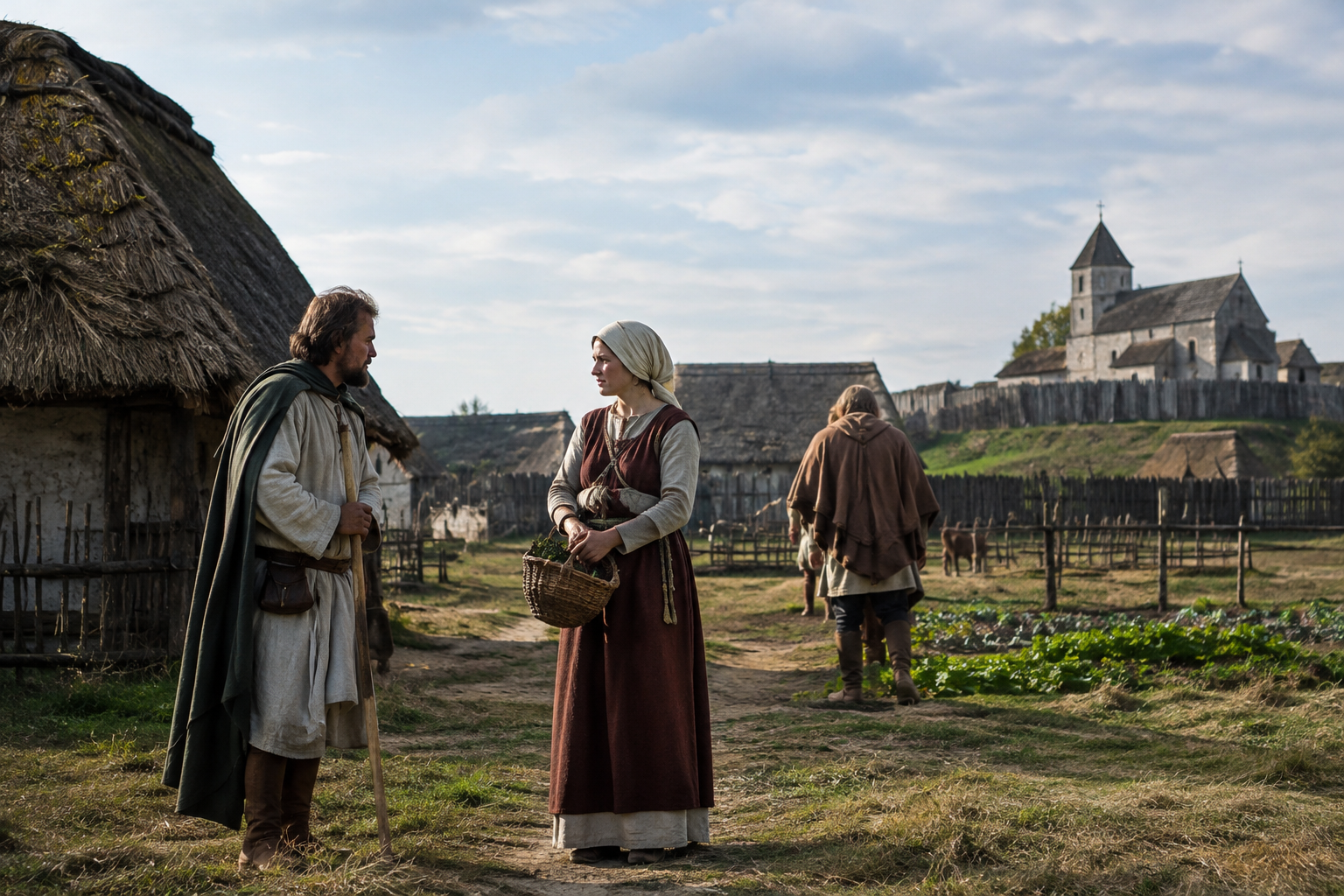
At Steuden in Saxony-Anhalt, one excavated medieval individual has become a small but telling witness to a much larger story. Sample SDN003, dated to around AD 1050 and described as a Western Slav settler, carries the Y-DNA haplogroup R1b1a1b1a1a1c2b2a1b1a4. That formidable string of letters and numbers is a very narrow paternal branch, and its appearance in a Slavic-settled part of medieval Germany matters because it reminds us how untidy, local, and human the making of Europe really was.
The setting is as interesting as the haplogroup itself. By the 10th and 11th centuries, the lands east of the old Frankish-Saxon core were zones of contact, settlement, pressure, and accommodation. A man like SDN003 does not stand for an entire people, still less for all Western Slavs, but his direct paternal line places one fine-grained genetic marker inside that frontier world where language, rule, and ancestry did not always travel together.
Steuden lies in modern Saxony-Anhalt, a region that sat within one of the most important cultural borderlands of the High Middle Ages. This was the broad belt where German-speaking polities, ecclesiastical expansion, and Slavic communities met and overlapped. Archaeologists and historians have long known that these frontier landscapes were not empty waiting rooms for later states. They were inhabited, cultivated, argued over, and socially mixed.
That is what makes SDN003 valuable. He is not a king, not a chronicler, not a grand founder in a patriotic legend. He is better than that for our purposes: a documented individual from a real settlement context, dated to a moment when the Elbe-Saale region was shaped by ongoing contact between Saxon and Slavic populations. His Y-chromosome line, reported here as R1b1a1b1a1a1c2b2a1b1a4, traces only one paternal thread, but it gives that thread a place in a historically meaningful landscape.
An ancient DNA project associated with these medieval remains can be followed through the research archive at https://www.ebi.ac.uk/ena/browser/view/PRJEB81250. It is worth stressing that the importance here is not glamour but context: a precisely placed man, in a precisely contentious region, carrying a paternal lineage often associated at broad scale with western Eurasian history yet found here in a medieval Slavic settlement horizon.
The wider parent haplogroup R1b is one of the major paternal lineages of western Eurasia, with a deep and complicated history stretching across many periods and regions. But the article haplogroup here is not "R1b in general." It is the much narrower branch R1b1a1b1a1a1c2b2a1b1a4, and that distinction matters. A narrow subclade should never be made to carry the whole historical baggage of its much older parent lineage.
So what can responsibly be said? Only that this paternal branch appears in at least one medieval man from a Western Slav settler context in central Germany, and that this places the lineage within the social world of east-central Europe's medieval frontier. It does not by itself prove ethnicity in the modern sense, political loyalty, first language, or membership in a named tribe from a textbook map.
That caution is not a nuisance. It is the interesting part. Medieval communities were full of people whose cultural identity, legal status, speech, marriage networks, and paternal ancestry did not line up in neat columns. Y-DNA traces one direct male line only; historical lives were much broader than that.
There is a temptation, when reading medieval frontier history, to imagine clean blocks: Germans here, Slavs there, and a hard line between them. The archaeology of settlement has been undoing that picture for years. Places in the Elbe-Saale region often show continuity, reuse of landscapes, and layered communities rather than abrupt civilizational replacement.
SDN003 belongs to precisely that debate. A Western Slav settler in Saxony-Anhalt around AD 1050 was living in a world shaped by the aftermath of earlier Slavic expansion into eastern Germany, followed by growing incorporation into Latin Christian polities. The significance of the haplogroup is therefore not that it labels a people once and for all, but that it gives us one identifiable paternal line anchored in that process.
In other words, this lineage is historically interesting because it appears not in abstraction, but in a contact zone. Medieval frontiers were not merely military edges; they were places of farming, marriage, local lordship, church building, negotiation, and bilingualism. Genetics does not replace that history. It sharpens it.
By the 11th century, the region around modern Saxony-Anhalt was entangled in what older historians used to describe rather too triumphantly as the eastward expansion of the German world. That language can flatten the reality on the ground. Expansion happened, certainly, but through institutions and settlements that landed on top of older communities, not on empty territory.
Western Slavic groups had been established across broad stretches east of the Elbe for centuries before this date. Their descendants could be absorbed, displaced, intermarried, linguistically assimilated, or remain locally distinct for long periods. A paternal lineage like R1b1a1b1a1a1c2b2a1b1a4 appearing in this setting sits comfortably within that kind of mixed historical landscape.
It is also a useful corrective to simplistic ideas about "Slavic" Y-DNA as though one lineage should define an entire linguistic or cultural sphere. Medieval Slavic-speaking populations, like medieval Germanic-speaking ones, were genetically varied. What ancient DNA keeps showing is not purity, but populations made through repeated episodes of mixture, continuity, and local persistence.
That broader lesson appears in other frontier and migration-period studies too, including work on mixed communities in central and eastern Europe. The point is not that every site tells the same story, but that the old search for one bloodline per people is a dead end. The medieval record is messier and more persuasive than that.
There is only one ancient individual supplied here, and that fact should guide the scale of the argument. We are not looking at a cemetery-wide paternal dynasty or a regional survey with dozens of male lines. We are looking at one well-placed data point: SDN003 from Steuden, medieval Saxony-Anhalt, around AD 1050, classified as a Western Slav settler.
Yet one sample can still be historically rich when it falls in the right place. Steuden is not random. It belongs to a region where written sources speak in broad ethnic and political categories, while archaeology and genetics let us inspect actual people. That shift in scale matters enormously. History becomes less about giant labels and more about communities composed of particular bodies, families, and lineages.
For anyone carrying this haplogroup today, the most responsible historical takeaway is not a claim to a single ancient nation. It is the possibility that one branch of your direct paternal line once moved within the socially mixed world of medieval east-central Europe, where Western Slavic settlement and German expansion overlapped on the ground.
R1b1a1b1a1a1c2b2a1b1a4 enters the ancient record here not as an imperial banner or a legendary dynasty, but as the paternal line of a man from a Western Slav settler context in medieval Steuden. That is the distinctive insight: this branch belongs, at least in one documented case, to the lived reality of the 11th-century Elbe-Saale frontier. For family historians, that makes it a lineage worth reading through local history rather than mythic origin stories: parish landscapes, settlement zones, border societies, and the long entanglement of Slavic and German-speaking communities in central Europe.

Comments