Haplogroup R1b1a1b1a1a1c2a1d2a2

– 5 min read


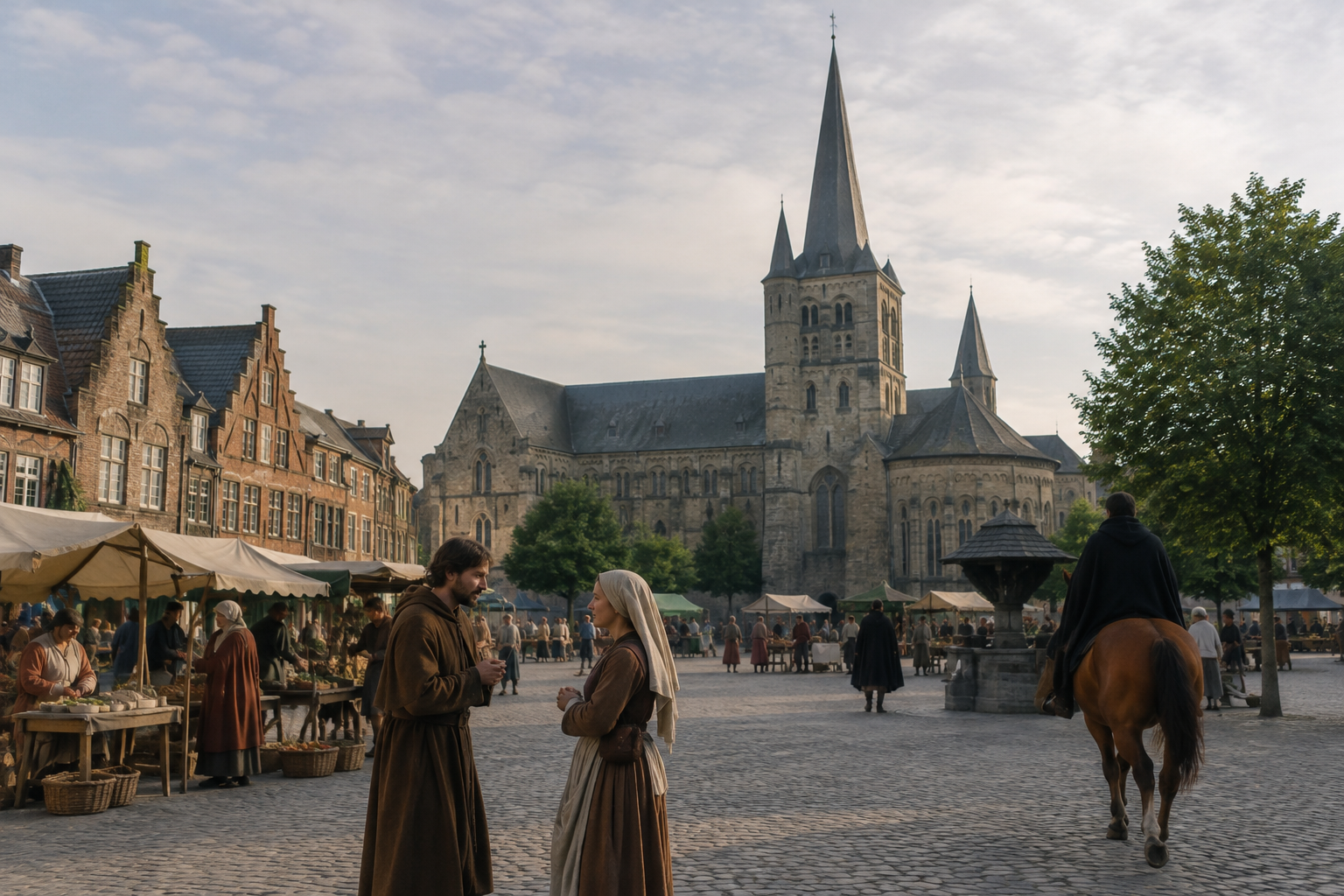
In medieval Sint-Truiden, in what is now Belgium, two men buried about a century or two apart offer a neat glimpse of how a paternal line can sit quietly inside the life of a town. One is ST0871 from Sint-Truiden Onze-Lieve-Vrouwekerk, dated to around AD 900. The other is ST2169 from Sint-Truiden Groenmarkt, dated to around AD 1075. Both have been associated here with the Y-DNA branch R1b1a1b1a1a1c2a1d2a2.
That intimidating string is a very narrow paternal lineage inside the much broader R1b family, one of the major Y-chromosome groups in western Europe. Y-DNA follows only the direct male line - father to son to grandson - so it does not describe a person's whole ancestry. But when the same branch appears in more than one burial from the same medieval town, it becomes historically interesting, because it hints at continuity, settlement, and the ordinary persistence of male lines in a changing urban world.
Sint-Truiden was no backwater. In the early and high medieval centuries it stood within a densely connected part of northwestern Europe, shaped by monasteries, trade, lordship, and the steady thickening of Christian institutions. Churches and churchyards became places where communities fixed memory in the ground, one burial at a time.
That matters for these samples. We are not looking at a heroic founder in a saga, nor at a king in a jewelled tomb, but at men buried in the orbit of important religious and urban spaces. ST0871 comes from Onze-Lieve-Vrouwekerk, while ST2169 comes from Groenmarkt, both within medieval Sint-Truiden. Even with sparse personal detail, the pairing is useful: it places this paternal branch in a real, documented town across roughly the 10th to 11th centuries.
The first thing to say is also the most important: two men do not equal a dynasty. They do not prove close kinship, and they certainly do not stand in for the whole population of Sint-Truiden. But neither are they trivial. When a fine-grained paternal branch appears in the same town in two different medieval contexts, that is evidence that this lineage was part of the local male population over time.
ST0871, dated around AD 900, belongs to the earlier phase of the pair. This is a period when the old Carolingian world had fractured politically but church institutions remained central to social life. A burial at Onze-Lieve-Vrouwekerk places this individual inside that Christian landscape. His Y-chromosome assignment ties one direct male line to the community present there at the start of the 10th century.
ST2169, dated around AD 1075, comes from a later medieval setting at Groenmarkt. By then, towns across the Low Countries were becoming more economically and socially complex. If this individual is correctly associated with the same narrow paternal branch, he suggests not sudden arrival but continued presence: the same male-line signature still visible in Sint-Truiden roughly 175 years later.
Readers often meet a lineage like R1b1a1b1a1a1c2a1d2a2 and understandably want the grand shortcut: which tribe, which invasion, which royal house? Ancient DNA is less obliging than that, and better for it. A deep subclade can tell us that certain men shared a specific paternal ancestry, but it cannot by itself assign them a language, social rank, or ethnic label.
What it can do, especially in medieval archaeology, is anchor continuity. The broad parent haplogroup R1b has a long and complicated history in Europe, but this article's branch is much narrower. The safe historical point is not that all medieval men in this region belonged to it, nor that it arrived in Belgium in any one dramatic migration. The point is that this particular paternal line was present in Sint-Truiden's medieval population, and present more than once.
That may sound modest, but modesty is often where the real history lies. Medieval towns were built from accumulations of families, tenants, clergy, traders, craftsmen, and migrants from nearby districts. A repeating Y-line in such a setting is a clue to how male descent lines endured within places that were becoming more urban, more institutional, and more interconnected.
It would be a mistake to imagine medieval Belgium as genetically sealed. The wider region sat close to major routes of movement between the North Sea, the Rhineland, and inland Francia. Soldiers, merchants, pilgrims, clerics, and marriage partners all moved through it. Yet movement does not erase continuity. Quite often, ancient DNA shows both at once: local persistence alongside fresh arrivals.
That broader tension helps frame these Sint-Truiden burials. The two men associated with R1b1a1b1a1a1c2a1d2a2 may represent a line already established locally, or one maintained through several generations after an earlier arrival from elsewhere in the surrounding region. The evidence we have does not let us choose between those possibilities. What it does support is a picture of medieval urban life in which some paternal lines remained visible across centuries even as towns absorbed people from multiple directions.
A recent ancient DNA study examining medieval Sint-Truiden explored exactly these questions of urbanization and biological patterning in the town's population, giving important context for how these individuals are interpreted within their local setting: research on medieval Sint-Truiden. Without needing to overstate the case, that kind of work lets us move beyond isolated skeletons and ask how churchyards, markets, and neighborhoods were populated over time.
The two site names themselves are revealing. Onze-Lieve-Vrouwekerk points to an ecclesiastical setting; Groenmarkt evokes an urban marketplace. Medieval towns were structured around exactly such institutions and spaces. To find the same narrow paternal branch in burials tied to different parts of the same town is a reminder that Y-DNA belongs not only to battlefields and princely tombs, but to the fabric of everyday settlement.
There is also a chronological subtlety here. Around AD 900 and around AD 1075 are not the same world. The earlier burial belongs to a period still close to the Carolingian order; the later sits in the more developed urban landscape of the 11th century. If the same paternal branch appears in both, then this lineage was present through a time of real institutional change.
If your paternal line falls under R1b1a1b1a1a1c2a1d2a2, these Sint-Truiden burials do not hand you a named medieval ancestor. They do something more grounded and, in its way, more valuable: they place this direct male-line branch in a documented town in medieval Belgium, at least by around AD 900 and again by around AD 1075. That is a small but real historical foothold.
The distinctive lesson of this haplogroup here is not aristocratic glamour or epic migration, but continuity in a lived landscape of churches, markets, and growing towns. In other words, this paternal branch was part of the human texture of medieval northwestern Europe - not in legend, but in excavated burials with names, dates, and places.

Comments