Haplogroup R1b1a1b1a1a1c1b1
– 4 min read


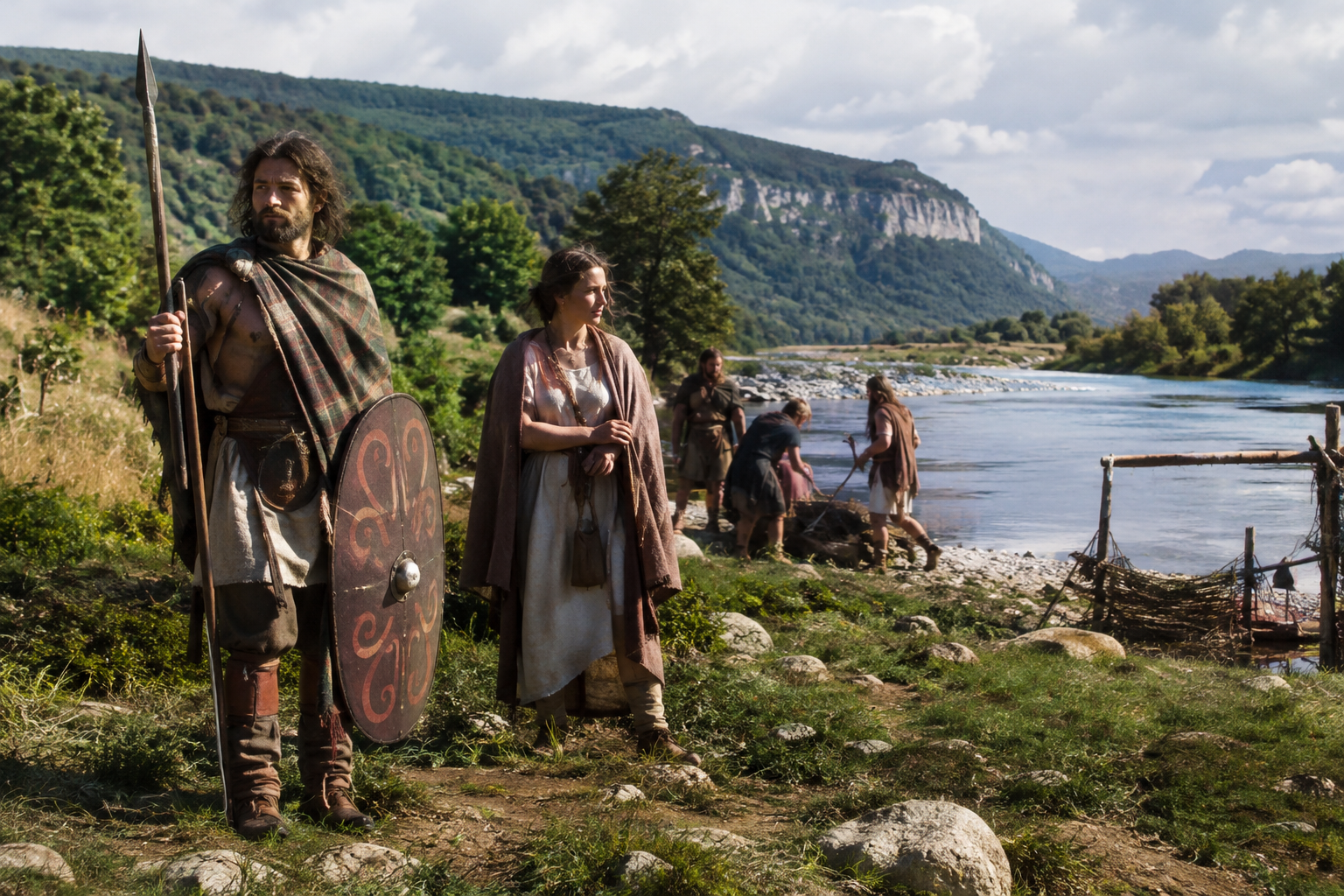
At Pont de Cornaux-Les-Sauges in Switzerland, one man from around 200 BC has become an unexpectedly useful witness to the history of a paternal line. Identified in the ancient DNA record as sample 3430, he lived in the Late Iron Age, in a region shaped by Gallo-Celtic communities, Alpine routes, and the steady political pressure of the wider Mediterranean world. His reported association with the Y-DNA haplogroup R1b1a1b1a1a1c1b1 places a very specific paternal branch into a well-dated archaeological setting rather than leaving it floating in the abstract world of modern haplogroup trees.
That matters because Y-DNA traces one direct male line only: father to father to father. It does not sum up a whole person, still less an entire people. But when a branch like R1b1a1b1a1a1c1b1 appears in an Iron Age burial from Celtic Switzerland, it gives us something precious: a real human context for a lineage that today may survive in many very different families.
Pont de Cornaux-Les-Sauges lies in western Switzerland, in a landscape that was anything but isolated in the centuries before Rome absorbed much of Celtic Europe. This was a zone of movement around lakes, river corridors, and overland connections into Gaul, the upper Rhine, and the Alpine world. A man buried here around 200 BC belonged to that busy frontier of exchange and local continuity.
Sample 3430 is therefore interesting not because he can be turned into a legendary chieftain or attached to a named tribe with false confidence, but because he anchors this haplogroup in a concrete Gallo-Celtic milieu. The Late Iron Age in Switzerland was part of the La Tene cultural world, known archaeologically for settlements, craft production, trade networks, and distinctive mortuary practices. A lineage found here is a lineage present in the heart of continental Celtic society before the full Roman transformation of the region.
The long name R1b1a1b1a1a1c1b1 tells you at once that we are dealing with a fine-grained sub-branch inside the much larger R1b family, one of the major paternal lineages in western Europe. That broad parent lineage appears in many ancient and modern populations, but it would be a mistake to pour the whole history of R1b into this narrower branch as though they were the same thing. The archaeological value here comes from the specific pairing of a precise lineage label with a specific Iron Age individual.
In practical terms, sample 3430 shows that this paternal line, or a very near branch of it, was present among people living in Celtic Switzerland by about 200 BC. That is already enough to make the lineage historically vivid. It situates one direct male ancestry line within the societies that linked temperate Europe long before medieval surnames, early modern parish registers, or modern nation-states existed.
By 200 BC, the communities of the Swiss plateau were not living in some sealed ethnic capsule. They were part of a wider Celtic-speaking cultural horizon stretching across much of temperate Europe. Goods, styles, technologies, and people moved through this world, though not always in simple or one-way fashion. A paternal lineage found at Pont de Cornaux-Les-Sauges may reflect local continuity, mobility, or both; what the evidence securely shows is presence, not a neatly mapped migration story.
This is one of the reasons ancient DNA has changed the conversation so much. Instead of assuming that every cultural label maps onto a single biological population, we can now examine actual individuals from actual cemeteries. In regions like Iron Age Switzerland, that often reveals communities that were locally grounded yet connected across surprisingly large distances.
An ancient DNA study examining these Swiss burials is linked through this research publication, which helps frame the genetic and archaeological discussion of Late Iron Age mobility in the region. Even without forcing the evidence beyond what is known for any one grave, the broader picture is clear: these were populations participating in a dynamic European landscape.
Funerary Practices in Celtic Switzerland
There is also a historical reason this Swiss evidence carries extra weight. Around 200 BC, the peoples of the region stood on the threshold of enormous political change. Rome had not yet fully reordered the local world, but Roman influence was growing, trade networks were widening, and the older Iron Age map of Europe was beginning to shift.
A paternal branch present in this moment could have descendants who later passed through very different identities: Helvetian, provincial Roman, post-Roman, medieval, and modern. The Y chromosome itself does not record language change, citizenship, or loyalty to empire. Yet one man from Pont de Cornaux-Les-Sauges reminds us how often the same male line can pass through several historical worlds while remaining biologically continuous along its single paternal path.
That is especially useful for descendants today who may encounter a highly specific haplogroup label and wonder whether it belongs to one dramatic migration alone. Usually history is less theatrical and more interesting. A lineage like this may have been carried through ordinary generations of farmers, craftspeople, traders, soldiers, or local elites whose names are lost but whose DNA still survives.
Some readers understandably hesitate when only one ancient individual is attached to such a narrow branch. But archaeology often works like this: one securely placed person can matter enormously if he stands at the right intersection of date, place, and cultural context. Sample 3430 does exactly that. He gives R1b1a1b1a1a1c1b1 a foothold in the Late Iron Age of the western Alps and the Celtic world north of Rome.
He also illustrates a more general lesson from archaeogenetics. Paternal lines can be highly stable across time even while whole societies change around them. The material culture may shift, political borders may vanish, and languages may spread or contract, yet a direct male line can continue quietly through all of it. That combination of continuity and change is one of the most revealing things ancient DNA has brought to the study of Europe.
For someone researching the haplogroup R1b1a1b1a1a1c1b1, the strongest supported insight here is not a royal claim or a tidy migration slogan. It is the presence of this paternal line in a documented man from Gallo-Celtic Switzerland around 200 BC, in a region central to Late Iron Age Europe. That places the lineage within a historically rich setting of Celtic communities, local continuity, and cross-regional movement just before Rome redrew the map.
Comments