Haplogroup R1b1a1b1a1a

– 6 min read


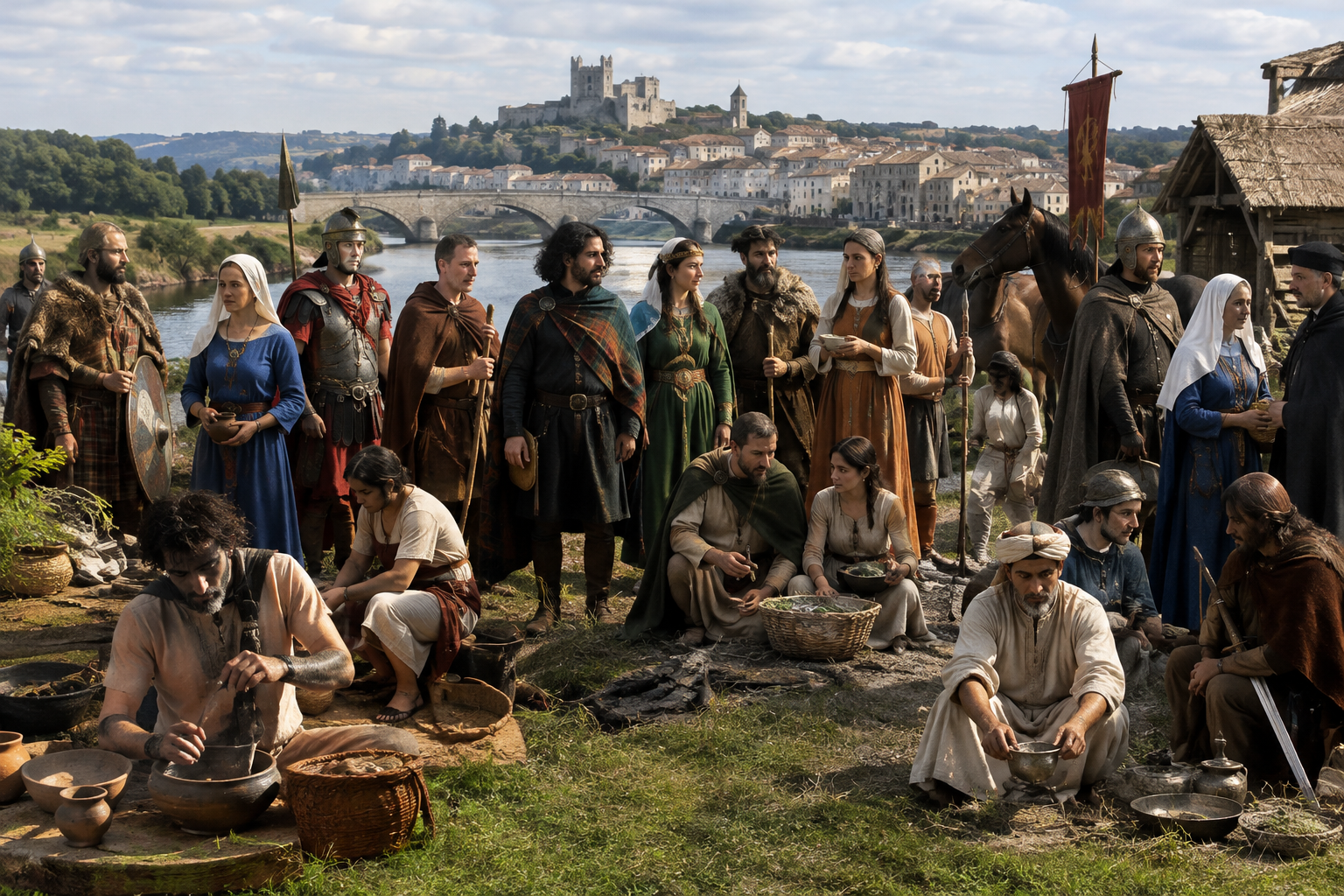
Haplogroup R1b1a1b1a1a sits inside one of the best-known paternal lineages in western Eurasia, but that does not mean its story is simple. Quite the opposite. When a specific branch like this turns up in ancient graves from Bronze Age France, Celtic burials in Germany, Roman-era Britain, medieval Iberia, Pict-era Scotland, and even later dynastic contexts in Poland, what emerges is not a neat ethnic label but a long history of movement, survival, and local continuity.
That is worth stressing at the start. Y-DNA haplogroups track one direct paternal line only: father to father to father. They do not describe a person's whole ancestry, culture, or identity. Still, they are extraordinarily useful. A lineage such as R1b1a1b1a1a can act a bit like a thread running through the archaeological record, helping us see how male lines were distributed across time and place, and how ancient populations relate geographically to the later world of kingdoms, noble houses, and castles.
For a branch this specific, caution matters. We should not lazily assign to R1b1a1b1a1a the entire history of every broader R1b lineage. But the sample pattern supplied here points firmly toward a long presence across western and central Europe, especially from the Copper Age and Bronze Age onward.
Some of the earliest anchors come from prehistoric central and western Europe: sample I7288 from Copper Age Radovesice in the Czech lands, dated to 2350 BC; BRE445FK from Early Bronze Age France at les Pointes et les Grevottes, Greviandes, Aube, dated 2339 BC; I4951 from Bell Beaker Wiltshire Upavon in England, dated 2300 BC; and SMGB54 from Saint-Martin-la-Garenne, Yvelines, Ile-de-France, dated 2139 BC. Add to these VLI092 and VLI085 from Bronze Age Vlineves Bohemia CWC, STD002 from Stadice Bohemia CWC, and LEU040 and LEU065 from Bronze Age Unetice Leubingen in Thuringia, and a broad zone appears: the line was present in the heartlands of Bronze Age Europe.
That matters because these were not isolated backwaters. They were landscapes of exchange, metalworking, burial display, and changing social hierarchies. The presence of this paternal branch in Bell Beaker, Corded Ware-related, and Early Bronze Age contexts suggests that by the early 2nd and late 3rd millennia BC, this lineage was already established across several interacting societies of western and central Europe.
By the Iron Age, the same paternal branch appears in settings we would conventionally call Celtic, though even that label deserves care. Sample LWB002_ss and its paired listing LWB002_ss_b come from an elite Celtic burial at Ludwigsburg Roemerhuegel in Germany, dated 450 BC. There is something wonderfully concrete about that: not merely "Celts" in the abstract, but a high-status burial in southwestern Germany, where power was displayed materially as much as politically.
Other Iron Age samples widen the picture. We find CGG022436 among the Belgic Suessiones at Bucy-le-Long in France, dated 330 BC; CHF106 from a Gallic burial in Marne, dated 430 BC; BES1096B from the Gallic Volcae at Bessan, dated 450 BC; I13623 linked to the Gaulish Sordones at Roquepertuse, dated 300 BC; I7632 from a Celtic Briton at Slonk Hill, Sussex, dated 295 BC; and I19653 from Ham Hill Fort in Somerset, dated 250 BC. This is less a single tribe's signature than a recurring paternal line across the broader Iron Age west.
Then comes Rome, and with Rome, mobility. Sample I21059 from Gallic Belgium, Gallia Belgica, Tongeren, dated 35 AD, places the lineage in a provincial Roman setting. In Britain, WBK106 from Celtic Durotriges territory at Duropolis, Winterborne Kingston, dated 125 AD, and I8202 from Roman-era Emporion, dated 200 AD, remind us that Roman rule did not erase local paternal histories. Often, it sat atop them.
The result is not "Romans carried this haplogroup" or "Celts carried this haplogroup" in some exclusive sense. Rather, ancient DNA shows that this paternal line was present among populations later drawn into Celtic-speaking zones, Roman provinces, and frontier communities.
If the Bronze and Iron Ages show spread, the early medieval evidence shows staying power. In Scotland, the cluster from Rosemarkie Cave on the Black Isle is striking: KD001, KD001_2, KD001_3, KD001_4, KD001_6a, and KD001_6b, all dated 541 AD and identified as Pict-era Scotland. Even without claiming close kinship from haplogroup alone, the recurrence of this lineage in a single place underlines how a paternal branch could become embedded within a local community over generations.
England offers more examples: S16392 from Anglo-Saxon period Fox Holes Cave in Yorkshire, dated 720 AD; ATP_PSN_944 from medieval Cherry Hinton, dated 1034 AD; and ATP_PSN_36 from Cambridge St Johns Hospital, dated 1250 AD. Northern Germany contributes DUN002 from Saxon Lower Saxony, dated 840 AD, and SRS001 from medieval Schortens, dated 790 AD. These are not the same societies politically, but they show the branch moving comfortably through post-Roman and medieval northwestern Europe.
Iberia is equally important. Sample ALM057 from Middle Bronze Age El Argar in Murcia, dated 1650 BC, shows an old foothold in the peninsula. Much later, we see ldo040 and ldo046 from medieval northern Spain at Las Gobas, dated 1000 AD and 1025 AD. Portugal adds a particularly useful sequence: LP112_13 from early medieval Castro de Avelas Torre Velha, dated 750 AD; CGG018558 from Visigothic Portugal, dated 845 AD; LP117_2 from Christian Conquest Portugal, dated 1100 AD; LP115_5 from Loulé in the Umayyad Caliphate, dated 1250 AD; and several samples from Santarem, LP117_12, LP117_7, and LP123_5, all dated 1300 AD.
That sequence is fascinating because it crosses political and religious regimes: Visigothic, Islamic, Christian-conquest, and later medieval Portuguese settings. The paternal line persists while the governing world changes around it.
Explore Portugal's Genetic History
The later record includes samples from clearly historical ruling contexts, and these need to be handled carefully. The Piast material is a good example: PCA0646, a Piast Masovian Dynasty male dated 1298 AD; PCA0621, a Piast Dynasty prince dated 1354 AD; and PCA0659, Boleslaw III Duke of Plock, dated 1351 AD. These samples show the haplogroup in a dynastic framework, but they do not entitle us to blur all Piasts, all Polish nobles, or all later families into one genetic story.
Still, they help illustrate a key point. Ancient DNA can intersect with the world of chronicles, ducal titles, and stone residences in ways older genealogy alone cannot. A castle, an abbey tomb, or a princely burial gives us names and status. DNA gives us a separate line of evidence: sometimes confirming continuity, sometimes complicating it, always reminding us that noble history was biological as well as political.
The same applies more broadly to aristocratic associations. If a later noble house or clan is historically connected with regions where this haplogroup appears in ancient burials, that is a meaningful historical parallel. It is not proof that every bearer of that surname or title belonged to this exact branch. Medieval families were shaped by adoption, illegitimacy, cadet branches, inheritance through women, and simple documentary confusion. Genetics can clarify parts of that story, but not by magic.
What, then, does R1b1a1b1a1a reveal? First, that one paternal lineage can appear across an astonishing range of archaeological settings: Bell Beaker graves in England, Bronze Age France, Unetice Thuringia, Iron Age Gaul, Romano-British and Roman provincial worlds, Pict-era Scotland, medieval Iberia, Saxon Germany, and Piast Poland. Second, that these appearances are often best understood regionally rather than ethnically. A haplogroup is not a tribe. It is a paternal line that people of different languages, loyalties, and identities may have shared.
And this is where castles and noble strongholds become useful historically even when they prove nothing genetically on their own. They preserve the geography of power: the very landscapes where long-established paternal lines might persist, mingle, disappear, or re-emerge in the record. Ancient DNA lets us glimpse the men behind the categories. Not "a Celt," "a Pict," or "a noble" in the abstract, but individual human beings buried at Tongeren, Rosemarkie, Las Gobas, Santarem, Leubingen, and Plock.
If you want to think more broadly about how such lineages survived the end of Roman rule and the making of medieval Europe, the changing communities of post-Roman central Europe are especially worth exploring.
Explore Post-Roman Central Europe
R1b1a1b1a1a is a reminder that paternal ancestry can link Bronze Age burials, Iron Age elites, medieval communities, and dynastic graves across a huge sweep of European history. On MyTrueAncestry, you can explore whether your DNA shows similarities to ancient individuals like SMGB54, LWB002_ss, KD001, or the Piast samples, and place your results in a deeper archaeological setting. Those matches do not automatically prove direct descent or noble ancestry, but they can offer a remarkable new perspective on where your family story fits into the human past.
Comments