Haplogroup R1b1a1b1a1

– 5 min read


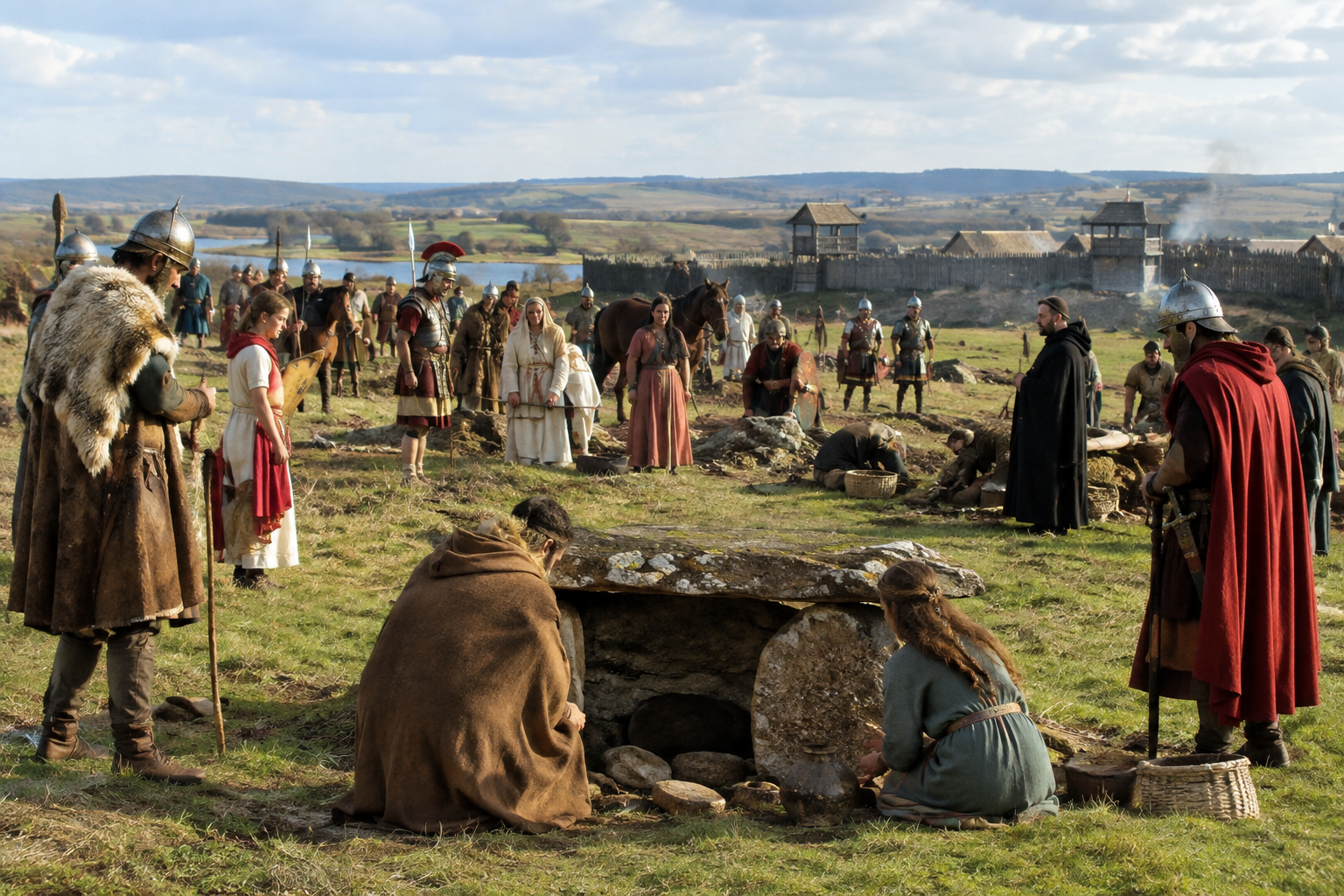
At Magdalenenberg near Villingen-Schwenningen in southwest Germany, one of the best known elite burials of early Celtic Europe has also become a genetic landmark. Among the ancient individuals linked with the paternal line R1b1a1b1a1 is sample MBG013, dated to around 530 BC and associated with the great burial mound complex at Magdalenenberg. That matters because this is not a vague appearance on a map. It places the lineage in a world of high-status Hallstatt-period burial traditions, at a moment when central Europe was producing some of the most archaeologically visible elites north of the Alps.
R1b1a1b1a1 is a Y-DNA designation, so it tracks one direct paternal line only: father to son, across many generations. It does not describe a person's whole ancestry, culture, or language. But when the same branch turns up in elite Celtic contexts, Bronze Age graves, Roman-period Britain, and early medieval communities from Italy to Scotland, it gives us something more interesting than a simple origin story. It shows a paternal line embedded in several of the key historical transformations of western and central Europe.
MBG013 from Magdalenenberg is not alone. The same haplogroup is also reported in the Hochdorf area of Baden-Wurttemberg, with HOC001, HOC001b, and HOC001c dated to about 515 BC at Eberdingen-Hochdorf Biegel. These are among the most evocative settings in early Celtic archaeology: monumental burial landscapes, concentrated wealth, and communities tied into long-distance exchange networks across Iron Age Europe.
What makes these samples so useful is not that they prove a single ruling family across all Celtic Europe - they do not - but that they place this paternal line in a recognisably high-status central European environment. In other words, R1b1a1b1a1 was present not merely somewhere in prehistoric Europe, but in the social world from which later La Tene and historically attested Celtic societies emerged.
A wider ancient DNA study of Iron Age and later European populations has helped sharpen this central European context for Celtic-associated paternal lines, including lineages connected with Hallstatt and La Tene worlds through research on the spread of Celtic-speaking populations. That does not reduce language or identity to one Y chromosome. It does, however, place branches like R1b1a1b1a1 firmly inside the biological history of those communities.
If we step back in time, the picture gets broader and older. One of the earliest listed examples is I20499 from Zabalj-Medisova-humka in Serbia, dated to around 2633 BC in a Yamnaya-associated setting. Other Bronze Age appearances include LEU064 from Leubingen in Thuringia, I5757 from Sion-Petit-Chasseur in Switzerland, VLI081 from Bohemia, ALT_4 from Althausen in Germany, and a remarkable spread of Iberian finds such as ALM046 and ALM049 from La Almoloya in Murcia, I3487 from Cabezo Redondo in Valencia, I4559 from Tarragona, I8570 from Tumulo Morterem, and VAD005 from northern Spain.
That is already enough to warn against an overly tidy tale. R1b1a1b1a1 is not something that can be boxed into one later people and one later nation. Its presence in Bronze Age central Europe, the Balkans, and Iberia suggests that this paternal branch belonged to the great post-steppe reshaping of European male lineages, and then persisted locally in quite different regional societies.
The Iberian examples are especially instructive. They show the branch long before Rome, and long before medieval kingdoms, in societies that were already regionally varied. So if a modern tester belongs to R1b1a1b1a1, the deep story is not just "Celtic" or "British." It may also run through Bronze Age Iberia, Alpine Europe, or the middle Danube, depending on the downstream branch and the fuller family record.
Britain provides one of the densest clusters in this dataset. Before the Roman period there are already Iron Age examples such as I16600 from Amesbury Down in Wiltshire, I11146 from Meare Lake Village in Somerset, CE004 from Carsington Pasture Cave in Derbyshire, I3083 from the Thames in London, and I21307 from Battlesbury Bowl. These are different places and contexts, but taken together they show that the branch was already established in pre-Roman Britain.
Then the line continues into Roman and immediately post-Roman contexts. NWC009 from Eddington in northwest Cambridgeshire dates to about AD 150, while ARB003 from the high-status wooden coffin burial at Arbury, and DUX003 from Duxford, belong to Roman Cambridgeshire as well. In Dorset, the Durotrigan samples WBK17, WBK192, and WBK10 from Winterborne Kingston sit in a local population living through the Roman period rather than vanishing at conquest.
That continuity matters. It suggests that in at least some parts of Britain, paternal lines associated with later R1b-rich western Europe remained in place through political change. Rome transformed administration, economy, urban life, and military organisation, but not every local paternal history was swept away. For this broader British story, one useful synthesis is a major ancient DNA study on Roman and early medieval Britain, which showed both continuity and migration, depending on place and period.
Roman and early medieval Britain
The post-Roman centuries are where this haplogroup becomes particularly revealing. In eastern Scotland, the Lundin Links cemetery produced a cluster centred on LUN004 and related designations LUN004a through LUN004h, dated to around AD 550 in a Pict-era setting. In Cambridgeshire there is ELY003 from Ely, an Angle-period burial of roughly the same age. In southern England there are post-Roman individuals from Apple Down in Sussex, I20602 and I20608, and from Worth Matravers in Dorset, including I11573, I11574, I11577, and I11578.
These are not all the same people, nor one tidy ethnic block. That is precisely the point. A paternal branch like R1b1a1b1a1 can run through communities later labelled Pictish, Anglo-Saxon, or post-Roman Brittonic because such labels describe historical societies, not single biological lineages. The Y chromosome is narrower and more stubborn than politics.
The same pattern appears on the continent. COL_150, COL_150b, and COL_150x from Collegno in northern Italy are linked to a Lombard warrior elite context around AD 580. Early medieval Spain adds I29896 from Malaga province. Medieval Ireland contributes KIL030, KIL038, and KIL045 from Kilteasheen in Roscommon, while SWG014 from Hedeby shows the line in the trading world of the North Sea and Baltic around AD 1105.
By the Middle Ages, R1b1a1b1a1 turns up in contexts that are less spectacular archaeologically but historically just as important. There are urban and ecclesiastical burials from England, such as ATP_PSN_177 and ATP_PSN_203 from St John's Hospital in Cambridge and ATP_PSN_957 from the Augustinian Friars. Belgium contributes ST2114 and ST2071 from Sint-Truiden. Portugal adds LP117_3 from Castro de Avelas and LP114_7 from Sao Miguel de Odrinhas.
This is the sort of evidence that stops us romanticising haplogroups into the property of princes alone. Yes, the line appears in elite burials. But it also appears in hospitals, friaries, market towns, and churchyards. That is exactly what long-lived paternal branches do. Over time they move through every level of society, from celebrated mound burials to the far more numerous lives that enter history only through excavated bone.
There are also higher-status medieval examples in central and eastern Europe, including PCA0503 from a Piast-dynasty context at Santok and PCA0665, identified as Piast Prince Konrad I. Useful though these are, they should be handled carefully. They show that this haplogroup reached medieval dynastic circles in Poland, but they do not entitle anyone with the same broad branch to claim descent from a specific prince without documented genealogy and much finer-resolution testing.
The strongest lesson of R1b1a1b1a1 is not a single homeland badge, but durability across major European transitions. This branch is present in Bronze Age horizons shaped by steppe-derived ancestry, in early Celtic elite centres like Magdalenenberg and Hochdorf, in Iron Age and Roman Britain, and in the mixed political landscape of early medieval Europe. For someone researching this paternal line today, that means the most defensible historical picture is one of deep western and central European roots with repeated appearances in communities that became Celtic, Romano-British, Lombard, Pictish, Anglo-Saxon, Irish, Iberian, and medieval urban.
Comments