Haplogroup R1b1a1a2a1b1a
– 5 min read


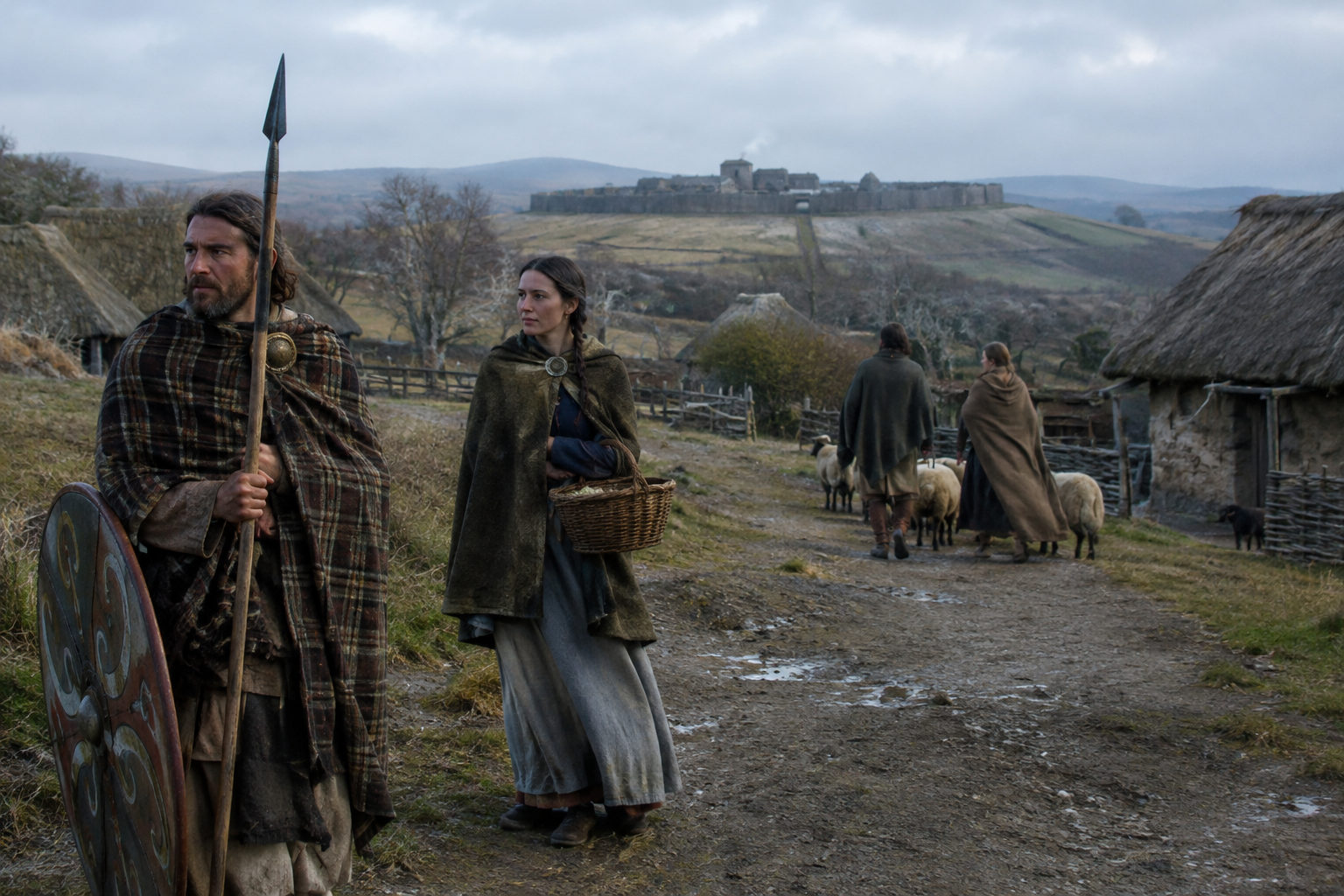
At Winterborne Kingston in Dorset, archaeologists uncovered a Roman-period cemetery linked to ancient Durotriges territory, and among the burials was an individual identified as WBK24, dated to around AD 125. That is already enough to make the find arresting: this is not a legendary king or a named soldier from a classical text, but an ordinary man from Roman Britain whose direct paternal line has survived in the genetic record.
WBK24 is associated here with the Y-DNA haplogroup R1b1a1a2a1b1a, a branch within the broader R1b family that is common in western Europe today. Y-DNA traces one narrow line only, from father to son, so it does not describe a person's whole ancestry. But in a burial like this, it gives us something unusually crisp: a paternal thread running through a landscape where Iron Age communities, Roman administration, and local traditions all overlapped.
The label "Celtic Durotriges England Duropolis Winterborne Kingston" places WBK24 in a very specific historical world. The Durotriges were the Iron Age people of much of present-day Dorset and surrounding areas, known from their settlements, coinage, and distinctive regional material culture before the Roman conquest. By around AD 125, however, this was no longer pre-Roman Britain. It was a province of the Roman Empire, with roads, forts, markets, and new forms of power pressing into older local geographies.
That is what makes WBK24 so useful. He appears in a period when "Roman" and "native" were not neat opposites. A man buried in Durotrigan country in the second century AD might belong to a family long rooted in the region, while also living in a world shaped by imperial taxation, military movement, and changing social habits.
A report on the Dorset discoveries drew attention to the recovery of these roughly 2,000-year-old remains and the value of the cemetery for reconstructing life in the county under Roman rule. Even without inventing a grand biography for WBK24, the setting matters: this was a community in which local continuity can be studied directly, person by person, rather than guessed at from later legend alone. See the archaeology report here: https://archaeologymag.com/2023/07/2000-year-old-human-remains-in-dorset/.
Roman and Early Medieval Britain
The haplogroup name R1b1a1a2a1b1a is very precise, but precision in labels should not tempt us into overstatement. The wider R1b lineage has a deep and complicated history in Europe, especially in Atlantic-facing regions, yet the narrower branch named here is not simply a synonym for "Celtic," "British," or "Durotrigan." Those are different kinds of categories: one genetic, one linguistic, one political, one archaeological.
Still, the association is historically suggestive. In Roman Dorset, a paternal lineage within R1b fits comfortably with what many ancient DNA studies have found across later prehistoric and historic western Europe: strong long-term continuity in some male lines, even as culture, language, empire, and identity changed around them. The important point is not that a single lineage proves ethnic purity - it does not - but that local male lines could persist through the Roman centuries.
For family historians, that is often the real value of a sample like WBK24. It does not tell you that your paternal ancestors were "the Durotriges" in any exclusive sense, but it does show that this branch was present in southern Britain during the Roman period, embedded in a real excavated community.
Roman Britain is sometimes imagined through its most conspicuous machinery: legions, bathhouses, villas, mosaics. But the archaeology of cemeteries often gives a quieter and more useful picture. Most people did not live inside a history-book headline. They lived in villages, small towns, farming districts, and tribal territories that were gradually absorbed into imperial systems without instantly losing their local character.
That is exactly the sort of context in which a haplogroup like R1b1a1a2a1b1a becomes historically interesting. If WBK24 belonged to a local paternal line, then his burial shows continuity within change. Dorset under Rome was not an empty stage suddenly filled by outsiders; it remained populated by descendants of earlier communities, though increasingly tied into a larger political world.
This broader pattern has become clearer through genomic work on Britain, which repeatedly shows that Roman-period populations could include both mobility and continuity at the same time. Some sites reveal immigrants from far beyond Britain; others show families whose ancestry was largely local. Those are not contradictions. They are the normal texture of an empire.
To understand why this matters, it helps to remember how distinctive Dorset was before Rome. The Durotriges are associated with one of the best-known Iron Age landscapes in Britain, including hillforts and settlements that speak to dense local organisation before the Claudian conquest of AD 43. Their world was already sophisticated and regionally defined. Rome did not create society there from scratch; it took hold in an already inhabited and structured country.
So when a Roman-period male from Winterborne Kingston carries a branch within the broader western European R1b pattern, that sits neatly within the archaeological expectation that at least part of the population was descended from earlier inhabitants of the area. The conquest changed administration, military presence, trade networks, and elite behaviour. It did not require wholesale population replacement.
That is one reason southern British ancient DNA matters so much to public history. It helps move the conversation away from crude all-or-nothing models - either total continuity or total replacement - and toward something more realistic. Communities can remain recognisably local while also becoming Roman in law, economy, and daily practice.
Southwestern Britain Deep Past
With only one named ancient individual in view here, caution is essential. WBK24 does not stand for every man in Roman Dorset, and certainly not for all of Britain. But archaeology is full of cases where one well-placed sample matters because of where and when it appears. A burial from early second-century Durotrigan country is one of those cases.
It anchors this haplogroup in a documented historical landscape. It places the paternal branch not in an abstract frequency map, but in a cemetery, in a county, in a former tribal territory living through the long afterlife of conquest. That is precisely the sort of evidence that makes ancient DNA useful to historical interpretation rather than merely decorative.
It also reminds us that Roman Britain was not only a story of incoming soldiers and administrators. It was equally the story of provincial subjects whose family lines extended backward into the Iron Age and forward into later British history.
What makes R1b1a1a2a1b1a distinctive in this case is not a claim to fame, nobility, or a dramatic migration tale. It is the quieter fact that this paternal line appears in a real man from Roman Dorset, in the old territory of the Durotriges, at a time when Britain was both deeply local and unmistakably imperial. For someone researching this haplogroup today, that offers a grounded historical possibility: your direct paternal line may belong to the same broad world of long-rooted western European male ancestry that persisted through the upheavals of conquest and cultural change.






Comments