Haplogroup R1b1a1a2a1a2c1e1a

– 5 min read


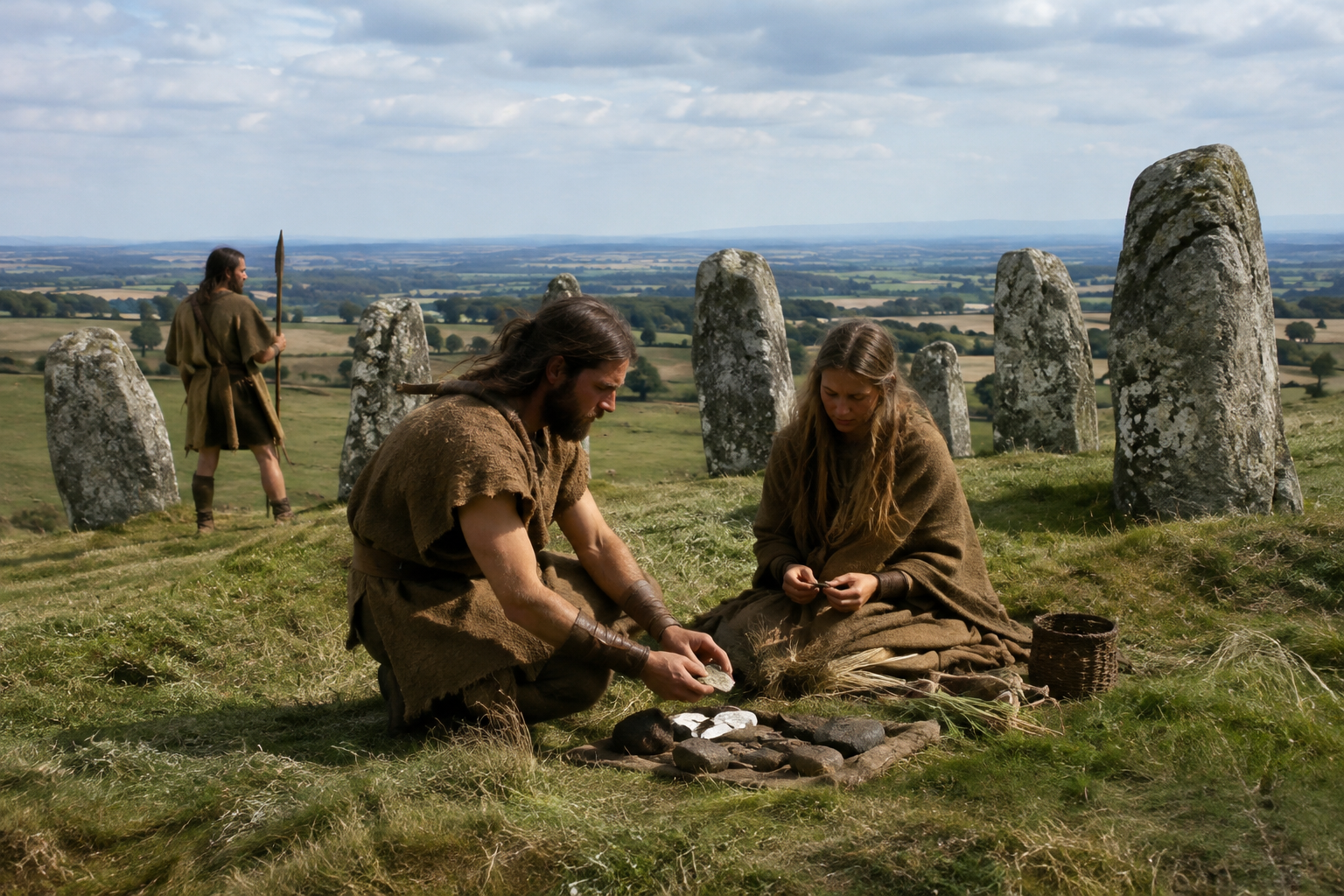
At Amesbury Down in Wiltshire, archaeologists recovered an Early Bronze Age man known as I2597, dated to around 2250 BC. That place matters. It lies in the same wider ceremonial landscape as Stonehenge, in a region that was being transformed in the centuries after the arrival of Bell Beaker communities in Britain. For anyone exploring the Y-DNA haplogroup R1b1a1a2a1a2c1e1a, this is the most concrete starting point in the evidence here: not a legend, not a surname tradition, but an excavated individual from one of prehistoric Britain's most intensely studied landscapes.
The important point is not that I2597 somehow "was" this whole haplogroup in the modern sense, but that he represents a paternal line associated with this branch inside a real archaeological setting. Y-DNA traces one direct male line only, and so it never tells the whole story of a person's ancestry. Even so, when a lineage turns up in an individual from Bronze Age Wiltshire, it places that paternal thread inside one of the decisive population changes in later prehistoric northwestern Europe.
Amesbury Down sits in a landscape where burials, monuments, and mobility have long attracted unusual attention from archaeologists. By about 2250 BC, southern Britain was not the same world that had built the great Neolithic monuments centuries earlier. New burial customs, new material culture, and new ancestry patterns were becoming common, especially in regions tied into the Bell Beaker horizon.
I2597 belongs to that changed world. The significance of a Y-chromosome assignment like R1b1a1a2a1a2c1e1a is that it falls within the broad family of R1b lineages that became strongly associated with many Bronze Age males across western Europe after major demographic shifts from the continent. In Britain, this wider change is one of the clearest findings of ancient DNA: paternal lines changed dramatically, even where landscapes, monuments, and local traditions still carried much older memories.
A landmark ancient DNA study of Beaker-period and Bronze Age Britain, published in Nature, helped establish just how substantial that population turnover was. The paper is often discussed for the scale of genetic change, but for a reader interested in one paternal branch, the human scale matters too: the transformation is visible not just in abstract graphs, but in excavated individuals like the man from Amesbury Down.
Bronze Age Britain and old monuments
The haplogroup name R1b1a1a2a1a2c1e1a is very precise, but precision in naming should not be confused with precision in prehistory. A narrow modern subclade sits inside a much larger R1b family tree whose branches diversified over long stretches of time. The broader R1b expansion in Bronze Age western Europe is well documented; the exact early history of every downstream twig is not always recoverable from a single ancient burial.
That distinction matters. It would be careless to take one man from Wiltshire and announce a complete migration route or a single tribal identity for everyone with this lineage. What can be said more safely is that this branch belongs within the paternal world that became prominent in Britain during the Beaker and Early Bronze Age transition, when ancestry connected to continental Europe spread widely through the island.
That is why I2597 is such a useful anchor. He fixes the discussion to a place, a date, and an archaeological moment when paternal lineages like this were becoming part of a new social landscape in Britain. The story is less about a lone founder and more about how one direct male line participated in a broad reshaping of population history.
There is a temptation, especially around Wiltshire, to let Stonehenge swallow every other story. But the archaeology of the area is more interesting when we look beyond the monument itself. The centuries after Stonehenge's main building phases were not an empty epilogue. They were a period in which older sacred landscapes were reused, reinterpreted, and inhabited by communities whose ancestry and paternal lines were, in many cases, strikingly different from those of earlier Neolithic populations.
That is the larger setting for I2597. He lived in a region where the past was visibly present: earthworks, barrows, and ceremonial sites already old by his time still structured the land. Yet genetically, Britain was changing. The contrast between durable monuments and shifting people is one of the most revealing features of prehistoric archaeology. Stones endure; populations do not stand still.
Seen in that light, R1b1a1a2a1a2c1e1a is not simply a label on a family-tree chart. It is one tiny surviving sign of the male-line histories carried into Britain during the Bronze Age, in a landscape where ancestry, memory, and place did not always move together.
Britain's deeper genomic history
The wider background to this lineage lies beyond Wiltshire alone. The Beaker phenomenon linked communities from Iberia to the Lower Rhine and onward into Britain, though not as a single uniform people marching in lockstep. Archaeology shows shared styles and practices; genetics shows that, in some regions, those styles were accompanied by substantial movement of people. Southern Britain was one of the clearest cases.
That broader connection helps explain why a lineage nested within R1b appears in an Early Bronze Age burial in England. By this period, Britain was not isolated at the northwestern edge of Europe, but part of a lively zone of exchange and migration. A paternal line such as R1b1a1a2a1a2c1e1a should therefore be understood within those continental-scale processes, while still remaining cautious about claiming too much from one excavated individual.
Ancient DNA research from the Rhine-Meuse world is especially useful for thinking about these connections, because it examines one of the major continental regions involved in Beaker-era population change. For that wider context, see MyTrueAncestry's discussion of Bell Beaker expansion in the Lower Rhine-Meuse region, which complements what the British evidence shows from the island side of the story.
Readers sometimes assume that a single ancient sample is too little to be meaningful. In one sense that is true: one man cannot represent all Bronze Age Britain. But ancient DNA becomes powerful when it is placed inside a well-studied archaeological pattern. I2597 matters because he is not floating free. He comes from a famous and heavily researched region, from a period already known for major demographic change, and from a paternal lineage family that fits that larger picture.
In other words, his importance is contextual. If the same haplogroup turned up without date or place, it would tell us much less. Found at Amesbury Down and dated to around 2250 BC, it becomes part of a specific historical argument about how male-line ancestry changed in Britain during the Early Bronze Age.
Ancient DNA in Britain across periods
What makes R1b1a1a2a1a2c1e1a distinctive in this case is not a royal pedigree or a romantic origin tale, but its appearance in a real man from Early Bronze Age Wiltshire, I2597, living in the shadow of one of Europe's great prehistoric ceremonial zones. For someone researching this paternal line today, the strongest supported insight is that it fits into the male-line transformations associated with Beaker and post-Beaker Britain, when new ancestry became deeply established in the island.
That is a modest conclusion, but a valuable one. It ties a modern paternal branch to one of the biggest population shifts ever documented in British prehistory, and it does so through an excavated individual rather than guesswork.
Comments