Haplogroup R1b1a1a2a1a1c

– 5 min read


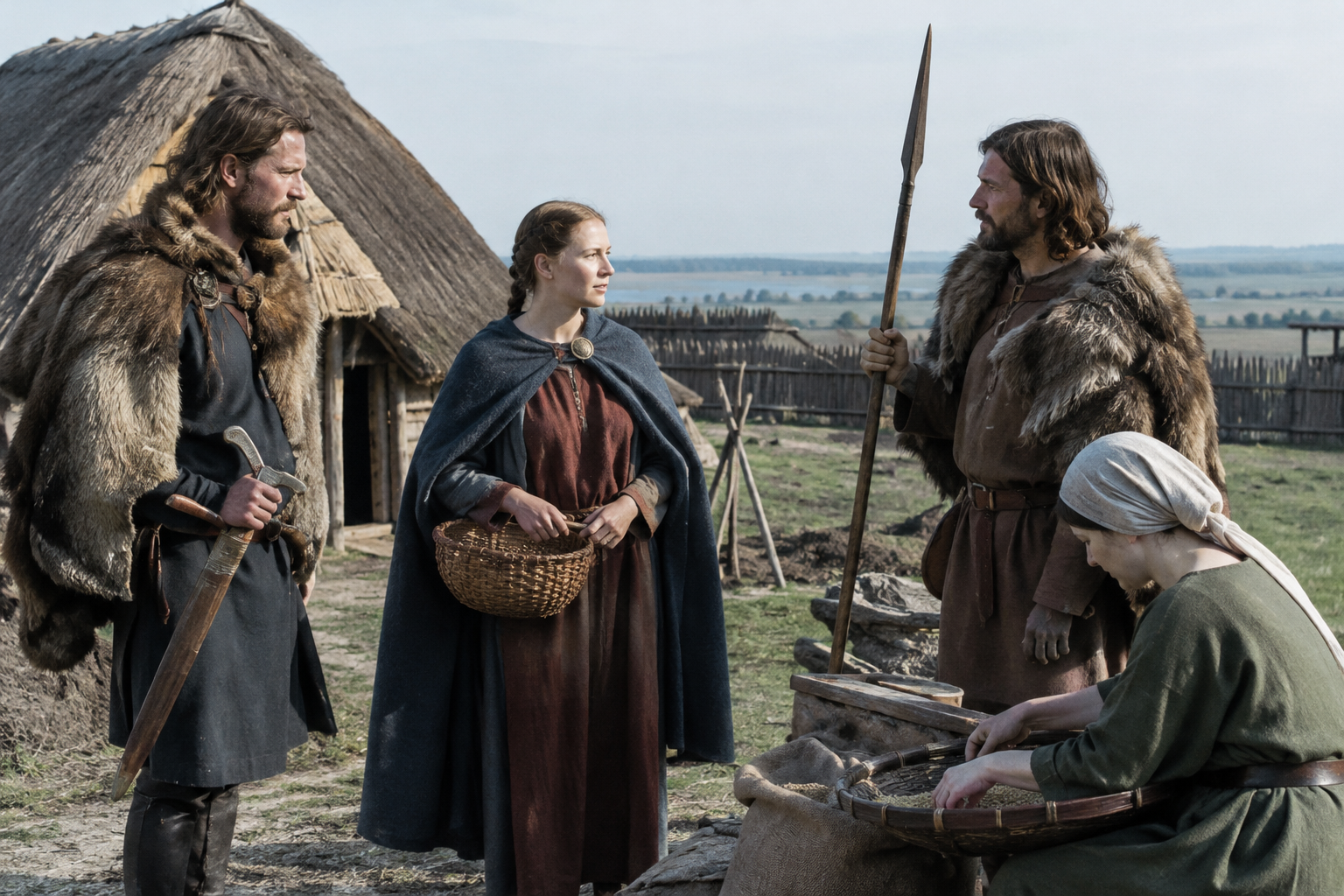
At Scarbantia Hegyko in Barbaricum, just beyond the old Roman frontier in what is now Hungary, several men buried in the Longobard period around AD 525 were found to share the Y-DNA haplogroup R1b1a1a2a1a1c. The individual IDs HMU050, HMU043, HMU019, and HMU062 do not give us a saga, a king list, or a famous tomb. What they give us instead is something archaeology often values more: a pattern.
That pattern matters because the sixth-century Carpathian Basin was not a quiet backwater. It was one of those restless border zones where the end of Roman power, the movements of post-Roman peoples, and the making of new early medieval societies all collided. When the same paternal branch appears more than once within this setting, it suggests that R1b1a1a2a1a1c was part of the male-line landscape of a community living through that transformation.
The four relevant individuals all come from the same broad archaeological horizon: Longobard-period Pannonia, dated here to about AD 525, at Scarbantia Hegyko Barbaricum Hungary. Even that place-name tells a story. Scarbantia was the Roman town, while Barbaricum was the Roman term for lands beyond direct imperial control. By the sixth century, this was a frontier in the old sense of the word: not a neat line on a map, but a zone of contact, settlement, and negotiation.
The Longobards are often remembered for their later move into Italy in AD 568, but before that they were deeply entangled with the middle Danube world. Pannonia was one of the crucial stages in that history. A group of burials here therefore sits at precisely the moment before a major historical shift, when communities associated with the Longobards were still based in the Carpathian Basin and interacting with neighbors, former Roman provinces, and other post-Hunnic populations.
An ancient DNA study of this broader world, published in Science, helps frame why such cemeteries are so important. The interest is not simply in assigning a label to a burial ground, but in seeing how early medieval communities on the Roman frontier were biologically mixed, locally rooted in some respects, and yet connected across large distances in others.
R1b1a1a2a1a1c is a very specific Y-chromosome branch, and that matters. Y-DNA follows one narrow line of descent, from father to son, so it tells us about one paternal thread rather than a person's whole ancestry. In an early medieval cemetery, that can be useful for detecting repeated male-line presence, but it does not by itself define ethnicity, language, rank, or personal identity.
It is also worth being careful about scale. The wider R1b family is enormous and widespread across Europe and beyond, but one should not lazily pour the entire history of R1b into this narrower branch. What the Scarbantia Hegyko evidence actually supports is much more specific and more interesting: this particular paternal lineage was present among men buried in a Longobard-period community in the Pannonian frontier zone around the early sixth century.
The samples HMU050, HMU043, HMU019, and HMU062 are valuable precisely because they are not isolated curiosities. Repeated occurrence at one site suggests that this branch was not a one-off arrival represented by a single burial. It had some real presence within the community sampled there.
Now, that does not automatically mean all four men were close relatives. Cemeteries can contain distant paternal kin, unrelated men who happen to share a deeper ancestral branch, or a mix of both. But repetition still sharpens the historical picture. Instead of asking whether R1b1a1a2a1a1c could have been present in the Longobard world, we can say that in this documented cemetery cluster it clearly was.
This is one of the great strengths of ancient DNA when handled properly. It does not replace archaeology, and it certainly does not solve every question, but it can reveal hidden structure inside communities that written sources flatten into a single tribal name. "Longobard" in a text is one thing; a cemetery containing several men from the same paternal branch is another, more grounded kind of evidence.
Around AD 525, the old western Roman order had gone, but the shape of medieval Europe had not yet settled. The middle Danube was full of communities often described with names like Goth, Gepid, Longobard, or Roman provincial, yet daily life on the ground was almost certainly more entangled than those labels suggest. That is why cemeteries in Pannonia and nearby regions are so useful: they catch people in the act of historical change.
For men carrying R1b1a1a2a1a1c, this means the lineage is attested in a place where mobility, alliance, and local continuity all overlapped. One should resist the temptation to turn that into a neat migration arrow. The evidence does not tell us that this branch "belonged" to the Longobards in some exclusive sense, nor that it arrived in Hungary in one identifiable event. What it does show is that this paternal line was part of the human fabric of the frontier world from which the later Lombard movement into Italy emerged.
That broader Lombard story matters because it connects the cemetery to one of the best-known population movements of the sixth century. Some of the people who lived in Pannonia eventually moved south-west into Italy; others did not. Archaeology and genetics together increasingly show that such movements were rarely the motion of a biologically uniform "tribe". They were social coalitions, often drawing in people of different backgrounds.
The Carpathian Basin has a habit of reappearing in ancient DNA because it was, for millennia, a zone of movement and recombination. Roman soldiers, provincial farmers, steppe-connected groups, Germanic-speaking communities, and later Avar and Hungarian populations all passed through or settled there. A cemetery like Scarbantia Hegyko belongs to that larger historical fact.
So when a modern tester finds a link to R1b1a1a2a1a1c, these Hungarian Longobard-period burials are useful not because they provide a grandiose identity claim, but because they anchor the lineage in a real archaeological setting. They place it among men living just beyond a fading empire, in a region where frontier life was shaping the next chapter of European history.
There is also a methodological point here. Famous royal burials often dominate public attention, but repeated ordinary or semi-ordinary burials can be more revealing. They let us see persistence rather than spectacle. HMU050, HMU043, HMU019, and HMU062 together suggest a lineage that was not merely passing through the record once, but had some continuity within this community sample.
The most distinctive thing about haplogroup R1b1a1a2a1a1c here is not a legendary founder or an attached dynasty, but a compact cluster of early medieval evidence from Longobard-period Hungary. Four men from Scarbantia Hegyko, dated around AD 525, show this paternal branch in a frontier community at a historically crucial moment. For anyone researching this haplogroup today, that is a sober but valuable clue: one documented place where your direct male line, or a very close branch to it, was present in the turbulent world between late Rome and early medieval Europe.

Comments