Haplogroup R1a1a1b2a2b1d1

– 5 min read


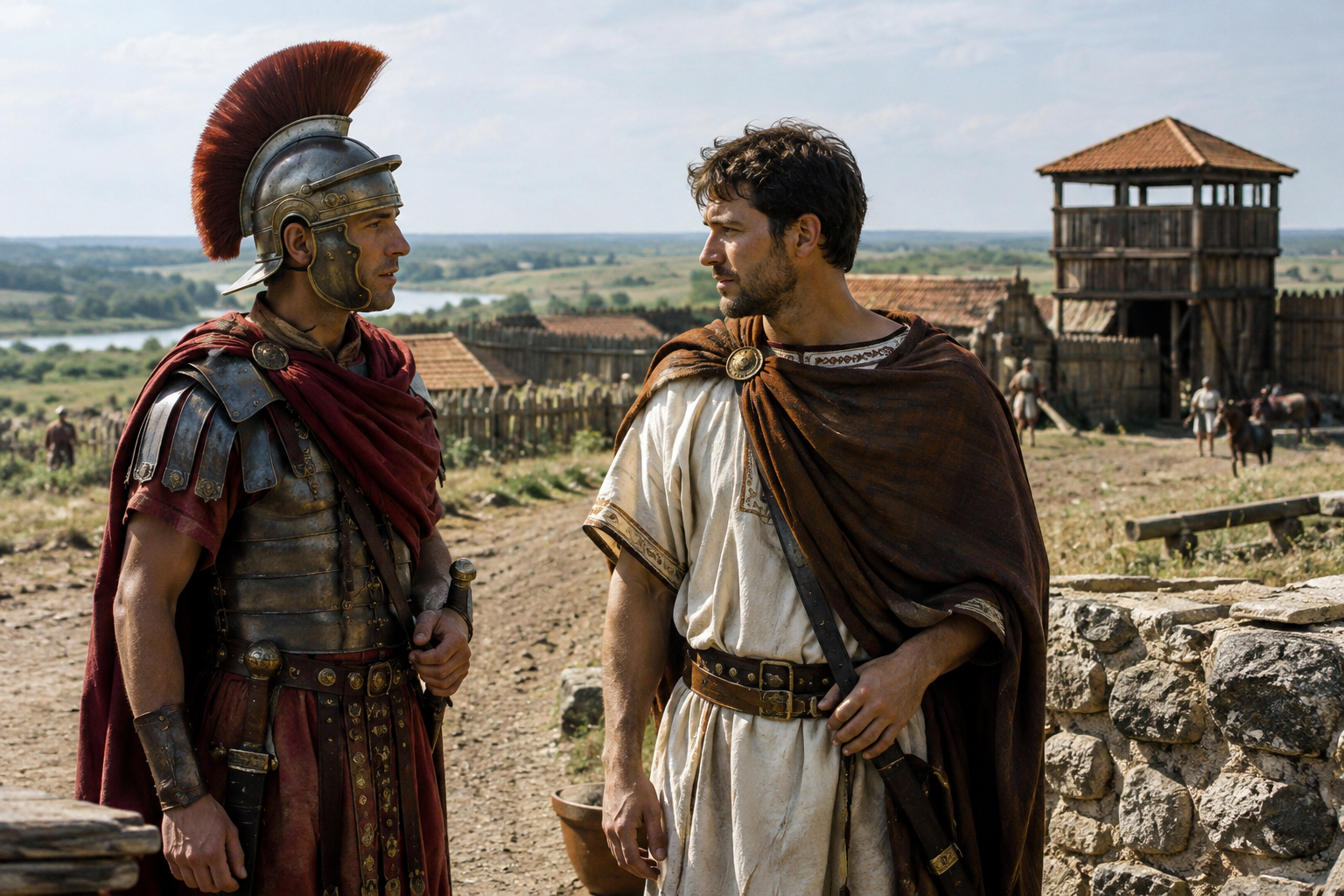
At Popova-zemlja near Beli Manastir in eastern Croatia, one late Roman burial has become unexpectedly useful for tracing a very narrow paternal line. The individual known as POP23, dated to around AD 338, belongs to the Imperial Roman era in a borderland that was never simply "Roman" in any easy, uniform sense. This was a region of roads, soldiers, farmers, river traffic, and repeated movement across the Danube world - exactly the sort of place where a Y-DNA lineage such as R1a1a1b2a2b1d1 becomes historically interesting.
The reason is not that one burial can stand for a whole province. It cannot. But when a specific paternal branch turns up in more than one Roman-period context - here in Croatia, and also in an individual from Roman Italy - it gives us a small but vivid glimpse of how male lines circulated within the empire and its hinterlands. Y-DNA traces one direct paternal line only, not a person's full ancestry, yet that single line can still reveal patterns of continuity, movement, and contact.
POP23 comes from Osijek-Baranja, a landscape tied closely to the old Roman frontier zone of Pannonia and the wider Danube corridor. By the fourth century AD, this was a world under pressure and in motion: imperial administration remained in place, but the region was also shaped by military recruitment, provincial resettlement, and the steady entanglement of local communities with newcomers.
That matters for a branch like R1a1a1b2a2b1d1 because broader R1a lineages are often associated, at large scale, with eastern and central European paternal histories. One must be careful here: that does not mean every narrow descendant branch had the same path, date, or ethnic label. What POP23 shows, more modestly and more usefully, is that a paternal line within this wider family was present in a late Roman community in Croatia during the fourth century.
Recent work on ancient Croatian genomes has been especially valuable for showing that the region's history was not a simple tale of replacement. Maternal lines often show long continuity, while paternal lineages shift more noticeably across periods, reflecting the fact that mobility, military structures, and marriage patterns could affect men and women differently. That broader context is explored in MyTrueAncestry's piece on Croatia's changing paternal landscape.
Croatia's Shifting Paternal Lineages
An ancient DNA study of the region published in Nature helped underline just how dynamic southeastern Europe's population history was from prehistory into historical times. For readers with this haplogroup, the Croatian evidence is a reminder that a paternal line can be rooted in a place for centuries and still participate in larger historical movements.
The second key figure is R1548, dated to around AD 165 at Monterotondo, in Hellenic Roman Italy. Even with sparse site details, the setting itself is suggestive. Central Italy under Roman rule was not an isolated ethnic core but one of the busiest zones of movement in the ancient Mediterranean, drawing in soldiers, traders, enslaved people, freed families, and provincial migrants from many directions.
So when a lineage associated here with R1a1a1b2a2b1d1 appears in Roman Italy, the important point is not to force a dramatic migration story onto one man. It is rather that this branch was present within the social world of the empire's Italian heartland by the second century AD. In other words, this was not a line confined to some remote edge of Europe; it had already entered, or persisted within, one of the empire's most interconnected regions.
Research on ancient Rome has repeatedly shown that Italy in the imperial period contained people of highly varied ancestry, especially in and around urban and suburban communities. A widely discussed ancient DNA study in Science made that point powerfully for the city of Rome and its changing population over time. R1548 fits comfortably into that broader historical picture of Roman Italy as a place where local and long-distance lineages met.
There is always a temptation with a very specific haplogroup to speak as if the branch itself comes with a ready-made historical label. It does not. R1a1a1b2a2b1d1 is a fine-grained paternal designation; the ancient individuals here are evidence for its presence in Roman-period contexts, not proof of a single named people, language group, or political identity.
That distinction matters especially in the Roman world. A man buried in Croatia in the fourth century and a man buried in Italy in the second century could share a paternal branch while having very different family histories, cultural lives, and genome-wide ancestry. One might descend from a line long established in the Balkans; another might represent movement through military or civilian networks; both possibilities can exist without contradiction.
For that reason, the strongest interpretation is the simplest one. This branch belongs to a wider R1a family with deep importance in Eurasian and European paternal history, but the evidence here is specifically Roman-era and southeastern-to-central European in its archaeological visibility. It points to circulation through imperial landscapes rather than to a single origin myth.
It is worth lingering on Croatia for a moment, because places like Osijek-Baranja are too often treated as marginal to the Roman story. In fact, the Danube provinces were central to the empire's military and political life. Emperors rose from this zone, armies were recruited here, and frontier communities were woven into supply systems that linked the Balkans to Italy, the Black Sea, and the wider Mediterranean.
Seen in that light, POP23 is not some provincial footnote. He belongs to one of the most historically active regions of late antiquity. If your paternal line falls within R1a1a1b2a2b1d1, the Croatian sample suggests that branches of this lineage were present in exactly those mixed frontier societies where Roman power, local continuity, and transregional mobility met.
Monterotondo adds something different from Popova-zemlja. Croatia shows this lineage in a frontier province; central Italy shows it inside the peninsula that was often imagined, by the Romans themselves, as the empire's center. Put together, the two samples hint that the branch was not merely brushing the Roman world from outside. It was part of that world.
That is one of the most useful corrections produced by ancient DNA. Roman society was never a sealed box of tidy ancestral categories. It was a social machine for bringing together lineages from different regions and embedding them in new local histories, sometimes for generations.
The most distinctive thing about R1a1a1b2a2b1d1 in the present evidence is not a claim to one famous tribe or dynasty, but its appearance in two different Roman-era settings: one in late Roman Croatia, the other in Roman Italy. That combination places this paternal branch within the human traffic of the empire itself. For someone researching this Y-line today, the responsible historical takeaway is a good one: your direct paternal ancestry may connect not to a single dramatic event, but to the durable, mobile, and thoroughly mixed societies of the Roman world.



Comments